TL;DR
- ChatGPT SEO means two things: using ChatGPT to do SEO work faster and optimizing your site so ChatGPT cites it back. Both matter in 2026.
- You can use ChatGPT effectively for at least seven important SEO tasks, but pretty much all of them still beg for a human in the loop.
- AI answers change the job of SEO professionals, but they do not replace the need for traditional search engine optimization.
- If you’re worried about ChatGPT SEO, there’s a ten-minute, three-step test you can do right now (details near the end of the article).
There are two completely different things people mean by ChatGPT SEO, and most guides only cover one… Some mean using ChatGPT to do the SEO work faster. Others mean getting their own site cited when ChatGPT answers a question.
This guide covers both. The prompts, the limits and the ranking factors that decide each one. But there’s more, such as how ChatGPT finds pages, the SEO tasks it is good and bad at, a useful prompt library, what gets you cited and whether it replaces SEO.
What ChatGPT SEO really means: two jobs, one name
People use the words “ChatGPT SEO” to point at two different jobs:
- Using ChatGPT as an SEO assistant
- Optimizing so ChatGPT recommends you
The smart move is to treat them as one workflow instead of picking a side. Here is how they split:
1 – ChatGPT as your SEO assistant
This is the meaning most people land on first. You open ChatGPT and ask it to cluster keywords, draft a brief, write meta descriptions or untangle a redirect rule.
It is fast, and it is genuinely good at the reformatting-and-ideas half of SEO. It is not good at anything that needs live data or a source of record, which is the whole catch covered later.
Think of it as a very quick junior who never gets tired and never checks their work. Useful, yes, but not to be trusted on its own.
If you need a quick example, feed ChatGPT a competitor’s post and ask for ten angles they left out; in seconds, you get a content gap list that would have taken an afternoon by hand.
Remember, though: this type of ChatGPT SEO compresses the boring middle of the work, not the judgment at either end.
2 – Getting cited by ChatGPT (aka GEO)
The second meaning is the one that will matter more over the next two years. When someone asks ChatGPT a question, which sites does it pull in, quote and link?
While often referred to as “ChatGPT SEO”, this process has its own name. Most people call it GEO, for generative engine optimization, or AEO, for answer engine optimization. Same idea, slightly different acronym (see our GEO vs AEO comparison for more).
GEO and AEO exist because ChatGPT stopped being a closed box. It reads the live web now, and that changes what optimization even means.
That’s fine, but why does it matter? Well, when ChatGPT recommends a product or names a source, it shapes a buying decision before the person ever opens a search engine. Being the site it names is the new version of ranking first.
How ChatGPT finds and cites web pages
Before either half makes sense, you need to know how ChatGPT gets to a web page at all. The mechanics are more specific than most guides admit, and one of them is a hard gate.
Three things are worth understanding:
- ChatGPT reads the live web
- A named bot decides whether your site is eligible or not
- Where results come from
1 – ChatGPT reads the live web now
ChatGPT is no longer answering only from training data. It can search the web and return answers with links to the sources it used, a feature OpenAI launched at the end of 2024 and has expanded since.
That single change is why GEO is possible. If ChatGPT could not fetch live pages, there would be nothing to optimize for. Because it can, your page can actually end up as one of the links under an answer.
The get-cited game is real, no doubt about it. The question now is what gets you into that set of links. One thing to know up front is that ChatGPT does not search on every question.
For simple queries, it answers straight from training data, and it only reaches for the live web when the question needs freshness or specifics. That’s why getting cited depends first on the query triggering a search.
2 – The OAI-SearchBot decides if you are eligible
Here is the part almost nobody checks first: OpenAI runs a dedicated crawler called OAI-SearchBot, and it is the one that controls whether your pages can show up in ChatGPT search answers.
It is a separate bot from GPTBot, which crawls for model training, and from ChatGPT-User, which fetches a page when a user asks for it directly. Three bots, three jobs; you can allow one and block another.
The practical consequence is blunt. Block OAI-SearchBot in robots.txt and you are invisible in ChatGPT’s search answers, though your pages can still show up as plain navigational links. Therefore, the baseline for getting cited is boring and non-negotiable: let that bot in.
You can check it right now. Just type yoursite.com/robots.txt into a browser and search the text for OAI-SearchBot:

The goal is to NOT to see “OAI-Search-Bot” anywhere in the page. If it sits under a Disallow rule or a wildcard block aimed at all bots, you are shut out and probably did not know it.
3 – Where ChatGPT pulls its results from
This is the part people overstate. ChatGPT search leans on third-party search providers plus content from OpenAI’s partners, and early on it drew heavily on Bing’s index (per Search Engine Land).
That history is why setting up Bing Webmaster Tools still helps. It is also why you should not treat “ChatGPT is just Bing” as a fixed fact. The retrieval stack is moving toward OpenAI’s own crawling, and the exact mix keeps shifting.
The safe read: get eligible through OAI-SearchBot, stay indexable in Bing and do not bet your whole plan on any single back-end index staying put.
Do not overthink this layer either. The bots and the index are plumbing. What actually decides whether you get cited is the content and the mentions, which is where the rest of this guide spends its time.
How to use ChatGPT to do SEO work
ChatGPT is a fast first-draft engine for about a dozen SEO tasks, and the ones it is good at share a pattern. To put it simply:
- It generates and reformats well
- It retrieves facts of record badly
Keep that line in your head as you read the next seven use cases, since every one plays to the strength and works around the weakness:
1 – Keyword ideas and clustering
ChatGPT is great at the messy front of keyword work. Paste a seed list and ask it to group terms by search intent, or to spin out fifty long-tail angles you had not thought of, and you’ll get great results.
Here is the catch: ChatGPT cannot give you real search volume or keyword difficulty. Those numbers do not live inside the model, so anything it “reports” is a guess dressed up as data.
Use it to widen the list, then validate every candidate in a real tool before you build around it. The ideas come from the AI, the numbers from your keyword tool.
One trick that works well here: ask ChatGPT to sort the list by likely funnel stage, top, middle or bottom. This way, you can see which terms deserve a full page and which are a single paragraph. It is guessing at the edges, but the grouping is usually sane and saves a sorting pass.
2 – Content briefs and outlines
This is where ChatGPT earns its keep. Give it the target keyword, the top three ranking titles and the angle you want, and it returns a working brief in seconds.
The output is a starting point, not a spec. It will miss the one subtopic your competitors all cover and invent one nobody searches for. It should be edited, not blindly accepted as it is. Treat the brief as a fast rough draft of your thinking.
3 – First drafts and editing
ChatGPT drafts fast and edits even better. The editing is honestly the stronger use. Paste a clunky paragraph and ask it to tighten it, cut the throat-clearing or match a plainer voice.
Drafting from scratch is riskier. Unedited AI prose reads like unedited AI prose, and it tends to state things confidently that are just wrong.
The rule that works: let ChatGPT draft the scaffolding, then rewrite in your own voice with your own examples. The parts that make content rank are the parts only you can add.
There is a tell to watch for, though. If a paragraph could describe any company in your industry, ChatGPT wrote it and nobody fixed it. In this case, swap the generic line for a specific number, a real example or an actual opinion. That one edit is the difference between filler and content worth ranking.
4 – Meta titles and descriptions
This one is a clean win. Ask for ten meta title options under sixty characters and ten descriptions under one hundred and fifty-five, each with the keyword near the front.
Honestly, you will keep maybe three and rewrite two… Nevertheless, that is still ten minutes saved per page.
A pro tip: explicitly give ChatGPT the character limits. It writes long when left to itself, and a truncated title in the results page helps nobody.
5 – Schema markup generation
Structured data is fiddly, repetitive and exactly the kind of thing ChatGPT handles well. Describe your page and ask for valid FAQPage, Article or Product JSON-LD.
ChatGPT gets the syntax right almost every time. What it cannot promise is that every property matches your live page, so validate the output before it ships.
Finally, run the result through a schema validator. Two minutes of checking beats a broken rich result that quietly fails for months.
6 – Technical SEO grunt work
The unglamorous tasks are where ChatGPT quietly shines: regex for a filter, a redirect map from an old URL list, Hreflang tags for a multi-language site, a robots.txt rule you keep second-guessing, and so forth…
Using the AI is faster than looking up the syntax every time. Moreover, ChatGPT is confidently wrong often enough that you should test the output on a staging environment, never straight on production.
Ask it to explain what each line does. If it cannot, that is your signal to slow down and check.
7 – Internal linking and topic clusters
Feed ChatGPT a list of your published URLs and ask where the internal linking gaps are. It is good at spotting that your pillar page never links to three of its own supporting posts.
It will occasionally suggest a link that does not make sense because it is pattern-matching on titles, not reading every page. Sanity-check the map before you act on it. It’s also handy for the reverse problem: just ask which of your posts are orphans with no internal links pointing at them.
You often surface three or four pages Google barely knows exist. Fixing those is some of the cheapest ranking work available.
Used this way, ChatGPT turns a half-day audit into a coffee-length one! That is the honest ceiling of the do-SEO-with-AI half. Real speed on the busywork, yes, but zero trust on the facts.
Where ChatGPT gets SEO wrong
Now the part the excited guides skip: ChatGPT will hand you a confident, well-written answer that is flat wrong, and it will do it with the exact same tone it uses when it is right. This makes it virtually impossible to know which answers can or cannot be used from the get-go.
Sadly, that is not a bug you can prompt your way out of. It is how the tool works, and it definitely has an impact on how you should use it.
It confidently makes things up
OpenAI has said since day one that ChatGPT “sometimes writes plausible-sounding but incorrect or nonsensical answers“. Nothing about that has fundamentally changed.
For SEO, that means fabricated statistics, invented studies and citations to pages that do not exist. The writing quality makes it worse because polished wrong is harder to catch than clumsy wrong.
Every fact, stat and source it gives you is a lead to check, not a citation to publish. This bites hardest with statistics. Ask for a study showing X and ChatGPT will often hand you a real-sounding number attached to a source that does not exist.
Search for the exact figure before you use it. If you cannot find the primary source in two minutes, assume it was invented.
It does not know your rankings
ChatGPT has no live view of your Search Console, your keyword positions or your traffic. Ask it why your rankings dropped and it will produce a tidy, generic list that has nothing to do with your actual site.
It can reason about SEO in general, sure, but it cannot diagnose your specific site without the data in front of it, and even then it is guessing at causes. So, it’s your job to bring the data. ChatGPT becomes useful as a second pair of eyes, not a diagnosis.
It’s an assistant, not an autopilot
ChatGPT is an assistant, not an autopilot, and the moment you skip the human check is the moment it embarrasses you.
The teams that get burned are the ones that removed the human to save time. They shipped AI drafts at scale, hit thin-content and accuracy problems, and spent longer cleaning up than a review would have taken.
The old “it only knows up to 2021” complaint is out of date, and that trips people the other way too. Newer models train on far more recent data, and ChatGPT reads the live web anyway.
The two golden rules of ChatGPT SEO?
- Use it for the first eighty percent of any SEO task.
- Do not ship anything it produced without a human who knows the topic reading it first.
A copy-paste ChatGPT SEO prompt library
Most guides show you prompts as screenshots you cannot copy. That is useless. Here are a few you can paste today, written to work around the limits explained above:
Prompts for research and planning
Use this one at the front of a project (when you are widening the idea space):
Here are 40 keywords from a niche site: [paste]. Group them into topic clusters by search intent. Label each cluster and mark it informational or commercial. Do not invent search volumes or difficulty scores.
This one’s for when you have a raw keyword dump and need structure before you touch a real tool:
Act as an SEO editor. The target keyword is [keyword]. The top three ranking titles are [titles]. Return an H2 and H3 outline, the questions the page must answer and three subtopics competitors miss. Keep it to what a searcher actually wants.
Prompts for writing and formatting

Use this prompt once you have a draft or a structure to work from:
Write 10 meta titles under 60 characters and 10 meta descriptions under 155 characters for a page targeting [keyword]. Put the keyword near the front. No clickbait, no exclamation marks.
Use this one to reformat prose for the way both readers and AI engines skim:
Rewrite this section so the answer comes in the first sentence, then the supporting detail. Use short paragraphs and turn the topic into a clear question as the subheading: [paste text].
This one’s great to add an FAQ block and its schema in one pass (don’t forget to validate the JSON before publishing):
Based on this article, write 6 FAQ questions real people would ask, each with a two-sentence answer. Then return the same six as FAQPage JSON-LD.
Prompts for technical SEO
Use this prompt on a site migration, then diff the output against your list:
Here is a list of old URLs and their new equivalents: [paste]. Generate 301 redirect rules for [Apache or Nginx]. If any old URL has no clear match, flag it instead of guessing.
Use this one when you are about to change crawl access and want a second read before you break something:
Explain what this robots.txt rule does line by line, then say whether it would block OAI-SearchBot: [paste rule].
How to optimize so ChatGPT cites you
Getting cited comes down to three things:
- Letting the crawler in
- Publishing content worth quoting
- Getting mentioned in enough places that ChatGPT keeps running into you
Work them in that order. The first one is a five-minute fix that most sites get wrong.
Let the OAI-SearchBot in
Before anything clever, check that ChatGPT is allowed to fetch you. Open your robots.txt and make sure OAI-SearchBot is not blocked:
“` User-agent: OAI-SearchBot Allow: / “`
A surprising number of sites block AI bots by reflex, then wonder why they never show up in ChatGPT answers. If you want the training crawler blocked but the search crawler allowed, that is fine too, because they are separate bots.
Write content ChatGPT wants to quote
Once you are eligible, the content itself has to be quotable. There is real research here, not just opinion:
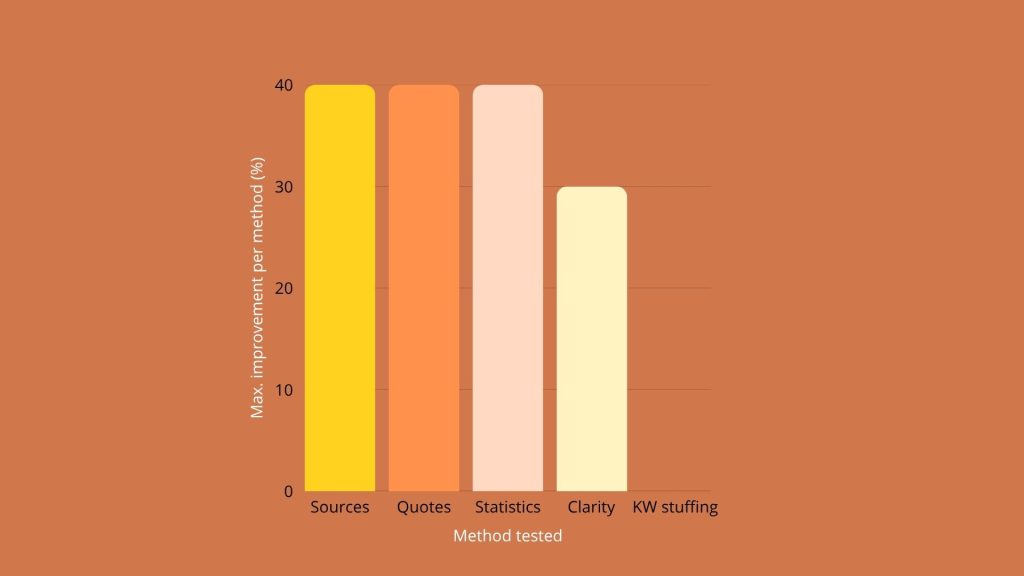
A Princeton study on generative engine optimization found that adding citations, quotations and statistics to a page can lift how often generative engines surface it by up to 40%. On the other hand, “old-school” SEO methods such as keyword stuffing registered no improvement.
The takeaway is practical. Pages that cite their sources, quote named experts and carry concrete numbers get pulled into AI answers more often than pages that assert things vaguely. Write like you expect to be quoted.
Compare these two lines:
- “This channel works well”
- “This channel returns about X dollars for every dollar spent, according to a named study”
Line one is vague and forgettable, whereas line two is a sourced sentence an AI answer can lift whole. The specific version gets pulled and the vague one gets skipped – it’s that simple.
For more details, please check our GEO optimization article.
Show real experience and expertise
The quality signals that help you get cited overlap heavily with the ones Google already rewards. Google frames content quality around E-E-A-T, which is Experience, Expertise, Authoritativeness and Trustworthiness.
You cannot prove ChatGPT weighs these directly. What you can see is that content with a real author, first-hand detail and a track record tends to be the content AI engines reach for.
Put a named human on the byline, show the receipts and say things a generalist could not. Generic content is the easiest thing for an AI to skip.
Structure pages so answers are easy to lift
ChatGPT pulls answers, not whole pages. If the answer’s easy to find, it is more likely to be the one lifted.
Lead each section with a direct answer in the first sentence, then explain. Use clear question-style subheadings, keep paragraphs short and add a summary near the top.
None of this is new. It is the same clean structure good technical writers have always used, and it happens to be exactly what an extraction model wants.
Here’s a simple test you can do and that works for any section: copy it, paste it somewhere with no surrounding context and read it cold.
If it still answers a clear question on its own, an AI engine can lift it cleanly; if it only makes sense after three paragraphs of setup, it gets passed over.
Get mentioned across the web
ChatGPT does not only cite the page, it also leans on what the wider web says about you. The more places your brand and expertise show up, the more chances it has to run into you.
That means digital PR, guest posts, being quoted in roundups and being active in the communities that get cited, including Reddit threads and industry publications.
To be clear, this is about being a citable source those places reference, not running a marketing play on any single platform. Think of it as building an entity, not just a page, because ChatGPT recommends brands it has seen described consistently in a lot of trustworthy places.
The practical version is unglamorous but doable: get quoted in a couple of industry roundups and keep a real presence where your buyers already talk. Make sure your own “About” page states plainly who you are and what you do.
Consistency across all those places is the signal, not any single mention.
Set up Bing Webmaster Tools
Because ChatGPT search has historically drawn on Bing’s index, staying visible there is a cheap hedge. It’s easy: just verify your site in Bing Webmaster Tools and submit a sitemap.
The process costs an afternoon and covers you regardless of how the retrieval mix shifts. You shouldn’t over-index, but there is no downside to being indexable in more than one place.
How to tell if ChatGPT is citing you
You cannot improve what you do not measure, and GEO is measurable in three ways:
- Ask ChatGPT directly (this one’s free)
- Use AI citation tracking tools and watch your analytics
- Set your expectations low at the start
Before you check anything, keep in mind that AI referral traffic is still small, so do not expect a flood on day one.
1 – Ask ChatGPT directly
The free method is to become your own tester. Open ChatGPT with search on and run the questions a buyer would actually type about your category.
Watch two things:
- Does your brand come up at all?
- When a source is cited, is it you or a competitor?
Five or ten prompts should be enough to spot a pattern. The problem is that this process is manual and does not scale. On the other hand, it’s the truest read you can get in ten minutes, as nothing beats seeing the actual answer a customer would see.
One tip: ask the same question a few different ways, because ChatGPT does not answer identically every time. Show up for three phrasings out of five, and that is a real position; show up once, and it’s just noise.
Track it with an AI-visibility tool
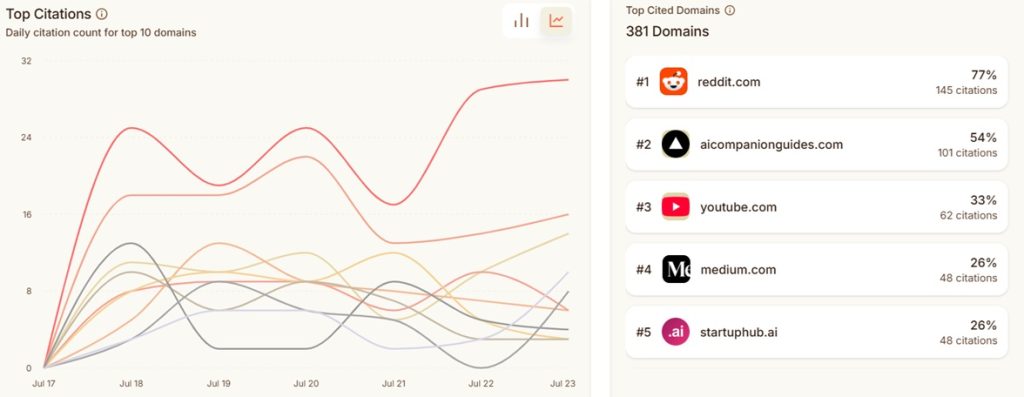
From specific citation trackers to broader AI visibility tools, a whole new category of services now automatically tracks ChatGPT citations. CrowdReply, Profound and others monitor which prompts mention you, which sources ChatGPT pulls your citations from and how that shifts week to week.
The value is coverage and history. A tool runs hundreds of prompts on a schedule and shows the trend, which your manual spot-checks cannot.
Whether you pay for one depends on how much AI visibility matters to your business yet. For most sites, start manually and graduate to a tool when the channel is worth watching daily.
3 – Use your analytics to set realistic expectations
Your own analytics catch the traffic that does convert. This means you should filter referrers for chatgpt.com and the other AI domains in order to see real sessions coming from AI answers.
Keep the numbers in perspective: an Ahrefs study of 3,000 sites found 63% had received at least one visit from an AI chatbot, but AI still drives only about 0.17% of the average site’s traffic, with ChatGPT accounting for roughly half of that.
So the traffic is a trickle today and a trend line worth watching. You optimize for it now because the line points up, not because it pays the bills this quarter.
Set a reminder to check all three signals monthly. AI visibility moves faster than classic rankings, so a monthly read catches a drop or a win while you can still act on it. A number nobody looks at is not really a metric.
Will ChatGPT replace SEO?
Short answer, no. It changes what SEO points at, it does not delete it, and the numbers are not close to what the panic implies. The “SEO is dead” takes make for good headlines… and bad planning.
Here’s the whole gist:
What the numbers actually say
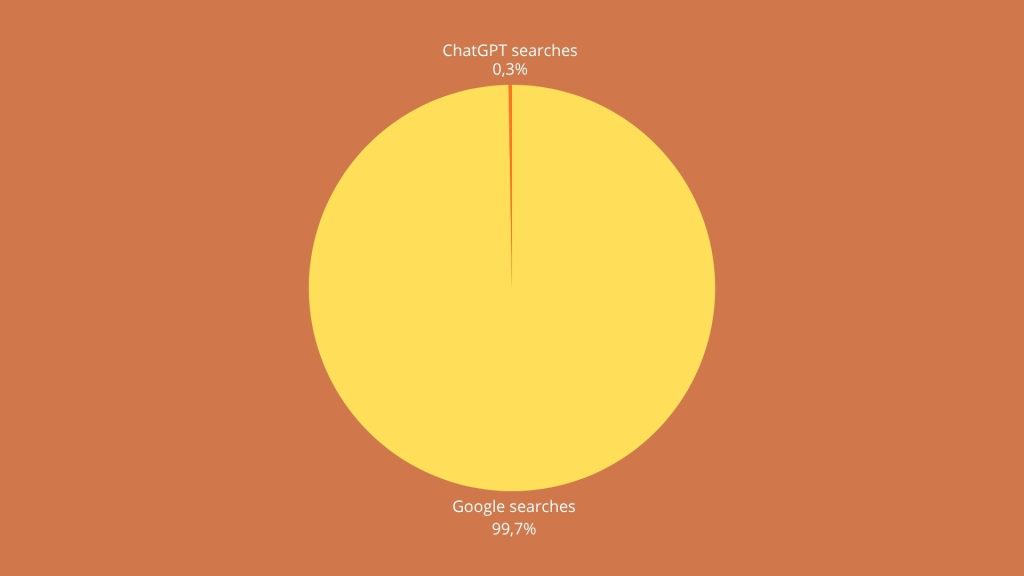
According to Search Engine Land, Google handled roughly 373 times more searches than ChatGPT in 2024 (about 14 billion a day against ChatGPT’s estimated 37.5 million search-like prompts). Its search volume also grew that year, but the gap has narrowed since.
It hasn’t decreased to anything close to parity, though. If you pair the study above with the traffic reality from the last section, the picture is clear: AI answers are a real new surface, not a replacement for traditional search.
The honest framing is expansion, not substitution. People ask questions in more places now, and some of those places are AI answers. Your job is to show up in the new place without abandoning the one that still sends most of the traffic.
You can find more details about this in our GEO vs SEO guide.
What changes (and what does not)
What changes is where your content needs to show up. You now optimize for two surfaces at once (the ten blue links and the AI answer), and the work for each overlaps more than it differs.
What does not change is the fundamentals: good content, crawlable pages, a credible brand and clear structure win in both places.
The teams that struggle treat this as either-or. They either ignore AI answers and lose the new surface, or they panic and abandon the search traffic still paying the bills. The smart play is to cover both because the same content mostly serves each surface.
So, to make it very, very clear:
No, SEO is not dying, and people only think so if they see AI Answers as a threat instead of as what they actually are – a new surface.
Yes, your job changes, because now it goes past SEO’s ten blue links and includes being the source that AI answers quote.
ChatGPT SEO: what you should do right now
Please do not take this guide’s word blindly; go on and pressure-test yourself to be absolutely sure. Three checks settle the big claims above in about ten minutes, and you should run them on your own site:
- Crawl access: open yoursite.com/robots.txt and confirm OAI-SearchBot is not blocked. If it is, that is your single highest-value fix and you found it in thirty seconds.
- Citation reality: run five brand and category prompts in ChatGPT with search on, and note whether you appear and who gets cited instead. That tells you where you actually stand today.
- Traffic reality: open your analytics, filter referrers for chatgpt.com and the other AI domains and see the real number. It will be small, and now you have a baseline to grow.
Run those three and every claim here stops being theory and becomes a number about your site.
What I learned about ChatGPT SEO after writing this article
- The two halves of ChatGPT SEO are really one workflow. Use AI to move faster through the busywork and make your site the thing ChatGPT reaches for when it answers.
- The teams that win treat ChatGPT as both a coworker and an audience. They let it draft and cluster and clean up, but they check every fact it hands over. The rest is about making their pages easy to crawl, easy to quote and backed by a real brand.
- None of this needs a big budget or a new team. It needs someone who knows the topic sitting between ChatGPT and the publish button.
- You should add a few hours a month spent making pages easy to find and worth quoting. The tools change fast; that discipline does not.
ChatGPT SEO (FAQ)
Can you use ChatGPT for SEO?
Yes. It is fast at keyword clustering, content briefs, meta tags and schema, and unreliable for anything that needs live ranking data.
What is SEO for ChatGPT called?
It is usually called GEO, short for generative engine optimization, or AEO, for answer engine optimization. Both describe the same: you optimize your content so AI engines like ChatGPT cite and recommend it, not only so it ranks in the classic blue links.
Is SEO dead or evolving in 2026?
Evolving. The surface you optimize for is widening to include AI answers, but search itself is still growing.
Can ChatGPT perform keyword research on its own?
It’s not recommended to use it on its own. It’s good at brainstorming and clustering keyword ideas, but it cannot pull real search volume or difficulty since those numbers do not live inside the model.
Can ChatGPT create SEO-optimized meta descriptions?
Yes, and it is one of the tasks it does best. Give it the target keyword and the character limits, ask for ten options and you will keep a few after light edits.
How accurate is ChatGPT for SEO purposes?
Useful but not trustworthy on its own. OpenAI itself warns that ChatGPT can write plausible-sounding but incorrect answers.
Does ChatGPT provide updated, current SEO insights?
Yes, more than people assume. The old “stuck in 2021” line is out of date because newer models train on more recent data and ChatGPT can read the live web with search on.
Is ChatGPT effective for generating backlinks?
No. ChatGPT can draft outreach emails and suggest link prospects, but it cannot earn a real backlink, and anything it auto-generates is either invented or low quality.