By Dawood Khan, Founder of CrowdReply.
TL;DR
- CrowdReply is my #1 pick because it’s the only tool here that gets you named in the sources LLMs cite instead of simply charting the gap.
- For enterprise depth and model coverage specifically, my top recommendation is Profound.
- Beginners and teams virtually working without a budget should definitely give Peec AI a go.
- For agencies, things are different: consider Frase, Scrunch AI and EverTune.
- Run your brand through ChatGPT and Perplexity today. The size of the gap you find decides which tool you actually need.
I’ve lost count of the LLM visibility tools that turned out to be a dashboard and an invoice, so I tested the eight tools people shortlist, framed by one question:
- When a buyer asks a model about your category, does it name you, and can the tool fix?
The answer is in the table below, but before jumping into my conclusions, let’s learn a little bit more about what LLM visibility actually means:
LLM visibility explained
LLM visibility is whether and how AI models name your brand when someone asks them a question. It gets measured as a mix of citation share, mention frequency and sentiment, covering large language models such as ChatGPT, Google AI Overviews, Perplexity, Gemini and Microsoft Copilot.
It’s not the same as LLM observability
This trips people up constantly, so let me draw the line early. LLM observability is an engineering discipline: it watches your own model calls for latency, token cost and output quality, and it lives in tools like Datadog and LangSmith.
That’s not this. LLM visibility is a marketing problem, not an infrastructure one. It watches how public models talk about your brand, not how your own models perform. If a vendor starts pitching you traces and eval dashboards, you’re in the wrong aisle.
GEO, AEO and LLM SEO are three names for the same job
The naming is a mess, so let’s get this straight before moving on: GEO stands for generative engine optimization, AEO is answer engine optimization (the term most marketers actually say out loud) and LLM SEO is the same idea with a friendlier name.
Albeit different, the three acronyms describe the same task: getting your brand inside the answer instead of next to it. When I say LLM visibility in this piece, this is what I mean.
The 8 best LLM visibility tools in 2026
Here’s the whole field before the deep dives, so you can jump to your situation:
- Best overall for teams that want to move the number: CrowdReply
- Best for enterprise depth and model coverage: Profound
- Best for fast, clean multi-region tracking: Peec AI
- Best for an on-page action layer: AthenaHQ
- Best cheap starting point: Otterly.AI
- Best for a low false-positive rate: Ahrefs Brand Radar
- Best for client-ready reporting: Semrush AI Visibility Toolkit
- Best for Google AI Overview audits: ZipTie
| Tool | From (per month) | Models tracked | What it does about it | Best for |
|---|---|---|---|---|
| CrowdReply | $99 | 7 (pick 2 up to all 7 by tier) | Off-site execution: gets you cited, fixes hallucinations | Mid-market teams that must move the number |
| Profound | $99 (ChatGPT only) | Up to 10 | Deep monitoring and analytics | Enterprise depth |
| Peec AI | $80 | 6 (3 base, extras paid) | Monitoring only | Fast multi-region tracking |
| AthenaHQ | Free, then $295 | Up to 9 | On-site content optimization | On-page action layer |
| Otterly.AI | $29 | 4 (extras paid) | Light audits and advice | Cheapest start |
| Ahrefs Brand Radar | ~$828 all-in | 6 (Google-skewed) | Monitoring only | Low false-positive rates |
| Semrush AI Toolkit | $99 add-on | 4 to 5 (expanding) | Monitoring plus generic recs | Client-ready, out-of-the-box reporting |
| ZipTie | $69 | 3 | On-site optimization briefs | Google AI Overview audits |
Now the deep dives, in order:
1. CrowdReply: best for moving the number, not just watching it

CrowdReply is the one tool here built to close the visibility gap off your own site, not just report it. If you’ve confirmed you have a problem and the question is now “how do we actually fix it,” this is where I’d start.
What is it?
- CrowdReply tracks where models recommend you daily, across up to seven engines, then hands you the workflow to change the answer.
The tracking half looks like everyone else’s: share of voice, competitor leaderboards, sentiment, which sources feed each answer, etc. The other half is what nobody else ships.
What stood out?
- When I set up a brand and its three closest competitors, the citation-gap view showed me the exact Reddit threads and editorial pages a model was pulling from to name the competitors and skip me.
Most tools stop there and leave the doing to you, but CrowdReply keeps going.
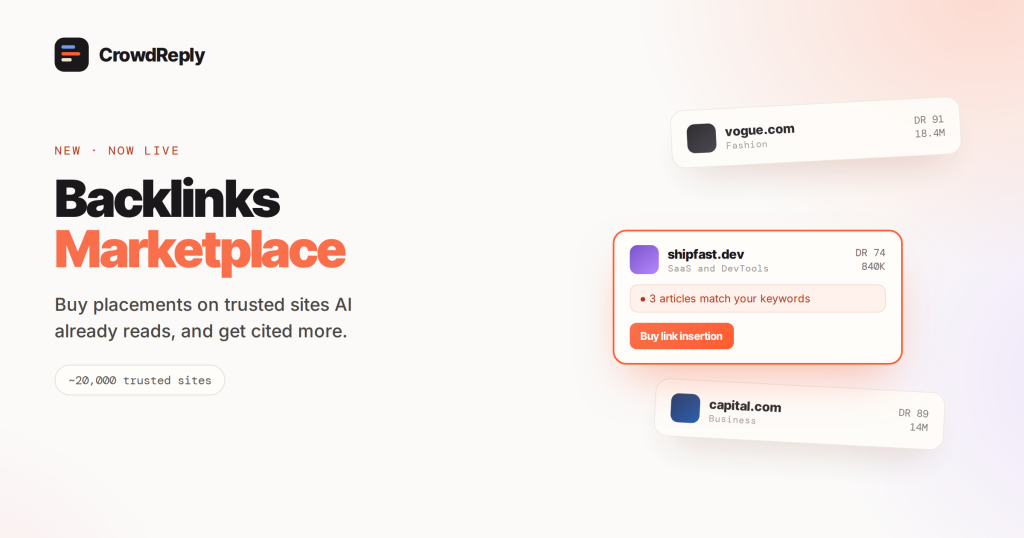
Its Engagement Engine places your brand into those conversations through platform-native accounts, the Backlinks Marketplace sources and places editorial links for you from vetted publishers and the Brand Knowledge fixer works on a wrong fact about you until the model’s answer updates.
What made me come back?
- The whole loop lives in one place. I could spot a gap, order the fix and watch the citation change without exporting a CSV into three other tools.
Since only about 17% of AI citations come from pages that rank in the organic top 10, the sources you need are usually ones you don’t control. A tool that only edits your own site can’t reach them.
How much does it cost?
- Starter is $99/mo, Growth is $299/mo and Enterprise starts at $499/mo, with engagement credits bundled into every tier and the model count scaling from two up to all seven.
The trade-off is that credits are consumable, so real cost tracks how much off-site placement you actually run.
Where does it fall short?
- It’s been picked over by far fewer public reviewers than Profound or Peec AI, which have had a year longer under the microscope. Moreover, CrowdReply carries a Reddit-and-Quora heritage that can read as “a Reddit tool” if you haven’t seen where the product went.
In other words? If you want something a thousand strangers have already stress-tested before you touch it, please keep in mind that CrowdReply’s track record is still being written.
Who is it for?
- Mid-market B2B SaaS growth and SEO teams that will act on citation gaps in-house rather than hand them to an agency. If that’s you, start here!
2. Profound: best for enterprise depth and model coverage
Profound is the polished, well-funded enterprise option, and it’s the one I’d send a Fortune 500 marketing team to. The data is the deepest in the set, and the model coverage is the widest.
What stood out?
- Coverage goes up to ten engines on the top tier and the Prompt Volumes feature surfaces the real questions users ask through an opted-in panel, which reads like keyword research for AI.
With Profound, you can see which sources feed a rival’s citations and diff them against yours; small competitors simply can’t replicate that panel data.
Where does it fall short?
- Profound measures beautifully and then leaves the next move to you. The insights are strong, but you still need a strategist to act on them (it’s an analytics platform, not a do-it-for-you machine). The learning curve is also steep.
How much does it cost?
- Starter is $99/mo but only watches ChatGPT with 50 prompts, and you’re at $399/mo on Growth before you get three engines. Enterprise is a custom sales call for the full ten-engine coverage.
One thing to watch out for: the realistic entry for a serious team is the $399 tier, not the headline $99.
Who is it for?
- Enterprise and upper-mid-market teams with a real budget and an analytics function to act on the data. If that’s not you, buying Profound can easily be a waste of money.
3. Peec AI: best for fast, clean multi-region tracking

Peec AI is the cleanest pure-monitoring tracker in the set and it’s the one I’d hand a data-minded SEO team that wants a tidy dashboard and nothing they didn’t ask for. It’s Berlin-built and the multi-country work is a real strength.
What stood out?
- Tracking held up across models and regions with a fast daily refresh when I ran it and the Looker Studio plumbing on the higher tier is the cleanest I saw for piping the data into a client report.
Moreover, seats are unlimited on every tier and pricing is per workspace, which is agency-friendly economics.
Where does it fall short?
- I ran into the same issue I had with Profound: Peec AI is monitoring, not optimization. Ask it what to actually do about a gap and there’s nothing there, no action layer and no fix step. You also get three base models, with Claude, Grok and DeepSeek billed as paid extras.
How much does it cost?
- Public at $80/mo Starter, $205/mo Pro and $420/mo Advanced, with Enterprise custom. Entry prompt caps are tight at 50, so heavy prompt sets push you up the tiers fast.
Who is it for?
- Mid-market brands and agencies that want fast, clean multi-region tracking and already have people in-house to act on the data.
4. AthenaHQ: best for an on-page action layer
AthenaHQ is the most action-oriented of the monitors, and it’s the one I’d give a team that wants more than a chart but isn’t ready to hand off execution. It’s built by ex-Google Search and DeepMind founders, and the methodology feels credible because of it.
What stood out?
- On top of cross-engine tracking across up to nine models, it ships a content-optimization agent that drafts fixes for your own pages, plus hallucination detection and competitor-impersonation tracking.
The dashboard is easy enough that an ops person picks it up in a day and there’s even a free Essential tier with five engines to test it on.
Where does it fall short?
- The action is on-page content, not off-site placement, it tells you which subreddits and pages to target, but you still send the outreach yourself and the deep agentic features get gated behind Enterprise.
How much does it cost?
- Free Essential tier with 300 credits, then $295/mo Starter ($245 annual) for up to nine models and the on-page action layer. Enterprise is custom for the citation engine and deep-research agent.
Who is it for?
- Buyers who want an on-page content-optimization layer rather than just measurement, especially on Shopify and GA4 stacks, with hallucination tracking as a first-order need.
5. Otterly.AI: best for the cheapest, honest start
Otterly.AI is the tool I recommend to founders who have never tracked LLM visibility before. It’s cheap, it’s transparent and it’s low-commitment. In sum, the right way to start!
What stood out?
- The big pro is that, at $29/mo for the Lite tier, there’s almost no financial risk to running your first baseline, and first reports surfaced within an hour of signup.
Additionally, the interface is clean and the GEO Audit it produces is a genuinely useful read on where you stand and the Looker Studio connector is a nice touch at this price.
Where does it fall short?
- Otterly.AI advises… it doesn’t execute. You get audits, recommendations and briefs, but nobody’s building anything for you.
Prompt caps are also low on Lite, sitting at just 15, and the tool covers four base engines with Gemini, Claude and AI Mode as paid add-ons that quietly drift your bill up.
How much does it cost?
- Published at $29/mo Lite, $189/mo Standard and $489/mo Premium, with a 15% annual discount.
Who is it for?
- Solo founders, freelancers and small in-house teams on a tight budget who are new to this and have the capacity to act on the insights themselves. If that’s you, it’s the easiest yes in the category!
6. Ahrefs Brand Radar: best for low false-positive rates
Brand Radar is the strongest pick if Ahrefs is already in your stack. It’s a research-database read on LLM visibility that sits right inside Site Explorer, next to your SEO data.
What stood out?
- The prompt index is search-backed, built from real query demand rather than synthetic prompts, so the false-positive rate is low. It’s the most accurate I tested on Google AI Overviews specifically, and it uniquely tracks mentions across YouTube, TikTok and Reddit that the pure-play tools skip.
I cannot tell you how convenient it is to see AI and SEO data in one single pane.
Where does it fall short?
- The real cost is buried. Brand Radar isn’t standalone, so full access runs around $828/mo once you stack the $199-plus add-on on top of a $129 base plan.
The data skews hard toward Google surfaces, with thinner ChatGPT and Perplexity coverage and no Claude or Grok, and… the add-on is monitoring only.
How much does it cost?
- A $129/mo base Ahrefs plan plus the Brand Radar add-on from $199/mo per platform, or $699/mo for all six AI platforms bundled.
All-in lands around $828 to $1,148/mo for most teams, roughly 2.5 times a dedicated tool!
Who is it for?
- SEO teams already inside Ahrefs who mainly care about Google AI Overviews, want AI mentions and web mentions in one workspace and can absorb the add-on cost.
7. Semrush AI Visibility Toolkit: best for client-ready reporting
The Semrush AI Toolkit is the convenient choice if your team already opens Semrush every morning because it folds LLM visibility into the suite you’re already paying for. The thing that really got me going, however, is the excellent client-ready, out-of-the-box reporting.
What stood out?
- Everything stays in one place, and the workflow runs from prompt research to competitor benchmarking to an AI Search Site Audit that prioritizes crawlability fixes.
The AI Visibility Toolkit is backed by one of the largest US prompt databases built from real queries, so the dashboards are presentation-ready for agencies.
Where does it fall short?
- The base plan caps you at 25 tracked prompts, and the add-ons stack the true cost fast. The $99 is the annual rate shown per month, so paying month to month costs more.
In addition to the high cost, AI Visibility Toolkit’s engine coverage is still expanding (lagging the dedicated tools) and the auto-generated recommendations skew generic.
How much does it cost?
- A $99/mo add-on per domain sitting on top of your existing Semrush plan, with report packages and extra prompts billed on top. The add-on has no free trial of its own.
Who is it for?
- Established brands and agencies already standardized on Semrush who want LLM visibility folded into an existing workflow with reporting they can hand a client.
8. ZipTie: best for Google AI Overview audits

ZipTie is the indie tracker with the sharpest Google AI Overview detection, and it’s the one I’d give to a technical SEO who lives in AI Overviews specifically. It renders results in a real browser instead of approximating through an API, and that accuracy shows.
What stood out?
- The AI Overview detection is the most accurate I tested, and you get the full answer, the citation set and a downloadable screenshot as evidence. If you want to rank in AI Overviews, ZipTie can be surprisingly helpful.
ZipTie’s screenshot-evidence capture is the best in the set for client deliverables and its content-optimization module turns each citation gap into a per-page brief. In other words, ZipTie acts, and it does it on-site.
Where does it fall short?
- It only covers three engines, Google AI Overviews, ChatGPT and Perplexity, with no Gemini, Claude or Copilot. If you need multi-engine coverage, that’s a dealbreaker on its own.
How much does it cost?
- ZipTie is transparent and cheap at $69/mo Basic, $99/mo Standard and $159/mo Pro, with a 14-day free trial. Basic includes 500 AI search checks a month, where one check covers all three engines for a prompt.
Watch out, though, as pricing is check-based and effectively single-seat on standard plans, meaning it scales badly for agencies.
Who is it for?
- Solo consultants and small SEO teams focused on Google AI Overviews who want per-page optimization guidance and reproducible evidence, not just a chart.
What each tool actually costs in 2026
Unfortunately, the editorial pricing for these tools is all over the place, and half of it is stale… I saw Profound quoted as both $499/mo and $82.50/mo on the same search page, for example!
It can be hard to keep track of prices, so here’s what each LLM visibility tool I tested actually costs:
| Tool | Entry price | Prompts or checks at entry | Notes |
|---|---|---|---|
| (ordered by starter cost) | (as of mid-2026) | (starter plans) | (worth knowing) |
| Otterly.AI | $29/mo | 15 prompts | Extra engines are paid add-ons |
| ZipTie | $69/mo | 500 checks | Single seat on standard plans |
| Peec AI | $80/mo | 50 prompts | 3 base models, unlimited seats |
| CrowdReply | $99/mo | 20 prompts | Pick 2 models, $50 credits bundled |
| Profound | $99/mo | 50 prompts | Starter is ChatGPT only |
| Semrush AI Toolkit | $99/mo | 25 prompts | Sits on your Semrush plan |
| AthenaHQ | Free, then $295/mo | 300 credits free | 5 engines free, 9 on Starter |
| Ahrefs Brand Radar | ~$828/mo all-in | 2,500 checks | $129 base plus a $199+ add-on |
Other tools worth knowing: 5 honorable mentions
These didn’t make the main eight, but they’re worth a line so you know where they sit:
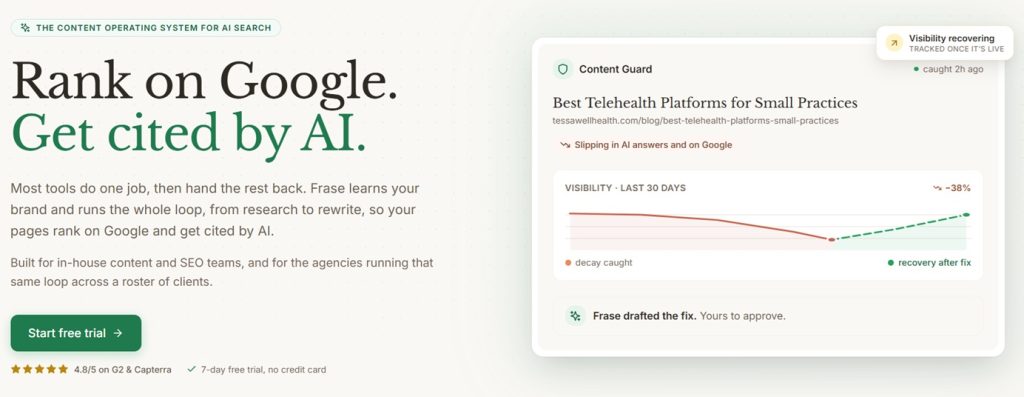
- Frase is a content-optimization platform that added an LLM visibility module, best if you want SEO and GEO scoring inside one writing workflow. From $39/mo yearly, with on-site optimization.
- Scrunch AI is an enterprise-leaning monitor with a product and shopping angle for AI search, from around $250/mo (please confirm the model count with Scrunch directly before you commit).
- EverTune is an enterprise platform with a data-science bent and an AI-advertising path, sales-led from around $800/mo. Great for a Fortune 500 brand team, overkill for everyone else (a good Profound alternative too).
- Rankscale is the widest engine coverage in the set, tracking 17-plus models with no per-engine upsell, from free up to $99/mo. Worth a look if broad coverage matters more than depth.
- Conductor is a legacy enterprise SEO platform that folded an AEO layer and agents into the same seat, with sales-led pricing and no public number.
Tools for agencies vs. in-house teams
Agencies have a different problem than in-house teams:
- For in-house teams, it’s all about “is my brand visible?”
- For agencies, it’s all about multi-client management, white-label reporting and per-seat economics that don’t blow up your margin.
The honest gap across the category is that white-label, multi-client reporting is still thin, so agencies often end up having to stitch two tools together. So, which LLM visibility tool should agencies go for?
These are my three top recommendations for agencies specifically:
- Profound (enterprise-level multi-brand depth)
- AthenaHQ (similar brand depth and reporting)
- Peec AI (unlimited seats and transparent per-workspace pricing)
How I judged these tools
I stopped scoring these on monitoring features. Monitoring is table stakes now. Every tool below tracks your prompts well enough, so the dashboard is not where the real differences live; these five things are:
1. Model coverage
Which named models does it track, and how many do you get before the price jumps?
- The 2026 baseline is: ChatGPT, Google AI Overviews and Perplexity. The next tier adds Gemini, Copilot and Google AI Mode. Claude and Grok usually sit behind the top plan.
The models you can’t see are often the ones your enterprise buyers are actually using, so a cheap plan that only watches ChatGPT can lull you.
2. Tracking method and refresh
How does the tool get its answers, and how often?
- The 2026 baseline is: real-browser and panel data that matches what buyers actually see. Daily beats weekly for anything that moves fast, so it should also be available.
Some query the models through APIs, some render results in a real browser like a person would, and a few use opted-in user panels for real prompts. Either way, the most important thing is to ensure the tracking method and refresh rate suit your team’s needs.
3. What it does after the dashboard
Once a tool tells you you’re invisible for “best LLM visibility tools” (for example), what does it hand you next?
- The 2026 baseline is: monitoring-only, but I believe it’s about time we change that standard… It’s also the main reason why CrowdReply sits at the top of my list.
Luckily, a few tools go over mere monitoring by offering on-site optimization. These include AthenaHQ, ZipTie and Frase (one of my honorable mentions).
As for off-site execution, there’s exactly one tool here that does that: CrowdReply. It goes and gets you into the third-party sources the models cite, the Reddit threads, the editorial pages and the corrections to a wrong fact.
4. Pricing transparency
Does the tool publish a number, or is it a sales call?
- The 2026 baseline is: honest pricing tiers without hidden costs. That’s the least we should expect for a professional premium tool, no matter the niche.
This is a buyer signal, not a moral judgment. Otterly, ZipTie, Peec and Frase, for example, print their prices. Profound hides enterprise, and Ahrefs buries the real cost behind an add-on.
5. Citation depth and sentiment
Were you named, how, when and which sources fed the answer in the first place?
- The 2026 baseline is: a tool that shows you which outside sources a model pulls from is showing.
How to choose the right one for your brand
It’s not that hard… Take note of these five questions, answer them in order and things should get a lot clearer:
1. Are you measuring or moving the number?
If you’re still trying to see where you stand:
- Any monitor above will do.
If you’ve watched the dashboard for a quarter and the question is now “how do we actually move citation share”, you need off-site execution:
- That routes to CrowdReply.
2. What’s your budget and team size?
Solo or tiny team under $50 a month:
- Start with Otterly.AI.
Mid-market teams with a real budget:
- CrowdReply.
Enterprises ready for a sales cycle:
- Profound or EverTune.
3. Are you already paying for Ahrefs or Semrush?
If yes, start with their modules before stacking a second tool:
- Brand Radar for Ahrefs users.
- AI Visibility Toolkit for Semrush users.
You’ll know within a quarter whether you’ve outgrown these tools.
4. Which models do your buyers actually use?
If you need Claude, Grok and the full spread:
- Profound or Rankscale go widest.
If your buyers live in Google AI Overviews:
- ZipTie or Ahrefs Brand Radar are the sharper picks.
5. Are you an agency?
Multi-client and white-label needs point to:
- AthenaHQ or Profound, not the general-purpose trackers.
When in doubt:
For the default mid-market team with a real visibility problem and the intent to fix it, three of the five questions above land straight on:
- CrowdReply.
That’s on purpose, as it’s the only LLM visibility tool I tested that was built for the fixing half.
Three more things you should know about LLM visibility:
Now that I’ve covered everything I learned about the best tools, I leave you with three final notes on the current state of LLM visibility:
1. If your visibility is bad, you have a revenue problem
The click-less shift stopped being a forecast. It’s the present tense, and the surfaces are search-engine-sized. In a 150,000-keyword analysis, Ahrefs determined there was a huge drop in CTR for position-one pages between March 2025 and March 2026:

Simultaneously, ChatGPT crossed 900 million weekly users in February 2026, more than double a year earlier… That’s not a niche assistant; it’s a discovery surface at Google scale, and your buyers are on it asking about your category right now.
Then there are the pure answer engines with no blue links at all. Perplexity’s CEO reported they were fielding about 780 million queries a month and growing over 20% per month by mid-2025. On a page like that, there’s no list of ten links to climb: either the model cites you or you’re not on the page.
The shift, in one line? Search used to send you a visitor, now it often keeps the visitor and hands them an answer… your only slot is inside that answer.
2. Being the top result in Google no longer gets you named
Only about 17% of the pages an AI Overview cites also rank in the organic top 10 – remember this stat I mentioned above? That should give you some food for thought…
It means roughly 5 of every 6 AI citations pull from pages that aren’t on page one of classic search. The obvious take? Winning the blue-link game buys you almost nothing in the answer box. That’s the exact gap an LLM visibility tool exists to measure.
There’s also the fact that the answer box eats your clicks, and this has been established by more than just the 150,000-keyword analysis cited above. In its own study, Seer Interactive tracked 3,119 queries and watched organic click-through on AI Overview results fall 61%, from 1.76% down to 0.61%:

The bottom line? Being the top blue link stopped meaning you get the click. The answer already took it…
3. Authority is still essential to get cited
When a model builds an answer, it leans on a small, third-party-heavy set of sources, and almost none of it is your own site. This means that “old-school” SEO authority still plays a big role in the age of LLM visibility.
In Ahrefs’ July 2026 data, Reddit was the single most-cited domain in US ChatGPT answers at 16.7% mention share, then Wikipedia at 8.9%, with YouTube and LinkedIn further down:
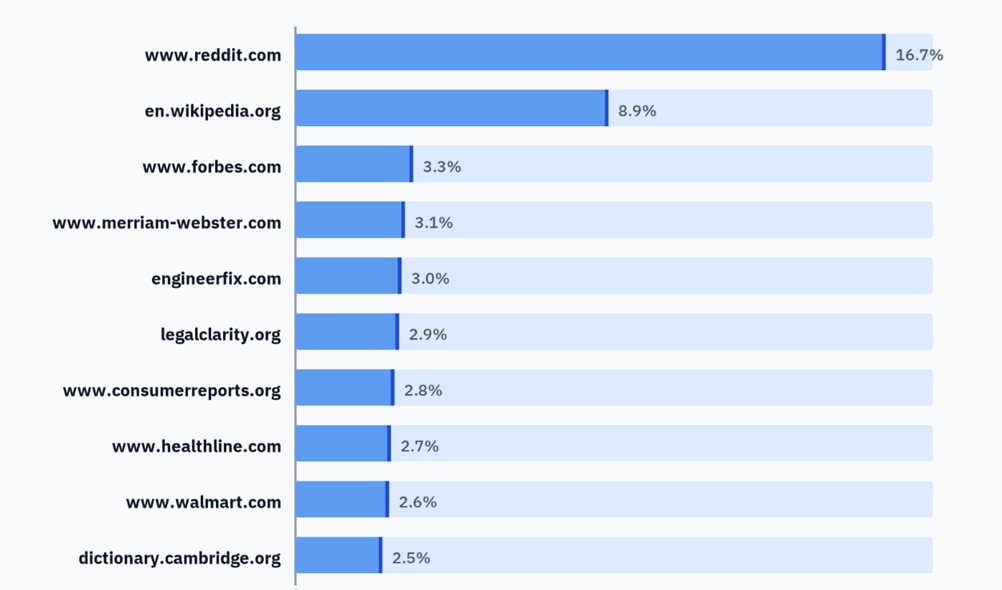
The pages a model quotes skew hard toward community and reference sites, not brand-owned pages. That is the whole reason off-site work matters.
However, this is still a moving target. After all, Semrush watched ChatGPT’s Reddit citation rate swing from around 60% of responses to roughly 10% inside a few weeks in 2025:

The mix is wildly volatile, which is the real argument for continuous monitoring over a one-time audit.
Put those two studies together, and the shape of the problem is clear: you get named by shaping what trusted third parties say about you and you have to watch it constantly because the sources shift. A tool that only edits your own pages can’t reach any of that.
How we tested:
I looked at the eight tools teams actually shortlist in mid-2026, from a $29 budget tracker up to sales-led enterprise platforms, and set the 20-plus long-tail options aside so the comparison stayed useful rather than exhaustive.
I judged each one on five things:
- How many named models it tracks
- How it collects its answers and how often
- What it does beyond monitoring
- How transparent its pricing is
- How deep its citation and sentiment data goes
Where a trial existed, I signed up and ran the same set of buyer prompts through it across the models it covers, worked the dashboard, and walked the pricing tier by tier to see where each one quietly stalled or nickel-and-dimed. Then I compared them head to head on those five criteria.
Every tool got judged against the same buyer profiles. Each best-for reflects where its strengths and gaps actually landed, not where its marketing says they should.
Frequently asked questions
What is the best LLM visibility tool?
CrowdReply is the best pick for most mid-market B2B SaaS teams, Profound is the stronger call for enterprise teams with the budget for sales-led pricing, Otterly.AI fits sub-$50-a-month budgets and Ahrefs Brand Radar makes sense if you already pay for Ahrefs.
What is LLM visibility?
LLM visibility is whether and how AI models name your brand in their answers.
How do LLM visibility tools work?
LLM visibility tools work by running a set of prompts against the models you choose on a schedule, then pulling brand mentions, citations and sentiment out of each response. The better ones add competitor comparisons and show which sources feed each answer.
How is LLM SEO different from traditional SEO?
Traditional SEO ranks your URL in a list of links. LLM SEO tracks whether your brand is named inside the answer, where there’s no list to climb. The metrics differ too. SEO is about position, whereas LLM visibility is about citation share in the response.
How do I track the LLM visibility of my brand?
Start by listing the 10 to 20 questions a buyer would ask a model on the way to your category, then run them through the engines that matter to you and log whether you’re named, cited or ignored.
How can I get my brand cited by LLMs?
You get cited by building authority on the sources models actually pull from and fixing what they get wrong about you. That means coverage in real publications, accurate mentions in community threads like Reddit, clean structured data and corrections to any wrong facts about you.
How much do LLM visibility tools cost in 2026?
LLM visibility tools run from $29 a month at the low end up to $800 a month and beyond for enterprise platforms. Otterly.AI starts at $29, Frase at $39, and most dedicated trackers land between $80 and $499. Ahrefs Brand Radar runs around $828 a month all-in once you add the required bundle.
What is the difference between LLM observability and LLM visibility?
LLM observability is an engineering discipline that watches your own model calls for latency, cost and output quality, while LLM visibility is a marketing discipline that watches whether public models name your brand in their answers.