TL;DR
- LLM optimization (LLMO) is the work of getting AI answer engines like ChatGPT, Gemini and Google AI Overviews to mention and cite your brand.
- LLMO is not a concern for the future because user behavior has already changed. Brands and marketing teams should adapt and act quickly.
- LLMO and SEO are complementary practices; your “old-school” SEO authority work, for example, can help you get cited more frequently in AI answers.
- On the other hand, some things have changed: off-site brand mentions correlate with AI visibility about three times more strongly than links do, meaning backlinks don’t have the same importance in LLMO as they do in SEO.
- You can measure your AI visibility manually or by using a dedicated search monitoring tool such as CrowdReply (start now for free).
LLM optimization – I’ve seen people get this one wrong all the time, so I decided to write an article about it. Below, I will tell you everything you need to know about LLMO, including how it relates to SEO, GEO and AEO, and what set of tactics it usually employs.
Before going into the definition of LLMO, though, a brief note:
There are two meanings to “LLM optimization”
The term “LLM optimization” is currently used to refer to two completely different jobs, so it’s important to clarify things before moving further:
- LLM optimization in engineering: it’s about improving the model itself through quantization, KV cache tricks, GPU bills, inference latency, etc. If that is what brought you here, this is not your guide.
- LLM optimization in marketing: it’s about getting your brand to show up inside the answers AI models provide to real people (such as your potential customers). This is the type of LLM optimization this guide is about.
So, just to clarify: when “LLM optimization” appears below, it means brand visibility inside AI answers, not tuning an AI model.
LLM optimization explained
LLM optimization, often shortened to LLMO, is the practice of shaping your web presence so AI answer engines surface, mention and cite your brand when someone asks a question you should show up for. That is the whole definition.
LLM stands for large language model, the type of AI behind ChatGPT, Gemini and Claude. LLM optimization is about influencing what those models say and which sources they point to. But is it any different from traditional search engine optimization?
Well, here is the shift that makes it a distinct discipline: a classic Google result is a ranked list of blue links and you fight for a position on it; an AI answer is a single synthesized response instead. The model reads a set of sources, writes one paragraph and maybe names a few of them.
As a result, you’re no longer fighting for position four; you’re fighting to be one of the handful of pages the model trusts enough to pull from. When I asked ChatGPT “what are the best AI visibility tools?”, for example, the model recommended seven products:
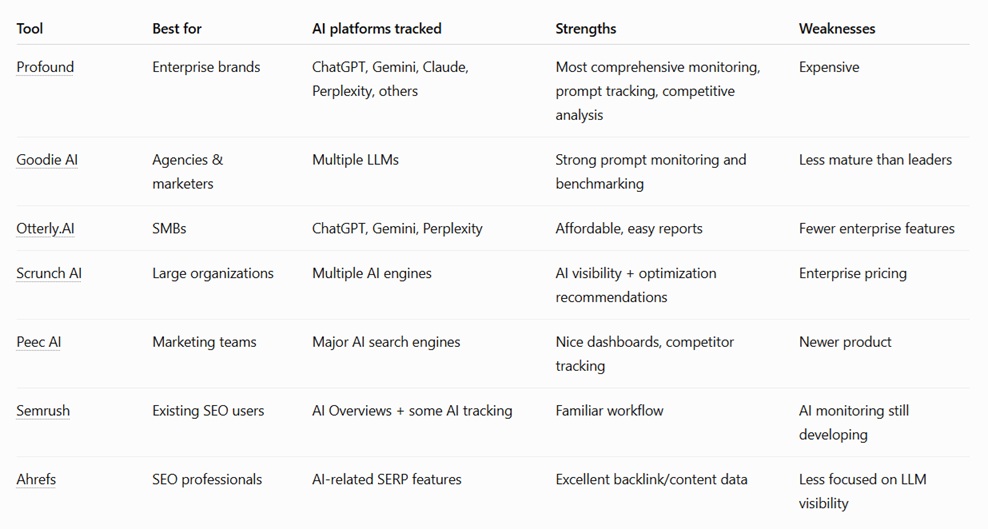
Whether I agree or not with the model doesn’t matter (here’s my own list, by the way)… what matters is to be one of the brands cited by the AI.
If your tool is mentioned, you just won a high-intent buyer without ranking a single page; if it isn’t, you were invisible for the query that mattered most. That is why the synthesis step matters so much.
A blue link gives every ranked page a shot at the click, while an AI answer gives the model’s chosen few a mention and hides everyone else. The harsh reality of LLM optimization? Second place is no place…
LLM optimization is also known as GEO, AEO, AI search optimization and other names. Those are largely the same idea under different labels (there is a whole section near the end that untangles the acronyms, so hold that thought).
Why LLM optimization matters now
The short version: a real and growing share of the questions your buyers ask never touch a traditional search results page anymore. This is not a forecast; it’s the present-day reality.
The audience already moved
ChatGPT reached roughly 900 million weekly active users in early 2026, up from about 400 million a year earlier, per TechCrunch. That is the fastest adoption curve any software category has managed.
Those people are not just writing emails with ChatGPT. They are asking which tool to buy, which agency to hire and whether your product is any good. And yes, they’re doing it right now.
Picture a buyer three months from a purchase. A year ago they opened ten tabs and read comparison posts. Now they ask one chatbot to shortlist their options and reason through the tradeoffs. If the answer never names you, you’re losing customers.
Google itself became an answer engine
This is not only a ChatGPT story. Google now answers a large share of searches directly with AI Overviews, the summary block that sits above the old blue links, and the prevalence swung hard through 2025:
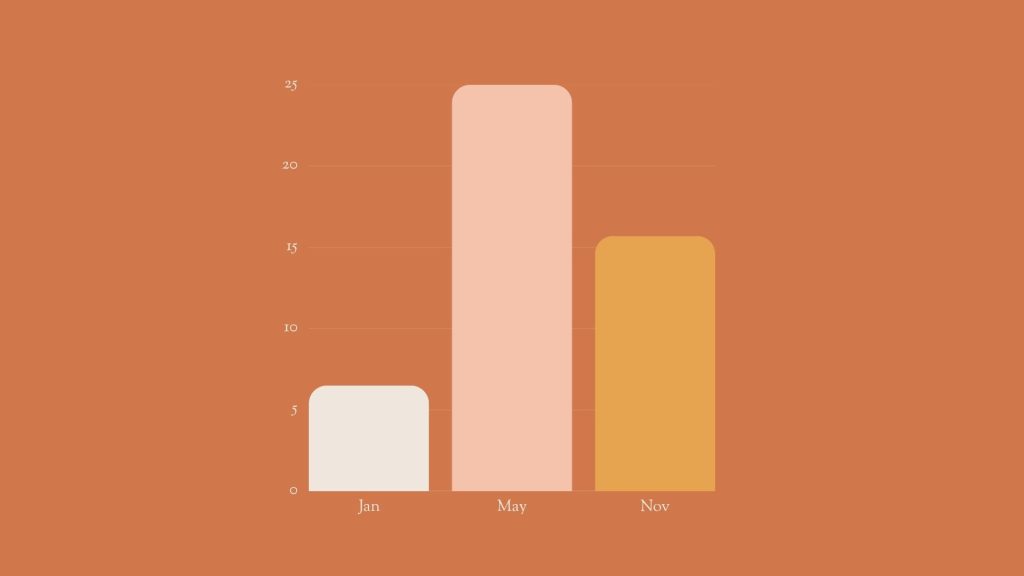
According to Search Engine Land, AI Overviews appeared on about 6.5% of queries in January, peaked near a quarter of queries in the summer, then settled to under 16% by November. Estimates vary a lot by tracker and keyword set, so treat any single number as a rough read, not gospel.
The direction is what matters: as Gartner’s Alan Antin put it, generative AI is becoming a substitute answer engine, replacing queries people used to run in traditional search.
What all of this means for you
Discovery is fragmenting across surfaces, and that means you cannot rank in the old way. Being findable now means being one of the pages these engines reach for, across all of them, not just ranking on google.com.
Misinterpreted stats and LLM optimization myths
The LLMO conversation is full of dramatic numbers, and a lot of them are misused. There are at least three worth getting right:
- LLM optimization isn’t “killing” SEO: Gartner forecast in early 2024 that traditional search engine volume would drop 25% by 2026, but that was never confirmed. Search is being reshaped, not deleted.
- Clicks go down… and up: SparkToro study determined that around 60% of U.S. Google searches end without a click, but that figure predates the AI Overviews surge. Zero-click search is a Google habit that AI answers are accelerating, not something that AI invented.
- AI Overviews are not gutting click-through rates: Semrush’s before-and-after data on the same keywords showed zero-click rates actually dipped, but the drop was very subtle (down from 38.1% to 36.2%).
The useful takeaway is calmer than the headlines. The behavior is shifting toward AI answers, and you want to be inside them. You do not need a doomsday stat to justify the work, so please ignore the noise and focus on what really matters.
How LLMs actually pick and cite sources
If you want to be cited, it helps to know how the citing works, and the best part is that it is less mysterious than it sounds. There are three things worth knowing:
1 – AI models use retrieval instead of memory
Modern AI search does not answer purely from what a model memorized during training; it retrieves. The system runs a search, pulls a set of live web pages, reads them, writes an answer grounded in what it found and then attributes some of those pages as sources.
That single fact changes your whole job. You are not trying to teach the model about your brand; you are trying to be in the set of pages it retrieves and trusts at answer time.
Retrieval also rewards freshness and clarity. A page that answers the exact question in clean, current language is easy to fetch and easy to quote. A page that buries the answer under three scrolls of preamble is neither.
2 – Authority still plays a big role
Here is the part that surprises people. The engines lean disproportionately on a small cluster of community and reference sites. Consider this graph, for example:

Across ChatGPT, Google’s AI Mode and Perplexity, Reddit, Wikipedia and LinkedIn sit among the most-cited domains. These conclusions come from a comprehensive Semrush study of more than 230,000 prompts and over 100 million citations.
Why those sites? They are broad, constantly updated and full of the plain-language, question-and-answer text these models find easy to lift. A Reddit thread answering “is X worth it” is written in exactly the shape an engine wants to quote.
Semrush’s Sergei Rogulin noted the mix even shifts over time as engines try to avoid over-citing the same handful of domains. So the specific ranking moves, but the pattern holds: community and reference sources punch far above their weight.
3 – Every model is different
According to a Profound analysis of 680 million citations, Wikipedia was ChatGPT’s single most cited source, while Reddit led on both Perplexity and Google’s AI Overviews. The logical conclusion? The engines do not agree with each other either.
The practical read is that there is no single “AI” to optimize for. Being present across owned content, reference sites and the communities that matter in your niche is what covers all of them at once.
LLM optimization vs traditional SEO
This is the question everyone is actually making, so here is the clean, honest answer: LLMO is not a replacement for SEO, and it is not the same thing either.
Allow me to clarify:
The overlap
Content that is crawlable, well-structured, genuinely useful and backed by real authority tends to help you in both classic search and AI answers.
This means the fundamentals of SEO are as important as ever. If a page is invisible to Google, it is usually invisible to the engines pulling from Google’s index too.
The differences
A top ranking is no longer the ticket it once was. A Semrush study found ChatGPT cites pages that rank in traditional organic positions 21 or lower almost 90% of the time. This means that ranking number one for a keyword is neither necessary nor sufficient to get named in the answer above it.
At the same time, strong traditional performance still correlates with getting cited on some engines. SEO didn’t die; it merely changed shape.
Think about a page ranking eighth for a query. In a classic search, that page barely earns a click, but in an AI answer, that same page can be the one source the model quotes. A weak ranking and a strong citation now live side by side.
Here are the main differences between LLM optimization and SEO, summarized in a table:
| Traditional SEO | LLM optimization | |
|---|---|---|
| Goal | Rank a page in the blue links | Be a source the AI answer cites |
| Unit of visibility | A position on the results page | A mention inside a generated answer |
| Main signal | Relevance and links to a page | Brand authority and mentions across the web |
| How you win | Beat other pages for a slot | Be trusted enough to get pulled into the answer |
| Success metric | Rankings and organic clicks | Share of AI mentions and citations |
How to earn authority and brand mentions
If you take only one tactic from this guide, take this one: the single strongest signal for showing up in AI answers is not your backlink profile, it’s how often and how well your brand gets mentioned across the web.
Ahrefs studied 75,000 brands and found branded web mentions correlated 0.664 with AI Overview visibility, versus 0.218 for backlinks:
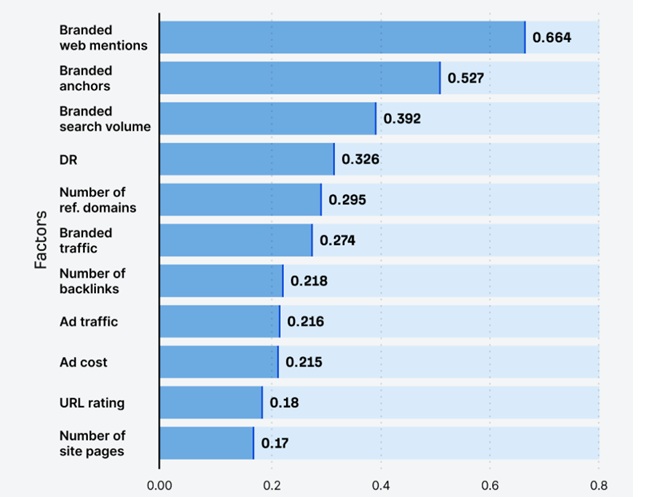
The usual caveat applies loudly here. Correlation is not causation, and the effect sizes are moderate at best, but the pattern lines up neatly with how retrieval works.
So the work looks less like link building and more like public relations:
- Get quoted in the outlets and newsletters your buyers read
- Go on the podcasts they listen to
- Publish a number or a benchmark other people will cite
Crucially, you should also show up in the roundups and the “best tools for X” posts because those are exactly the pages an engine pulls from when someone asks for a shortlist. Every clean mention of your brand next to your category is a vote the models can count.
If you get named in one well-read “best tools” roundup, quoted once in a trade newsletter and mentioned in a few active forum threads, you already have three trusted sources feeding the same brand signal, and that sure beats a month of link swaps.
To get it right from the get-go, write content worth citing. That means clear, direct answers near the top of the page, firsthand expertise, original numbers and quotable lines an engine can lift in one clean sentence.
If a human skimming your page cannot find the answer in five seconds, neither can a machine… Vague, hedged, keyword-stuffed pages give a model nothing to grab.
The community angle matters too. Since the engines lean on Reddit, forums and Q&A sites, a genuine, helpful presence in the communities that discuss your category earns you real estate on the exact pages AI cites most.
The importance of entity clarity
Search engines and AI models do not think in keywords. They think in entities, the real-world things a name maps to. Google has described this as understanding “things, not strings” since it launched the Knowledge Graph.
If a model cannot tell that “Acme”, “Acme Inc” and “acme.io” are the same company, it cannot confidently reach for you. Entity clarity is how you become a distinct thing worth citing rather than an ambiguous string.
Yes, the work is unglamorous, but it pays off:
- Describe your brand the same way everywhere, using name, category, founding facts and a one-line description that stays consistent across your site, your profiles and your listings.
- Earn a Wikipedia or Wikidata presence if your notability genuinely supports it.
- Give your homepage and about page a clear, factual account of what you are so the model has a clean source to anchor to.
Think of it as making yourself easy to introduce. If a stranger could summarize your company in one accurate sentence after ten seconds on your site, an AI can too.
Small inconsistencies do real damage. A different founding year on Crunchbase, a stale category on LinkedIn and a nickname in your own footer all blur the entity. Pick the canonical facts once and make every profile match them.
Structured data, llms.txt and crawler access
This is the section where people overspend effort chasing things that do not move the needle. Luckily, I can help you save some precious time; there are three key considerations:
1 – Don’t expect too much of structured data
Don’t get me wrong: you should continue to add schema markup where it fits, because it earns rich-result eligibility and helps machines parse your page. Just do not expect it to be a ranking lever.
Google is explicit that there is no special schema you must add to appear in AI Overviews or AI Mode. Structured data helps a machine understand a page. It does not, on its own, make you rank or get cited.
2 – Treat llms.txt as optional, not magic
llms.txt is a proposed file that tells AI crawlers where your clean content lives, and I’ve written about it before. The format is certainly worth understanding. Once more, though, you should curb your expectations.
Google’s John Mueller was asked whether Google’s own llms.txt files signal an endorsement and answered, “to be direct, no“. No major AI provider has confirmed using it. Add it if it is cheap. Do not build a strategy on it.
3 – Do not block the crawlers you want
The one accessibility mistake that actually costs you is blocking the AI crawlers you would like citations from. Check your robots rules and your bot management and make sure the engines you want to appear in can reach your content.
Go multi-format while you are at it. Images, video and a real YouTube presence feed the multimodal answers these engines increasingly build, and a video can be cited where a text page cannot.
How to measure LLM visibility
Here is the catch nobody warns you about: AI visibility is genuinely hard to measure, and most of the analytics you rely on will lie to you about it.
What to actually track
Track three things:
- Are you mentioned in answers for the prompts that matter?
- Are you cited (i.e., are you actually linked as a source)?
- What does the AI say about you?
The rollup metric worth watching is share of voice, your slice of brand mentions across a fixed set of prompts compared to your competitors. It is the closest thing to a rank tracker this channel has.
Watch sentiment too, not just presence. Being mentioned dismissively is not the same win as being recommended. Track whether the answer frames you as the safe pick, a niche option or a cautionary tale.
How to track LLM visibility without fooling yourself
Start manual and free. Pick five to ten prompts a buyer would actually ask, run them weekly across ChatGPT, Gemini and Perplexity and log who gets mentioned.
That baseline alone tells you more than most dashboards. Do it for a month, and you will see which competitors own the answers you want.
Keep the prompt set boring and buyer-shaped. “Best X for small teams”, “X vs Y”, “is X worth it”, “alternatives to X”. Those are the questions with money behind them, and the ones you most want your name inside.
The next step is to fix your analytics, since the defaults hide AI traffic. MarTech reported that, as of mid-2026, Perplexity often shows up in GA4 as a referral, ChatGPT’s Atlas browser frequently strips the referrer so visits look like direct traffic and AI Overview clicks get counted as plain organic search.
Without a custom channel group, most of your AI-driven visits are hiding in buckets you already have. GA4’s defaults for this keep changing, so confirm the current behavior when you set it up.
| Where AI traffic hides in GA4 | How it usually shows up |
|---|---|
| Perplexity | Referral (perplexity.ai) |
| ChatGPT Atlas | Direct or (not set) |
| Google AI Overviews | Organic search |
Once manual testing shows a real gap, purpose-built AI visibility trackers exist to automate the monitoring across engines. CrowdReply is one of them, and there are several others worth comparing before you buy.
What to do when AI gets your brand wrong
At some point an AI answer will state something about your brand that is flatly wrong, and it will say it with total confidence. This is common, not an edge case, as shown by a Columbia’s Tow Center test of eight AI search engines:
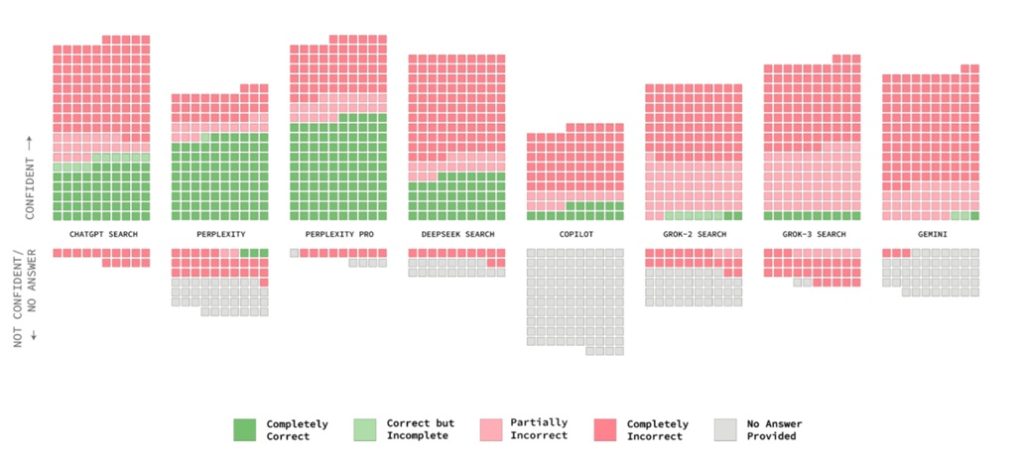
The eight popular AI search engines returned incorrect citations more than 60% of the time. Sure, models have improved since the study was published in early 2025, but the lesson stands:
- If AI misattributes the news, it will misattribute your pricing, your features and your founding story!
You cannot edit the model, so what can you do when AI gets your brand wrong? Well, you can change what the AI reads.
Fix the facts on your own pages first, since those are the highest-trust source about you. Then strengthen the correct signal on the places AI leans on: reference sites, high-authority third parties and the profiles that describe your entity.
Get the right fact repeated consistently across enough trusted places, and the answer usually follows. A wrong answer is a fixable input problem, not a verdict.
The brand version is easy to picture. An engine tells a prospect your cheapest plan costs twice its real price or credits a competitor with a feature you shipped first. Nobody flags it to you. The prospect just quietly goes elsewhere.
GEO, AEO, AI search… is it all LLM optimization?
Before wrapping things up, allow me to simplify the often-confusing AI-search “acronym soup”. LLMO, GEO, AEO and “AI search optimization” are different names for the same art form: getting cited in AI-generated answers.
GEO (generative engine optimization) is the academically coined term, AEO (answer engine optimization) leans toward featured snippets, voice search and direct-answer boxes. Despite some theoretical differences (find more in our AEO vs GEO comparison), they overlap almost entirely.
In practice, the same tactics you’d use in GEO optimization also apply to LLM optimization. So please don’t spend too much time thinking about the labels… Just pick the one your team likes and get the job done because the work is actually the same!
Frequently asked questions
What is LLM optimization?
LLM optimization (LLMO) is the practice of shaping your web presence so AI answer engines like ChatGPT, Gemini and Google AI Overviews mention and cite your brand.
What does the LLM model stand for?
LLM stands for large language model, the type of AI (ChatGPT, Gemini, Claude, etc.) trained on huge amounts of text to generate human-like answers.
Does traditional SEO still matter with LLMs?
Yes. Even though a number-one ranking is neither required nor enough to get cited, strong, crawlable, authoritative content (the type SEO pros are accustomed to) still helps.
How long does LLM optimization take to work?
Expect weeks to months, not days, because brand mentions and entity signals compound over time. Judge progress by the trend across a fixed set of prompts rather than a single snapshot.
Do backlinks still matter for LLMO?
They help, but unlinked brand mentions matter more for AI visibility. An Ahrefs study of 75,000 brands, for example, found that web mentions correlated far more strongly with AI Overview visibility than backlinks did.
Can small businesses benefit from LLM optimization?
Yes, and sometimes more than big brands. Entity clarity and niche authority are winnable without a huge budget, and being the clearest, most-mentioned source in a specific niche is very achievable at a small scale.
How do you fix it when AI states wrong facts about your brand?
You change the inputs, not the model. Correct your own pages first, strengthen the correct entity signal and get the right fact repeated on the sources AI trusts. Assume errors will happen and monitor for them, as AI engines get citations wrong often.
What tools track AI or LLM visibility?
Recommended AI visibility trackers include tools such as CrowdReply, Profound, Semrush and Peec AI.