TL;DR
- CrowdReply is the most accurate pick because it tracks daily across engines and lets you close the citation gaps it finds, not just chart them.
- The silver medal goes to Profound (best for enterprises) and the bronze medal goes to Peec AI (great value if you only need search monitoring).
- The real accuracy signal isn’t the headline percentage; it’s whether the tool shows its methodology, as the same prompt returns different answers run to run.
- Before you buy, run the same five brand prompts through your shortlist twice on the same day and compare (you can find the exact protocol below).
Every tool now claims to be the most accurate AI visibility software, but almost none of them will tell you what that number is measured against. I’m skeptical of big marketing claims, so I decided to collect the names of the 12 most popular AI visibility tools and test each one myself.
I compared the 12 tools on the accuracy of their metrics: sampling method, engine coverage, refresh cadence and whether they detect citations or just mentions. This is the most important thing I’ve learned from the experience: accuracy is about methodology, not the figure on the dashboard.
This made me even more convinced that CrowdReply, my own tool, happens to be the best for small- to mid-market teams. Moreover, it’s one of only three of the tested tools that actually pairs daily tracking with a way to act on the gaps. You don’t just see the metrics clearly; you also get to act on it!
The 12 most accurate AI visibility tools I tested
Here’s the whole set in one table so you can jump to whatever you’re shopping for:
| Tool | Best for | Engines tracked | Metrics reported | Refresh | Starting price |
|---|---|---|---|---|---|
| CrowdReply | Most teams (it measures and acts) | 2 to 7 (gated by tier) | Rank, score, citation source, SoV, sentiment | Daily, all tiers | $99/mo |
| Profound | Enterprise depth | Up to 10 (gated) | Mentions, citations, SoV, rank, demand | Daily | $99/mo |
| Peec AI | Value multi-engine | 3 of 7 (self-serve) | Mentions, URL citations, SoV, rank, sentiment | Daily | $95/mo |
| Ahrefs Brand Radar | Existing Ahrefs users | 6 (no Claude) | Mentions, citations, SoV, impressions | On-demand | From $199/mo |
| Semrush AI Toolkit | Semrush teams reporting | 4 base | Mention, citation, SoV, sentiment | Daily to monthly | $99/mo |
| Otterly.AI | Budget entry | 4 base (add-ons) | Mentions, citations, coverage, position | Weekly in practice | $29/mo |
| SE Ranking | All-in-one SEO suites | 5 claimed | Mentions, citations, SoV, rank | Weekly | +$79/mo add-on |
| Scrunch AI | Agent-experience action | 4 Core, 9 Enterprise | Answer share, citations, sentiment | Scheduled | $250/mo |
| Rankscale | Hands-on SEOs | 17+ (no gating) | Score, citations, SoV, sentiment | Hourly to monthly | ~$20/mo |
| ZipTie | Google AIO precision | 3 only | Mentions, URL citations, SoV, rank | Near real-time | $69/mo |
| AthenaHQ | Auditable data and action | 9 | Mention rate, citation rate, SoV, rank | Daily or weekly | $295/mo |
| EverTune | Enterprise statistical rigor | 10 to 11 | Brand index, SoV, sentiment, source influence | Daily | $800/mo |
I ranked these on the accuracy of the metrics, not the marketing:
- How they sample prompts
- How many engines do they actually track
- How often they refresh
- Whether they can tell a citation from a mention
Pricing is the current vendor figure, but keep in mind it may change from week to week. Engine counts flag where coverage is gated behind a higher tier, since that quietly bounds the cross-engine picture you get.
1. CrowdReply: best overall

CrowdReply is the pick for the mid-market team that needs to measure AI visibility accurately and then do something about it. It’s the tool I’d hand to a marketing lead tired of watching a number they can’t move.
I recommend it as the overall best AI visibility software, especially for mid-market B2B SaaS teams that need accurate daily measurement and a workflow to close the gaps.
What it tracks:
Rank shifts, a visibility score, citation-source intelligence at the domain level, share of voice against competitors, prompt-trigger frequency and sentiment. This means you see both whether the answer named you and which sources the engine pulled from.
How accurate it is:
Very accurate. Prompts refresh daily on every tier (not just the expensive one) and the citation-source data means you’re measuring the real primitive instead of a mention proxy.
Where it falls short:
The honest caveat is engine coverage, which is gated by tier. Starter tracks 2 chosen models and the full 7-engine picture is Enterprise-only, so a lower tier sees a narrower view.
The surface is also broad, running visibility, social listening and a new backlinks feature simultaneously. In other words, CrowdReply isn’t a single-purpose analytics microscope (which isn’t always bad).
Pricing:
Starter is $99/month, Growth is $299 and Enterprise starts at $499. There’s a 7-day trial on Starter. You can read the full breakdown on the CrowdReply features page.
2. Profound: best for enterprise depth
Profound is the polished enterprise option, with the broadest engine coverage in the category and pricing to match.
Enterprise and large ecommerce teams with budget, analytics staff and procurement needs like SOC 2 – does this sound like you? If so, Profound is a great fit. If you’re a solo freelancer, lean startup or small team, I recommend looking elsewhere.
What it tracks:
Brand mentions, source-level citations, share of voice, rank, sentiment and a demand-side Prompt Volumes metric. It’s the deepest analytics surface here.
How accurate it is:
Solidly accurate. It runs structured prompts across engines daily, and the prompt-level insights are effective. Prompt Volumes is modeled panel data, so treat it as directional.
Where it falls short:
It’s the most expensive tool in class, and the value gap shows: 4.5/5 on G2, even though hands-on reviewers landed nearer to 3.1/5 for SaaS use. The dashboard also won’t tell you what drove a score change.
Coverage is heavily gated though: Starter is ChatGPT only and the full engine set is Enterprise-only.
Pricing:
$99 Starter, $399 Growth and custom Enterprise, billed annually.
3. Peec AI: best value multi-engine

Peec AI is the clean, fast tracker most SMBs and agencies land on after pricing out the enterprise options. It’s monitoring-only, though…
If I had to describe the perfect Peec AI users, I would say SEO agencies and in-house teams treating AI search as a real channel who already have someone to act on the data.
What it tracks:
Mention count, citation data at the source and URL level, share of voice, average position and sentiment. The sentiment and URL-level citation detail are the best I’ve used at this price.
How accurate it is:
It’s impressively accurate. Peec AI scrapes the assistants’ own web interfaces rather than the model APIs, so you get something close to the real-user view. That’s a genuine accuracy edge.
Where it falls short:
The main catch? It’s monitoring, not optimization… There’s no site audit, no fix list and no traffic attribution. Paying more buys prompts and projects, not more engines.
Moreover, there’s a hard 3-of-7 engine cap on every self-serve tier and no historical backfill, so monitoring only starts the day you sign up.
Pricing:
$95 Starter, $245 Pro and $495 Advanced, with extra engines as paid add-ons.
4. Ahrefs Brand Radar: best for existing Ahrefs users
Brand Radar is less a tracker than a research database, and it’s a natural add for teams already living in Ahrefs.
If you don’t own Ahrefs yet, I wouldn’t recommend Brand Radar due to the high cost (it’s an add-on, meaning it requires an Ahrefs subscription). Nevertheless, it’s an excellent AI visibility software.
What it tracks:
AI mentions, citations, share of voice, impressions over time and cited domains and pages, all backed by 406M+ indexed prompts drawn from real search demand rather than synthetic queries. That’s pretty good!
How accurate it is:
Moderately accurate. The search-backed prompt database is the biggest here, a real strength for competitive research.
The accuracy caveat is significant, though: the keyword-based model misaligns with conversational prompts and underreports mentions, especially on ChatGPT and Perplexity. It’s a research engine, not a scheduled tracker.
Where it falls short:
No Claude coverage, per-domain pricing that doesn’t scale for agencies and no optimization workflow.
Pricing:
From $199/month for a single AI index, $699 for all platforms, priced per domain. Don’t forget, though: it’s an add-on!
5. Semrush AI Visibility Toolkit: best bolt-on for Semrush teams
The Semrush toolkit is the easy add-on for teams who need client-ready AI share-of-voice reporting without leaving Semrush.
Agencies already in Semrush who need client-facing AI reporting without adopting a separate platform should definitely get the AI Toolkit. Otherwise, it’s the Ahrefs Brand Radar dilemma all over again: the software is an add-on with huge entry costs.
What it tracks:
AI mentions, citations, sources, a share-of-voice score weighted by mention count and position, sentiment and an overall visibility score.
How accurate it is:
Questionably accurate. The honest limitation is that it runs simulated prompts rather than live user sessions, so the numbers are directional, not exact.
Semrush itself frames the data as strategy guidance and tells you to verify high-stakes findings by hand. For small or local brands, things can easily get volatile.
Where it falls short:
The simulated methodology, the 25-prompt cap and per-domain pricing all bite once you scale. It reports, but it doesn’t execute (consider CrowdReply for actionable AI visibility improvement features).
Pricing:
$99/month per domain for the base, with a 25-prompt cap and 4 engines. It also comes as an add-on to an existing Semrush plan.
6. Otterly.AI: best budget entry
Otterly is the price-transparent budget option, and it packs the deepest GEO audit you’ll find in the cheap tier.
Solo marketers and small teams who want fast diagnostics and a real GEO audit at an entry price will love Otterly.AI, but there are some cons to watch out for.
What it tracks:
Brand mentions, website citations, a Brand Coverage share-of-voice figure, average brand position and sentiment.
How accurate it is:
Surprisingly accurate. It scrapes full response text per prompt via Firecrawl and flags hallucinations and unlinked mentions, which is more than most budget tools bother with.
One thing to know plainly: Otterly markets a daily refresh, but in practice the data updates weekly (up to about seven days old). So, here’s my pro tip: plan around weekly.
Where it falls short:
No traffic attribution, the weekly lag despite the daily claim and a UX that reviewers and I both found cluttered – these are the most significant limitations.
Pricing:
This is where Otterly.AI gets sweet: $29 Lite, $189 Standard and $489 Premium, with Claude, Gemini and AI Mode as paid add-ons.
7. SE Ranking: best for all-in-one SEO suites
SE Ranking bolts AI tracking onto a familiar rank-tracker suite, so the adoption cost for existing users is near zero.
I fully recommend SE Ranking to agencies and SMBs already in, or shopping for, an all-in-one SEO suite whose main goal is to rank in AIO.
What it tracks:
Brand mentions, linked and unlinked citations, share of voice, average rank in the answer and citation trends. They also have a modeled AIO traffic value.
How accurate it is:
Moderately accurate. The monitoring is UI-based and captures responses as a real user sees them, which is good.
Two caveats, though: the traffic numbers are modeled, not measured, so they won’t reconcile with GA4, and engine coverage trails the pure-plays, with several still on the roadmap.
Where it falls short:
There are at least three things I don’t like about SE Ranking: the confusing split across the suite add-on and standalone versions, the roadmap gaps on engines and the weekly refresh.
Pricing:
Pricing is not bad, but far from ideal. AI tracking is a paid add-on (that’s the con) at roughly +$79/month on top of a base suite plan.
8. Scrunch AI: best for agent-experience action
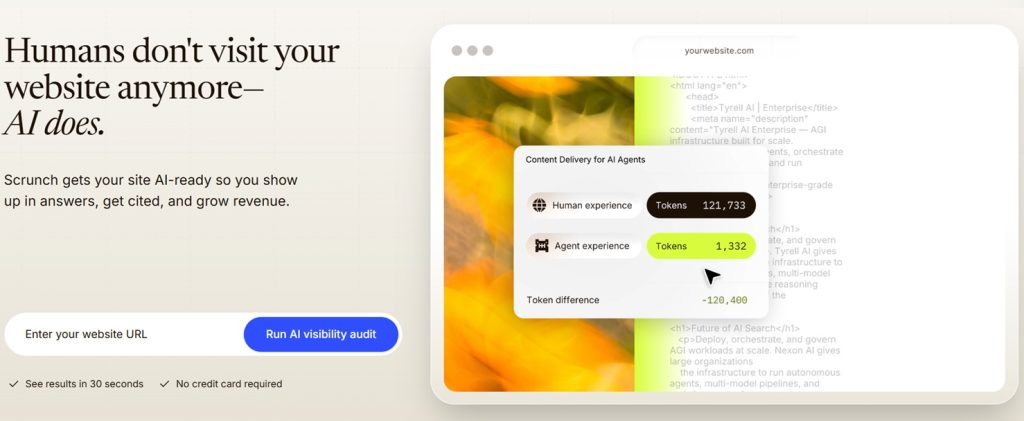
Scrunch AI is one of the few pieces of software that doesn’t just watch your visibility, but also improves it (a bit like my own tool, CrowdReply). It pairs monitoring with an action layer that feeds agents optimized content at the edge, so it isn’t a pure monitor.
It ranks lower than expected because it’s not an ideal solution for mid-market teams. It’s designed for enterprise and agency teams that want monitoring plus a layer that makes their site readable to agents.
What it tracks:
Answer share, trends over time, prompt-level detail, sentiment, citations and AI agent traffic. The distinctive piece is the Agent Experience Platform, which detects AI crawlers and serves them optimized content.
How accurate it is:
Questionably accurate. Scrunch leans on inferred prompts rather than live LLM-session prompts, so the data can feel smarter than it strictly is.
If real-session coverage matters to you, confirm it with Scrunch directly before you commit. The company also appears to be mid-transition, so check the current product state.
Where it falls short:
High entry costs (there’s no entry-level option), complex setup (especially for beginners) and zero features for improving content.
Pricing:
$250/month for Core, custom for Enterprise, with the full 9-engine set and the AXP action layer gated to Enterprise.
9. Rankscale: best for hands-on SEOs
Rankscale is the tool for professionals who want the raw data underneath the graphs and don’t need engine gating at all. This is why I recommend it to hands-on SEOs, but only if they are comfortable interpreting raw output-side data and running manual prompt tests.
The credit system is the main thing preventing me from ranking Rankscale a little bit higher. It’s a pity because the tool has great model coverage and perfectly fits the needs of teams tackling both SEO and GEO.
What it tracks:
A visibility score, mention presence and position, citations at the source and page level, share of voice and sentiment across brand, topic and model.
How accurate it is:
Moderately accurate. It’s output-side only, querying engines and capturing the full response per prompt across 17+ engines with no gating.
The strength is the single-query drill-down and schema audits tied to underperforming prompts; the limitation is that output volatility is unnormalized, so you do the interpretation yourself.
Where it falls short:
No input-side crawler visibility, recommendations only with no in-platform publishing and credit burn that scales fast.
Pricing:
Credit-based at roughly $20 Essentials, $99 Pro and $385 Growth. Currency reads ambiguously between dollars and euros, so please confirm at checkout.
10. ZipTie: best for Google AI Overview precision

ZipTie is a precision play on one engine: it detects Google AI Overviews at the browser level rather than approximating them through an API.
SEO teams whose number-one priority is Google AI Overview accuracy should definitely consider this tool, but its tracking for Perplexity, ChatGPT and four other models is not at the same level.
What it tracks:
Mentions, URL-level citations that inspect the cited pages, share of voice, placement, sentiment and a composite AI Success Score.
How accurate it is:
Surprisingly accurate, and I have the data to back that claim. This is its whole pitch, and it’s a real one:
Browser-level live-render detection catches AI Overviews that API-based tools miss. Publicly-available benchmarks put ZipTie at 28% AIO detection; meanwhile, some competitors hit as low as 1.6%…
The limitation is a Search Console dependency that opens discovery gaps on long-tail and new domains.
Where it falls short:
It’s far from a complete GEO solution despite the excellent accuracy and Google AIO coverage.
Pricing:
$69 Basic, $99 Standard and $159 Pro, where one check queries all available engines.
11. AthenaHQ: best for auditable data and action
AthenaHQ is a clean self-serve command center for AEO and GEO with a genuine action layer, held back mainly by its price floor.
Here’s the gist: you should consider AthenaHQ if you’re a mid-market brand where GEO is a real budget line, especially if you’re looking for measurement + action in one software.
What it tracks:
Mention rate, citation rate, share of voice, average position, sentiment, content gaps and hallucination detection.
How accurate it is:
Satisfyingly accurate. Since every AI response is stored in full and auditable, you get the actual captured text, not an estimate.
The caveat is that headline share of voice is prompt-set dependent and the auto-generated prompts flatter the tracked brand. Use it for trends, not absolute rankings.
Where it falls short:
The $295 floor with no mid-tier, the credits that drain fast and the heaviest optimization gated to Enterprise. This is what separates AthenaHQ from the two other actionable tools in the list, CrowdReply and Scrunch AI.
Pricing:
A free evaluation tier, then a $295/month Starter with no middle option, then custom Enterprise.
12. EverTune: best for enterprise statistical rigor
EverTune’s accuracy pitch is statistical rigor, and it’s built for enterprise brands in high-consideration categories. That includes, for example, enterprise teams in categories like auto, healthcare and B2B software.
EverTune was not included in my article about the best AI visibility tools, but I could never let it out of a list that prioritizes monitoring accuracy. Unfortunately, it misses out on entry-level plans and a free trial.
What it tracks:
A composite AI Brand Score, brand mentions and recommendations, share of voice, sentiment and source-influence analytics that go beyond counting citations.
How accurate it is:
Satisfyingly accurate. Each prompt is sampled 100 times per model for statistical significance, and it runs a dual-layer method: base-model API data plus a daily consumer-app panel.
The caveat, raised even by a competitor, is that base-model output can diverge from what real users see, and the consumer panel is small against global AI usage.
Where it falls short:
No self-serve, the $800 floor (this is the big one IMO), limited prompt-by-prompt granularity and no advertised SOC 2.
Pricing:
$800/month for Pro, custom for Enterprise, with no free trial and demo-only access.
So, what’s the right AI visibility software for you?
Before telling you more about the ins and outs of AI visibility metrics and how you can test a tool’s accuracy yourself, here’s a straight-to-the-point rundown of the best tools I tested (and who actually needs them):
- You’re a default mid-market team that needs accurate measurement and a way to move the number: start with CrowdReply.
- You’re an enterprise-only team with a high budget and procurement: look at Profound or EverTune.
- You’re looking for pure monitoring on a budget: Otterly.AI or Peec AI.
- You’re already using Ahrefs or Semrush: easy – go for Brand Radar (Ahrefs) or AI Toolkit (Semrush).
- You’re all about Google AI Overviews: try ZipTie.
- You’re a hands-on SEO professional looking for the raw output data: Rankscale has got you covered.
Pick according to the decision you need to make, not the biggest number on the pricing page. Remember: a tool that measures beautifully but leaves you nothing to do is half a purchase.
What makes an AI visibility metric accurate (everything you need to know)
Accuracy isn’t the number on the dashboard. It’s whether the tool controls for how these models actually behave, and most of the category quietly assumes behavior that doesn’t hold. That’s why it’s important to tackle some misconceptions.
There are at least three things I see people getting wrong all the time:
1. Mention, citation, share of voice and rank are four different metrics

Two tools can both claim to measure your AI visibility and be measuring completely different things. Being cited and being mentioned by name diverge more often than they agree.
In one Semrush study, 62% of brand appearances were ghost citations (i.e., instances where the page was used as a source but the brand name never appeared in the answer text). On the other hand, only 13% were both cited and mentioned, which is the most desirable outcome. It’s easy to see how this can misguide GEO operations.
To make things even trickier, different models have different citation behaviors. ChatGPT, for example, cited brands far more than it named them, whereas Gemini named brands far more than it linked a source.
Where the sources come from matters just as much. No engine leans on a single page. Ask about one brand and the answer still gets stitched from that brand’s own pages plus Reddit, Wikipedia and news. A tool tracking one engine only sees one slice of that mix, and a share-of-voice score built only on mention detection misses every ghost citation.
This means that you should match the metric to the decision you’re making; to do so, you need to understand what separates mentions, citations, share of voice, and rank. This is the simplest way I found to quickly describe them:
- Mentions: measure how often your brand is referenced by an AI model, regardless of whether it links to or recommends your website.
- Citations: measure how often an AI model explicitly attributes information to your website or content as a supporting source.
- Share of voice: measures what percentage of all brand mentions or citations in a set of AI responses belong to your brand compared with competitors.
- Rank: measures the position in which your brand, citation, or recommendation appears within an AI-generated response, with higher placements generally receiving more visibility.
Now that we got that out of the way, it’s time to consider the most volatile aspects of AI search monitoring.
2. You can run the same prompt twice and get different answers
Same prompt, same model, and two different answers? That’s not a bug in the tracker; it’s how production systems work.
The main driver isn’t floating-point math on its own, but rather batch-size variation. As server load shifts, requests get batched differently and the kernels running inference aren’t batch-invariant. Therefore, identical inputs can produce different completions (per Thinking Machines Lab).
The thing to remember? A tool that runs each prompt once is measuring a single sample of a noisy process… Sample size and repeated runs beat one snapshot every time.
3. There’s a randomness knob, and you can’t see it
There’s a deliberate randomness setting underneath AI visibility metrics. After all, models pick each word by sampling from a ranked list of candidate tokens. They use a setting called temperature to decide how adventurous that pick is.
Thanks to OpenAI’s official documentation, we do know one or two things about this randomness knob; for example: lower values stick to the most probable tokens and repeat more, while higher values widen the pool.
Here’s the catch, though: the consumer chat apps a tracker is hitting don’t expose the knob. A tool querying ChatGPT or Gemini through the front end can’t fix the decoding setting. This means its sampling design (i.e., how many prompts and how many runs) is ultimately what decides whether the number means anything.
How to audit any tool’s accuracy yourself
Don’t trust the headline accuracy number. Here’s the repeatable test I run first, and it only takes an afternoon:
- Pick 5 to 10 real buyer prompts. Real buyer prompts are the actual questions your customers would ask, not your brand name on its own.
- Run each one through the tool and by hand in ChatGPT, Perplexity and Gemini on the same day. Compare what the tool reports against what you see.
- Run the same prompts twice on the same day. If the tool’s numbers swing wildly between runs, it isn’t sampling enough to be stable.
- Check whether it caught the ghost citations, the answers that used your page as a source without naming you. A tool that only counts named mentions will miss them.
- Re-check weekly and watch the trend, not the snapshot.
That weekly cadence isn’t arbitrary. BrightEdge found that 96.8% of cited domains showed zero week-over-week change; when a domain did move, it showed a decline 87% of the time. The set is stable enough that daily churn is mostly noise – weekly catches the abrupt drop that actually matters.
One more thing to demand: the methodology. If a vendor won’t show you the sample size and the prompt set behind an accuracy claim, they’re offering you pure marketing instead of accurate AI visibility metrics.
Why ranking #1 on Google doesn’t buy you an AI citation
I explore this in detail in my AEO vs SEO guide and a few other previous articles, but I believe it’s important to reiterate why even the best Google rankings do not necessarily translate into AI citations.
First, there’s how engines pick their sources. Google says the links under an AI Overview point to pages that “support the information,” and that any page eligible for a normal search snippet can appear. It also fires off multiple related searches (a process known as query fan-out) to pull a wider set of sources than classic search would.
Then, the correlation. Being number one on Google moves the needle on AI citation surprisingly little. Kevin Indig’s analysis found almost no relationship between search rank and AI Overview citation. He also stated that none of the classic SEO metrics have strong relationships with citations.
If you spot any roundups reporting a strong correlation between some proprietary score and citation rates, treat it as a vendor-model artifact, not a finding. The independent read points the other way, so be wary of any tool whose headline score is really a repackaged SEO metric wearing a new label.
Methodology: how I tested these 12 tools
I looked at the 12 tools teams actually shortlist in this category as of mid-2026, from enterprise platforms down to budget monitors, focusing on the names that keep coming up in real buying conversations.
I judged each one on the accuracy of its metrics:
- The sampling method
- How stable the numbers were run to run
- Engine and model coverage
- What’s gated behind higher tiers
- Which primitives it reports (mention versus citation versus share of voice versus rank)
- Refresh cadence
- Pricing transparency
The approach was hands-on. I signed up where a trial existed, ran the same buyer-prompt set through each tool, cross-checked the results by hand in ChatGPT, Perplexity and Gemini, ran prompts twice to see the variance and walked each dashboard and read the pricing tier by tier.
Every tool was judged against the same buyer profiles. Since testing was focused on accuracy, the best-for call reflects where its accuracy and coverage actually landed, not what its homepage promised.
FAQ
What is the most accurate AI visibility metrics software?
CrowdReply is the most accurate choice because it tracks daily across engines and reports citation-source data rather than just mentions. Profound goes deeper for enterprise buyers with the budget for it, whereas Otterly.AI and Peec AI are the most accurate low-budget picks.
How is AI visibility accuracy measured?
Accuracy comes down to four things: how the tool samples prompts, how it handles the fact that the same prompt varies run to run, how many engines it covers and whether it detects citations or only named mentions.
What is the difference between a brand mention and a citation?
A citation is when an engine uses your page as a source for its answer. A mention is when the answer says your brand name in the text.
Do free AI visibility tools give accurate data?
Free tools are fine for a first look, but they rarely publish their methodology, so verify anything important by hand. When a tool won’t show its sample size or prompt set, treat the “accuracy” figure as marketing.
How often should I re-check my AI search visibility?
Weekly is enough for most teams. The cited set for any given engine is fairly stable week to week, so daily checking mostly shows you noise. Watch the trend line over several weeks and pay attention to sharp drops. When a domain loses a citation, it usually loses it abruptly.
Do I need a separate tool if I already use Semrush or Ahrefs?
Their AI bolt-ons are convenient and cheap to switch on, but both lean on simulated or research-database methods that are more limited than a dedicated tracker. If AI search is a genuine priority, a purpose-built tool will be more accurate.
How do I check if my brand shows up in ChatGPT and Perplexity?
Open each assistant and ask the real buyer questions your customers would ask, not your brand name on its own, then note whether you appear and whether you’re cited or just named. Run it twice to see how much the answer moves.