By Dawood Khan, Founder of CrowdReply.
TL;DR
- I tested 8 tools on price, engine coverage and what they actually do about your visibility, with current 2026 pricing for each one.
- For most mid-market B2B SaaS teams, CrowdReply is my pick: the only tool here that gets you cited in the sources AI pulls from, not just charts the gap.
- Profound is my top recommendation if you’re looking for enterprise depth.
- Ahrefs Brand Radar and Semrush AI Visibility Toolkit are perfect if your team already uses one of the tools.
I’ve lost count of the AI visibility tools that turned out to be a dashboard and an invoice. You plug in your brand, watch a share-of-voice chart wobble for a month, and nothing about your visibility actually changes…
That’s why I tested the 8 tools people are actually shortlisting in 2026, ran the same prompts through each and ranked them by what they do after they tell you you’re invisible. The short answer is in the table below. The longer answer is that most of them stop at the dashboard.
Before that, a quick note on why AI visibility matters today:
AI visibility: why it’s suddenly worth paying for
AI visibility refers to whether and how AI engines name your brand when someone asks them a question. If your brand is positively cited in AI answers, your AI visibility is good; if not, the opposite applies.
AI visibility gets measured as a mix of citation share, how often you’re mentioned and the sentiment attached, across ChatGPT, Google AI Overviews, Perplexity, Gemini and Microsoft Copilot. But why is it suddenly worth paying for?
In 2026, users have stopped clicking ten blue links; they read the answer instead. If your brand isn’t in the answer, you’re missing out on profitable opportunities.
Why AI visibility stopped being optional in 2026

According to BrightEdge, AIO presence (i.e., the percentage of Google queries showing AI-generated summaries) grew from 31% to 48% between early 2025 and early 2026, holding steady above 40% since June 2025. The click-less shift isn’t a forecast anymore; it’s the present tense.
AI visibility stopped being optional for brands because the answer box eats your clicks. On queries where an AI Overview fires, organic click-through has collapsed (I’ve explored this in detail in my guide on how to rank in AI Overviews). This means that being the top blue link is no longer enough.
That’s where AI visibility comes in. Can you do it by hand? Well, sort of. You can open ChatGPT, ask it who the best tools in your category are and see if you show up. Manual checks are a good place to start, but… They are not the best long-term solution.
What you can’t do by hand is track that across five engines, every day, for your brand plus your competitors, and catch it the week your citation share quietly drops. That’s the job the tools I will cover below can help you with.
Do you also need AEO and GEO?
AI visibility, AEO, GEO… The naming is a mess, and it trips people up. But here’s the plain version: the terminology loosely applies to the same set of tactics, so you don’t need to worry about AI visibility and AEO/GEO. Allow me to clarify.
AEO stands for answer engine optimization, and it’s the term most marketers actually use. GEO stands for generative engine optimization, the academic label from a 2024 Princeton paper that showed you could measurably lift how often an AI answer surfaces your content.
There are differences between AEO and GEO, but they describe the same job: getting your brand to appear inside the answer. AI visibility, the umbrella most tool vendors slap on the category, is therefore yet another term that can be used to refer to AEO and GEO.
How I judged these tools (the 5 things that actually matter)
I reviewed the best AI visibility tools according to 5 essential criteria:
1 – Engine coverage
- Which models does the tool track?
- How many models do you get before the price jumps?
- Are the models covered relevant?
2 – Prompt volume and refresh
- How many prompts can you track?
- How often does the tool re-run them?
- Is the per-prompt cost fair?
3 – What it does after the dashboard
- Once a tool tells you you’re invisible, what does it hand you next?
- Is it monitoring-only, or can it help you increase your visibility?
- Can it perform on-site optimization and off-site execution?
4 – Pricing transparency
- Does the tool publish a number, or is it a sales call?
- How much do tiers cost?
- Is the tool’s real cost buried behind an add-on?
5 – Sentiment and citation depth
- Can the tool tell you if you’re getting cited?
- Can it also tell you how you’re getting cited?
- Does it correctly list citation sources?
Summary of the 8 best AI visibility tools in 2026
Let’s start with a quick use-case read, mirroring how the answer engines themselves frame it:
- Best overall for teams that want to move the number: CrowdReply
- Best for enterprise depth: Profound
- Best bundled with a content workflow: Frase
- Best for sentiment and multilingual tracking: Peec AI
- Best cheap starting point: Otterly.AI
- Best if you already pay for Ahrefs: Ahrefs Brand Radar
- Best if you already live in Semrush: Semrush AI Visibility Toolkit
- Best for Google AI Overview audits: ZipTie
Table 1 summarizes the main differences between the 8 tools:
| Tool | From (per month) | Engines tracked | What it does about it | Best for |
|---|---|---|---|---|
| CrowdReply | $99 | 7 (choose 2 to all 7 by tier) | Off-site execution: gets you cited, fixes hallucinations | Mid-market teams that need to move the number |
| Profound | $99 (billed yearly) | Up to 10 (1 on Starter) | On-site content agents | Enterprise depth |
| Frase | $39 (billed yearly) | 2 to 8, tier-gated | On-site content optimization | Content teams |
| Peec AI | $95 | 3 below Enterprise | Monitoring only | Sentiment tracking |
| Otterly.AI | $29 | 4 (extras cost more) | Light advisory audits | Cheapest start |
| Ahrefs Brand Radar | ~$828 effective | 6 (Google-skewed) | Monitoring only | Existing Ahrefs teams |
| Semrush AI Toolkit | $99 add-on | 5 to 6 (more on Enterprise) | Monitoring plus generic recs | Existing Semrush teams |
| ZipTie | $69 | 3 | On-site optimization briefs | Google AI Overview work |
Since editorial pricing for these tools is all over the place and half of it is stale, table 2 shows what each one actually costs to start as of mid-2026:
| Tool | Entry price | Prompts at entry | Note |
|---|---|---|---|
| Otterly.AI | $29/mo | 15 | Extra engines are paid add-ons |
| Frase | $39/mo (yearly) | 50 | AI visibility bundled, not an add-on |
| ZipTie | $69/mo | 500 checks | Single seat on every standard plan |
| Peec AI | $95/mo | 50 | EUR-based, 3 engines below Enterprise |
| CrowdReply | $99/mo | 20 | Engagement credits bundled per tier |
| Profound | $99/mo (yearly) | 50 | Starter is ChatGPT only |
| Semrush AI Toolkit | $99/mo | 25 | Sits on top of a Semrush plan |
| Ahrefs Brand Radar | ~$828/mo effective | 2,500 checks | $129 base plus a $699 add-on |
Now, let’s take a closer look at each of these tools individually.
1 – CrowdReply: best for teams that need to move the number, not just watch it

CrowdReply is the one tool here built to close the visibility gap off your own site, not just report it. If you’ve already confirmed you have a problem and the question is now “how do we actually fix it,” this is where I’d start.
The tool tracks where AI recommends you, daily, across up to seven engines, then hands you the workflow to change the answer. The tracking half looks like everyone else’s, displaying share of voice, competitor leaderboards, sentiment and which sources feed each answer.
The other half is what nobody else ships… What’s different about CrowdReply is that, when I set up a brand and its three closest competitors, the citation-gap view showed me the exact Reddit threads and editorial pages the AI was pulling from to recommend the competitors and not me.
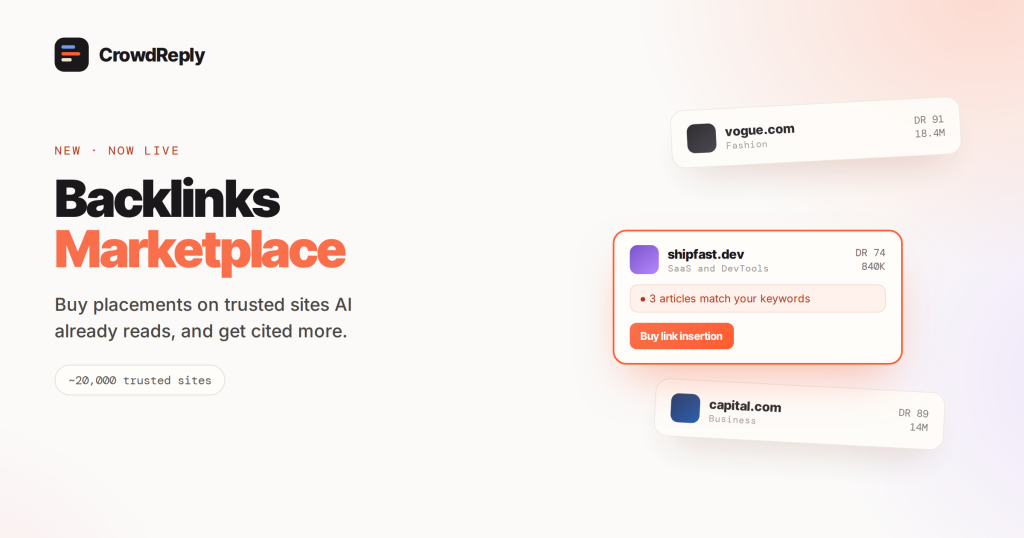
CrowdReply’s Engagement Engine places your brand into those conversations through platform-native accounts. The Backlinks Marketplace sources and places editorial links for you. The Brand Knowledge Fixer works a hallucination about your brand until the AI’s answer updates.
That’s off-site execution. Everyone else optimizes the pages you already own.
The pro:
CrowdReply goes beyond the obvious, and the whole loop lives in one place. I could see a gap, order the fix and watch the citation change without exporting a CSV into three other tools.
The con:
CrowdReply isn’t as established as other tools. It’s been scrutinized by far fewer public reviewers than Profound or Peec, for example, which have had a year longer under the microscope.
The price:
Starter is $99/mo, Growth is $299/mo and Enterprise starts at $499/mo, with engagement credits bundled into every tier and the engine count scaling from two up to all seven.
Who needs it:
Mid-market B2B SaaS growth and SEO teams that wand to act on citation gaps in-house rather than hand them to an agency. If that’s you, start here.
2 – Profound: best for enterprise depth and multi-engine tracking
Profound is the polished, well-funded enterprise option, and it’s the one I’d send a Fortune 500 marketing team to. The tracking is deep, the engine coverage is the widest in the set and it now ships a real content-action layer on top.
Consider it for tracking, though, not content optimization. Profound’s Agents feature drafts and publishes AEO content, so it isn’t a pure dashboard. That action, though, is on-site content generation. It writes copy for your own pages, but it doesn’t get you cited somewhere else.
The pro:
The multi-engine tracking goes wide, up to ten engines on the top tier, and the competitor benchmarking is genuinely strong. You can see which sources feed a rival’s citations and diff them against yours.
The con:
The cost-per-prompt is high and the learning curve is steep.
The price:
Starter is $99/mo billed yearly but only watches ChatGPT with 50 prompts, and you’re at $399/mo before you get three engines.
Who needs it:
Enterprise and agency teams with a real budget and an existing content team to feed the Agents. If that’s not you, Profound is simply too much.
3 – Frase: best for folding AI visibility into a content workflow
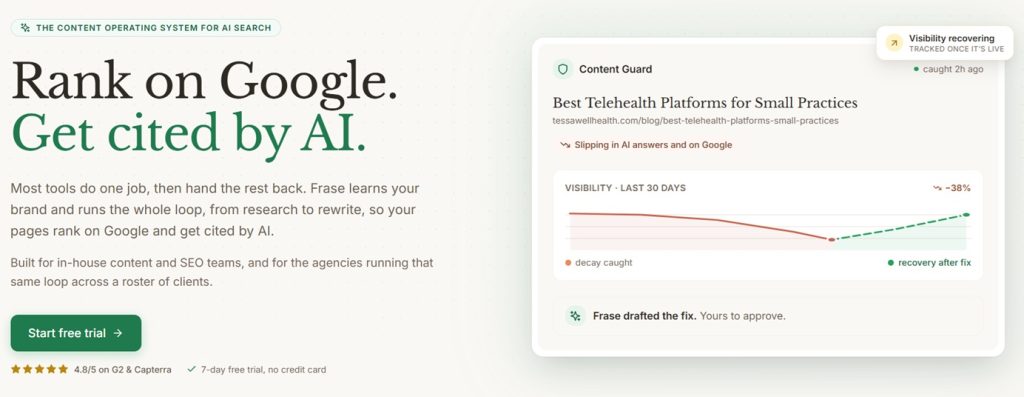
Frase is the interesting one for content teams, because it bolts AI visibility tracking onto a content-optimization platform you might already want anyway. Its whole pitch is monitor and fix in one workflow, and the fix is on-site content.
You get share of voice per prompt, the actual answer text and competitor benchmarking, sitting right next to the editor where you brief and write. The internal-linking suggestions were also accurate against real site content when I tested them.
The pro:
The AI visibility tracker is bundled into the base plan instead of sold as a separate $95-a-month add-on, which is genuinely good value at the entry price.
The con:
Frase’s AI drafting is where it gets shaky. The Write step gives you a fast first draft, but the citations it inserts often point at sources that don’t quite match or don’t exist. Fact-check every one before you publish.
It sits at 4.8 out of 5 across 300-plus reviews on G2, so content teams clearly like it, but it’s on-site optimization start to finish. It never touches the outside sources.
The price:
Starter at $39/mo, Professional at $103/mo and Scale at $239/mo.
Who needs it:
In-house content and SEO teams that want visibility tracking living inside the tool where they already research, brief and write.
4 – Peec AI: best for sentiment and multilingual monitoring

Peec AI is the cleanest pure-monitoring analytics tool in the set, and it’s the one I’d hand a data-minded SEO team that wants a tidy dashboard and nothing they didn’t ask for. It’s Berlin-built and the sentiment work is the best here.
The pro:
The brand-mention sentiment scoring is a real strength, not a checkbox. It tells you how the models talk about you, not just whether. Multilingual and country-level tracking come with no geo surcharge, setup took me about half an hour and seats are unlimited on every tier.
The con:
Peec AI stops at telling you where you stand. There’s no execution and no fix layer, just advisory tips. You get three of seven engines below Enterprise, Claude is locked to the top tier and there’s no traffic or lead attribution even on paid plans.
The honest way to put it: the tool answers “where do we stand” very well and leaves “what do we do about it” to your team.
The price:
Pricing is public at $95, $245 and $495 a month, EUR-based, with Enterprise custom.
Who needs it:
Mid-market and agency teams that want strong sentiment and multilingual monitoring and already have people in-house to act on the data.
5 – Otterly.AI: best for the cheapest honest starting point
Otterly.AI is the tool I recommend to founders who have never tracked AI visibility before. It’s cheap, it’s transparent and it’s low-commitment. In short, the right way to start.
The pro:
The interface is clean, setup is fast and the GEO Audit it produces is a genuinely useful SWOT of where you stand.
The con:
Otterly.AI advises, it doesn’t execute. You get audits, recommendations and content briefs, but nobody is building anything for you…
Prompt caps are low, extra engines beyond the core four are paid add-ons that quietly drift your bill up, and it isn’t built for agency or multi-brand work. Most teams outgrow it within a couple of quarters.
The price:
At $29/mo for the Lite tier, there’s almost no financial risk to running your first baseline. Standard is $189/mo and Premium is $489/mo, all published, with a 15% annual discount.
Who needs it:
Solo founders, freelancers and small in-house teams on a tight budget who are new to this and have the capacity to act on the insights themselves. If that’s you, it’s the easiest yes in the category.
6 – Ahrefs Brand Radar: best if you already pay for Ahrefs
Brand Radar is the strongest pick if Ahrefs is already in your stack. It’s a research-database read on AI visibility that sits right inside Site Explorer, next to your SEO data, and the trend history is better than the dedicated tools.
The pro:
The prompt database is search-backed, built from real query data, so the false-positive rate is low. You get historical trends, which most dedicated trackers can’t give you yet, plus mention tracking across YouTube, TikTok and Reddit sources that the pure-play tools skip.
Moreover, seeing AI and SEO data in one pane is convenient.
The con:
The data skews hard toward Google AI Overviews, with thin ChatGPT and Perplexity coverage and no Claude or Grok tracking at all. And the metrics can shift retroactively when the index rebuilds.
One long-term user put it bluntly on G2: every index update changes the historical view, so tracking progress over time gets unreliable. It’s monitoring only.
The price:
Unfortunately, the real cost is buried. Brand Radar isn’t standalone, so full access runs around $828 a month once you stack the $699 add-on on top of a $129 base plan.
Who needs it:
Teams already inside Ahrefs who want a directional read on AI visibility, especially on Google surfaces, plus trend history for leadership, and can absorb the add-on cost.
7 – Semrush AI Visibility Toolkit: best if your team already lives in Semrush
The Ahrefs logic also applies to Semrush AI Toolkit: it’s the convenient choice if your team already opens Semrush every morning. It folds AI visibility into the suite you’re already paying for, and the reporting is client-ready out of the box.
The pro:
Everything stays in one place, the dashboards are presentation-ready and the sentiment plus competitor benchmarking is solid across the major engines. Its Prompt Research feature is basically keyword research for AI, which is a smart reframe.
The con:
The data is simulated. It runs probabilistic prompts rather than real user queries, so the numbers are directional, not precise, and that showed when I compared them against what the models actually returned.
The AI-generated recommendations skew generic, the kind of “improve onboarding, increase awareness” advice that doesn’t tell you much. More than one reviewer has questioned whether it’s worth the extra $99 a month, and for a small or local brand with sparse data, I’d agree.
The price:
It’s a $99-a-month add-on per domain, billed annually, but that’s on top of your Semrush plan.
Who needs it:
Established brands and agencies already standardized on Semrush who want AI visibility folded into an existing workflow, with reporting they can hand a client.
8 – ZipTie: best for technical AI Overview audits

ZipTie is the indie tracker with the sharpest Google AI Overview detection, and it’s the one I’d give a technical SEO who lives in AI Overviews specifically. It renders results in a real browser instead of approximating through an API, and that accuracy shows.
The pro:
The AI Overview detection is the most accurate I tested, and you get the full answer, the citation set and a screenshot as downloadable evidence. Its content-optimization module turns each citation gap into a per-page brief, so it acts, on-site.
The con:
ZipTie only covers three engines, Google AI Overviews, ChatGPT and Perplexity, with no Gemini, Claude or Copilot. If you need multi-engine coverage, that’s a dealbreaker on its own.
The pricing is credit-based and single-seat on every standard plan, so it scales badly for an agency, and query discovery leans on Google Search Console, which leaves gaps for newer domains.
The price:
You can find transparent plans at $69, $99 and $159 a month.
Who needs it:
Solo consultants and small SEO teams focused on Google AI Overviews who want per-page optimization guidance, not just a chart.
Best AI visibility tools for agencies and freelancers
Agencies have a different problem than in-house teams. It’s not “is my brand visible,” it’s multi-client management, white-label reporting and per-seat economics that don’t blow up your margin. A few tools fit that shape better than the general picks:
AthenaHQ is the one the answer engines themselves keep naming for agencies, and it’s built for it. It’s a YC-backed GEO command center from ex-Google and DeepMind founders, with cross-engine tracking, source intelligence and dedicated agency pitch and reporting workspaces.
The catch is that it recommends, it doesn’t execute (you still send the outreach yourself). The generated content is the weak spot too, so I’d keep a human editing anything it drafts.
Mentioned above, Profound works for agencies with enterprise clients and the budget to match, thanks to its depth and multi-brand support.
Otterly.AI is the freelancer’s pick for single-client budgets. The honest gap across most of the category is that white-label, multi-client reporting is still thin, so agencies often end up stitching two tools together.
Other tools worth knowing about
None of these changed my top 8, but a couple are worth a look if your situation is narrow:
- EverTune is an enterprise GEO and AI-advertising platform with an unusually rigorous consumer-panel methodology and a retargeting path through The Trade Desk. Great for Fortune 500 brand teams, overkill for everyone else.
- Scrunch AI is a monitoring-first tracker with broad engine coverage, pitched at agencies, from around $250 a month.
- Rankscale is the cheap end, tracking 17-plus engines from about $20 a month, good for solo marketers.
- Conductor is an enterprise SEO platform that added an AEO layer and MCP-based agents, sales-led pricing.
- Clearscope is a content-optimization tool with AI-visibility features bolted on, better thought of as a writing tool than a tracker, from around $129 a month.
- Similarweb’s AI module ties AI mentions to real referral traffic, useful if you already pay for Similarweb.
How to choose the right AI visibility tool
Five questions is all you need:
- Are you measuring or moving the number? Then, any monitor above will do. If you’ve watched the dashboard for a quarter and the question is now “how do we actually move citation share,” you need off-site execution.
- What’s your budget and team size? Solo or tiny team under $50 a month, start with Otterly.AI. Mid-market with a real budget, CrowdReply. Enterprise ready for a sales cycle, Profound or EverTune.
- Are you already paying for Ahrefs or Semrush? If yes, start with their module, Brand Radar or the AI Toolkit, before you stack a second tool. You’ll know within a quarter whether you’ve outgrown it.
- Do you need category research or brand monitoring? If you want to study a whole category and its competitors without setting them up first, Ahrefs Brand Radar’s research database is the better shape. For your brand plus a few rivals, any focused tracker works.
- Are you an agency? Multi-client and white-label needs point to AthenaHQ or Profound, not the general-purpose trackers.
The final takeaway?
For the default mid-market team with a real visibility problem and the intent to fix it, three of those five questions land on CrowdReply. That’s on purpose. It’s the only one built for the fixing half.
Frequently asked questions
What is the best AI visibility tool?
CrowdReply is the best pick for most mid-market B2B SaaS teams because it’s the only tool in the category that executes off your own site to close the gap instead of just measuring it.
What are the best AI visibility tools for AEO?
For AEO specifically, the tools that help you appear inside the answer lead. CrowdReply executes off-site to get you cited, while Profound and Frase optimize your own pages toward AEO.
Do AI visibility tools fix problems automatically, or only report?
Most only report, and a growing few act, so it’s worth knowing which is which. Peec AI, Ahrefs Brand Radar and Semrush are monitoring-first. CrowdReply is the one that executes off-site, placing you into the third-party sources AI cites and fixing hallucinations end to end.
What is AI visibility?
AI visibility is whether and how AI engines name your brand in their answers. It’s measured as a combination of citation share, mention frequency and sentiment across ChatGPT, Google AI Overviews, Perplexity, Gemini and Microsoft Copilot.
How do AI visibility tools work?
AI visibility tools work by running a set of prompts against the engines you choose on a schedule, then pulling brand mentions, citations and sentiment out of each response. The better ones add competitor comparison and show which sources feed each answer.
How are AI visibility tools different from traditional SEO tools?
SEO tools rank your URL in a list of links, while AI visibility tools track whether your brand is named inside the answer, where there’s no list to climb.
How much do AI visibility tools cost in 2026?
AI visibility tools run from $29 a month at the low end up to $800 a month and beyond for enterprise platforms. Most dedicated trackers land between $95 and $499.
How can I get my brand cited by AI?
You get cited by building authority on the sources AI actually pulls from and fixing what it gets wrong about you. That means getting written about by real publications, showing up in community threads like Reddit, accurate structured data and corrections to any wrong facts about you.