TL;DR
- AEO and GEO are related, not identical. AEO optimizes so answer engines surface a direct answer to a question. GEO optimizes so conversational AI trusts, synthesizes and cites your brand.
- In simpler terms: AEO wants to be the answer and GEO wants to be the source the answer is built from.
- Contrary to public opinion, AEO and GEO aren’t replacing SEO. Studies show search rankings are still relevant in 2026.
- Measuring AEO and GEO is different from SEO. You should track citations in answer, not click-through rates.
- Pick the discipline that matches your goal, be the answer or be the source, then check whether AI answers cite you today before you optimize anything.
It’s easy to write off AEO and GEO as more acronym soup. Here’s the short version: AEO optimizes your content so answer engines hand back a direct answer, and GEO optimizes your footprint so conversational AI trusts and cites you. Both answer the same shift.
With more than 800 million people using ChatGPT every week, search is turning into answers and practices such as AEO and GEO are becoming more relevant than ever. This guide defines both, contrasts them with SEO, walks one query optimized two ways and shows how to measure each.
What is AEO (answer engine optimization)?
AEO is optimizing your content so answer engines surface a direct answer to a question, whether that shows up in AI Overviews, a voice result or a featured snippet.
The mechanism matters here. According to Semrush, an answer engine assembles one reply from many sources, where a featured snippet lifts a line or two from a single page. That turns Google into a search engine and an answer engine at once, which changes what you optimize for.
So AEO leans on the structural stuff. Clean structured data, tight FAQ blocks, clear headings and concise answers a model can extract without guessing. The goal is to be the extractable answer.
Where did the term come from? Well, nobody coined it in one paper… AEO grew out of featured snippets, People Also Ask and voice search around 2019 and 2020, and the name caught up later.
What is GEO (generative engine optimization)?
GEO is optimizing your brand’s overall footprint so conversational AI like ChatGPT, Perplexity, Gemini and Copilot trusts, synthesizes and cites you inside its answers.
The target is wider than one page. GEO works on off-site authority, entity optimization and the third-party mentions, reviews and citations models lean on when building a response. You’re shaping what the web says about you, not just formatting a page.
The term has a clean paper trail. “Generative Engine Optimization” was introduced in a 2023 Princeton study, then caught on in May 2025. Later on, Andreessen Horowitz framed it as Act II of search: traditional search was built on links, GEO is built on language.
AEO vs GEO: the actual gap (and how both differ from SEO)
Here’s the core difference: AEO aims to be the answer, GEO aims to be the trusted source it’s built from, and SEO still aims to rank a page of links.
Side by side
Lay them next to each other, and the split gets clear.
| AEO | GEO | SEO | |
|---|---|---|---|
| Goal | Be the direct answer | Be the cited source | Rank the page |
| Where it shows | AI Overviews, snippets, voice | ChatGPT, Perplexity, Gemini, Copilot | Google and Bing results |
| Primary tactics | Structure, schema, FAQs, clean answers | Citations, stats, entity authority, mentions | Keywords, links, technical health |
| Success metric | You are the answer that was surfaced | You get cited in answers | You rank and get clicks |
How both differ from SEO
SEO optimizes a page to win a spot in a list of blue links. AEO and GEO assume the user may never see that list. The answer arrives pre-assembled, so the goal is being inside it, not ranking beside it.
If you’re looking for a deeper dive on the differences between AEO/GEO and SEO, please check out the following guides:
You’ll also see AIO and GSO thrown around. Mostly the same core ideas under fresh labels. Don’t get lost renaming the work. The three goals above are what actually differ.
How to optimize for each: AEO and GEO tactics
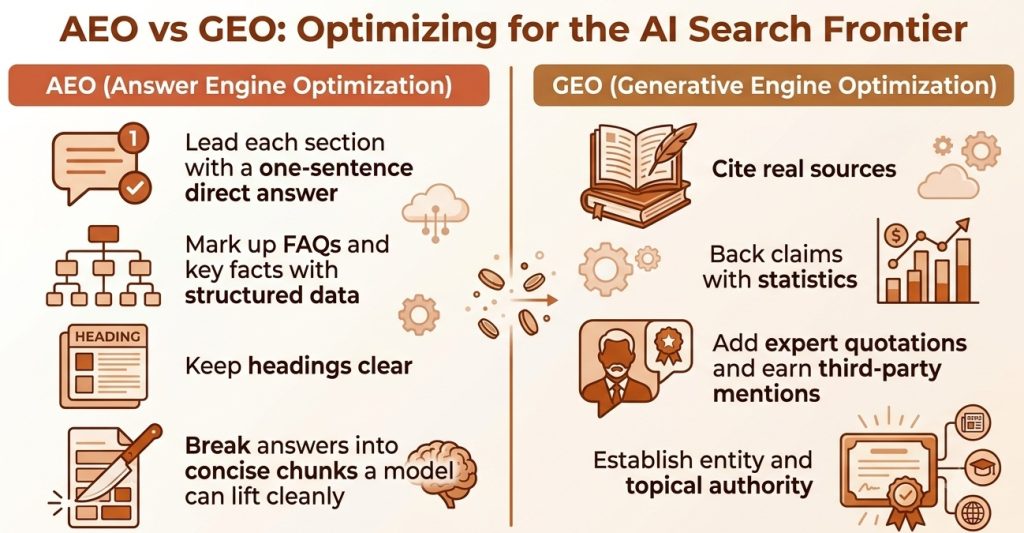
The tactics diverge sharply. AEO work is on-page and structural. GEO work is off-page and authority-building. Same content, different job.
AEO tactics: be the answer
AEO formatting is all about facilitating extraction. If a machine has to work to find the answer, it won’t use yours. This is what you should do:
- Lead each section with a one-sentence direct answer
- Mark up FAQs and key facts with structured data
- Keep headings clear
- Break answers into concise chunks a model can lift cleanly
GEO tactics: be the source
GEO is all about building the signals model trust. That means, for example:
- Citing real sources
- Backing claims with statistics
- Adding expert quotations and earning third-party mentions that establish entity and topical authority
This is not guesswork… In a controlled benchmark of roughly 10,000 queries, a Princeton study found that adding cited sources, statistics and expert quotations were among the highest-performing tactics for lifting visibility inside generative answers and lifted visibility by up to 40%.
AEO vs GEO in practice: the same query, optimized two ways
Take one question: “what’s the best project management tool for small teams?” The AEO and GEO versions look different on the page, and side by side, the distinction clicks.
The AEO version lives on your page. You open with a one-sentence lead answer naming your pick, mark up an FAQ block with schema, use a clear heading and keep the answer short enough to extract. You’re engineering the page so an answer engine can quote it directly.
The GEO version is everything around the claim. You back the recommendation with a cited source, add a real statistic, quote someone credible and get your brand mentioned across trusted third-party sites. That’s the citations-and-stats spine that moves generative answers.
They aren’t rival strategies. One makes the answer extractable, the other makes the source trustworthy.
Is AEO replacing SEO (and does GEO replace AEO)?
No. AEO and GEO add a layer on top of SEO rather than replacing it. You now optimize to rank, to be the answer and to be the cited source.
It’s a change in search, not the end of it. Ranking pages still feed the answer engines, and conversational AI still leans on the authority SEO helped you build. The disciplines stack.
One myth worth killing: you’ll see claims that AI Overviews now hit close to half of all searches. In reality, the largest public measurement puts it lower and choppier.
Remember that Semrush AI Overviews cited that we cited above? It determined that the trigger rate peaked near 25% in mid-2025 and settled around 16%, not 47%. This means that, while AI answers are growing, they haven’t replaced search at all.
AEO or GEO? How to choose
The routing is simpler than the acronyms suggest:
- Lean AEO if your goal is winning the direct-answer slot for question-shaped queries and you already have content that deserves to be the answer. This is a formatting and structure investment.
- Lean GEO if your goal is getting conversational AI to trust and cite your brand, and you’re competing on authority rather than one page. This is an off-site, longer-horizon investment.
- Do both if you’re serious about AI visibility (most brands eventually are). The same content usually serves both once the structural and authority work is done.
You’ll rarely pick one forever, so keep both approaches in mind. Start with whichever gap costs you now, then add the other.
How to measure AEO vs GEO performance
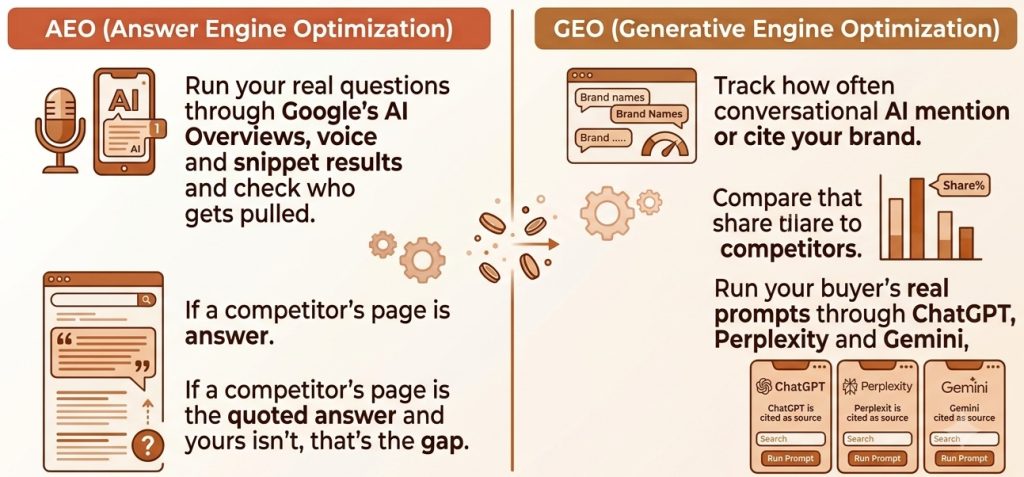
When it comes to success metrics, Andreessen Horowitz sums things up: unlike SEO, AEO and GEO are not about click-through rates (CTRs), but rather reference rates. This means tracking how often you’re cited inside a model’s answer, which can be harder than it sounds because the metric changes constantly.
Why does CTR break down? When the answer is synthesized and shown in full, the user often never clicks. A page can feed that answer perfectly and still register almost nothing in a traffic report. Clicks hide the win.
Moreover, measuring AEO and GEO are two slightly different processes:
Measuring AEO
- Run your real questions through Google’s AI Overviews, voice and snippet results and check who gets pulled.
- If a competitor’s page is the quoted answer and yours isn’t, that’s the gap.
Measuring GEO
- Track how often conversational AI mention or cite your brand.
- Compare that share to competitors.
- Run your buyer’s real prompts through ChatGPT, Perplexity and Gemini, then see who gets named (that citation share is the new visibility signal).
The bottom line:
AEO and GEO are two goals inside one shift to answer-based search: be the answer, be the cited source. They sit on top of SEO, not in place of it. Two goals, one shift.
Pick the discipline that matches your goal, then do what most brands skip: check whether AI answers cite you today. You can’t improve a reference rate you’ve never looked at, and the brands that do so are already winning.
FAQ
Are AEO and GEO the same thing?
No, they’re related but not identical. AEO optimizes to be the direct answer, and GEO optimizes to be the trusted, cited source across conversational AI.
Is AEO replacing SEO?
No. AEO merely adds an answer-optimization layer on top of SEO. Search is becoming answers as well as links, so you optimize to rank, to be the answer and to be cited.
Which should you use, AEO or GEO?
Choose by goal. Use AEO to win the direct-answer slot and GEO to get conversational AI to trust and cite your brand. Most brands end up wanting both, since they’re complementary moves on one page.
Do I need GEO if I already do SEO?
If you want conversational AI to cite you and not just Google to rank you, yes. SEO earns the ranking page, while GEO earns the off-site authority.
Is AEO just writing better content?
No. It’s structuring content so an answer engine can extract a clean, direct answer, which is a formatting discipline, not just quality. Clear headings, concise lead answers, FAQs and structured data do the heavy lifting.
What are AEO vs GEO examples?
An AEO example is an FAQ-marked page that wins the AI Overview answer for a question. A GEO example is a brand cited by ChatGPT because it’s referenced across trusted third-party sites.
How do you measure AEO vs GEO performance?
Track the reference rate, how often you’re the surfaced answer for AEO or cited by conversational AI for GEO, instead of click-through rate. Run your real questions through the models and see who gets named.