TL;DR
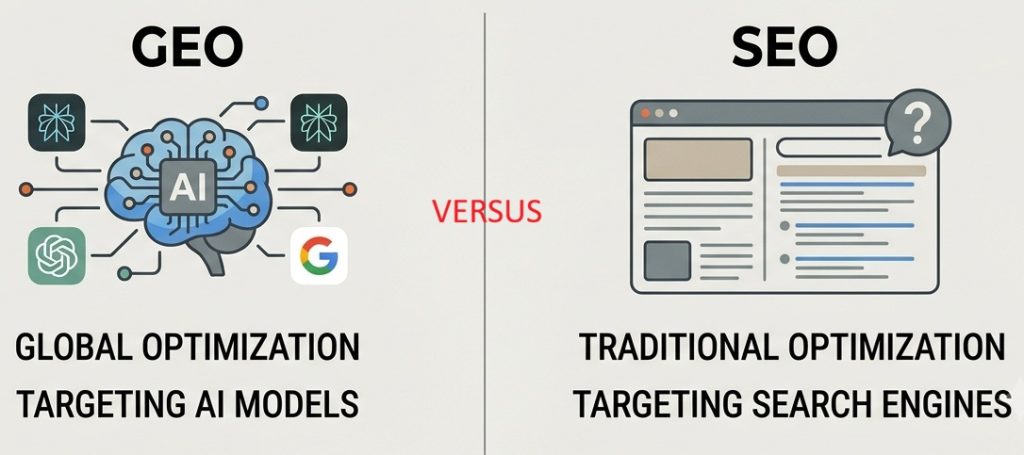
- SEO gets you ranked and clicked on a search results page. GEO gets you cited and mentioned inside the answer an AI writes for the user.
- It isn’t GEO or SEO. GEO is mostly good SEO with a few new moves on top, and no, SEO is not dead.
- If your brand is only doing SEO, you’re missing out. Perfect rankings no longer guarantee clients.
- Despite the steep growth of AI traffic, there’s no conclusive evidence that AI traffic converts better than SEO.
- GEO is essential, not perfect. High costs and model volatility are the two main catches.
- Start right now by running your brand through ChatGPT and Google’s AI Overview. If you’re invisible there, that’s your answer on where to start.
Search for “geo vs seo” and Google answers it with an AI Overview before you click anything. That is the whole shift, right there on the page. This article covers the real differences, where the two overlap, why the shift is happening now, how to actually do GEO and how to decide where to spend.
The short answer: SEO gets you ranked on a results page, while GEO gets you named inside the answer an AI writes for the user.
Customers getting answers without opening a single link is already mainstream. According to Semrush, AI Overviews show on roughly 15% of Google searches as of late 2025.
What SEO and GEO actually mean
Search engine optimization is the work of getting your pages to rank in a search engine’s results. Keywords, links, technical health, content that matches what someone typed… You know the drill.
Generative engine optimization is the work of getting your brand cited, quoted or recommended inside the answers that generative AI tools write. Think ChatGPT, Perplexity, Gemini, Google’s AI Overview and so forth.
GEO might be new, but it’s a real thing. Far from marketing fluff, the term comes from a 2023 research paper out of Princeton and Georgia Tech, formalized at the KDD 2024 conference. The researchers found that GEO tactics could lift a source’s visibility inside AI answers by up to 40%.
You’ll also see terms such as AEO (answer engine optimization) and LLMO (large language model optimization) thrown around. Same neighborhood, slightly different framing. Don’t get lost in the acronyms. The one that matters here is GEO.
GEO vs SEO: the core difference
Here’s the thing that trips people up. SEO and GEO are not that different, but they are playing for different scoreboards.
SEO plays for rankings and clicks. You rank, the user clicks, you get the visit. That’s been the deal for twenty years.
GEO plays for mentions and citations. The model writes the answer, and you only win if you’re named or linked inside it. Nobody clicks ten blue links anymore: you get one answer, and that’s it.
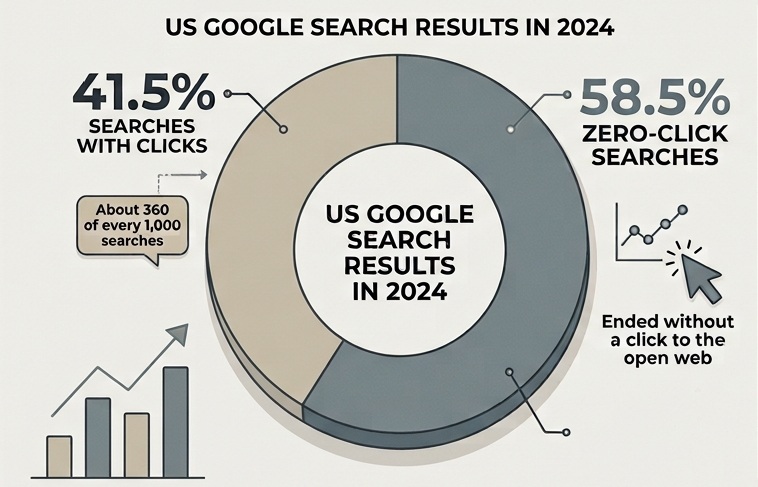
The click itself is disappearing. In 2024, 58.5% of US Google searches ended without a click to the open web, according to SparkToro’s zero-click study. Only about 360 of every 1,000 searches sent someone out to a website. This illustrates the growing importance of GEO.
The bottom line? The marketer’s goal has quietly changed from “get the visit” to “be the answer, even when there’s no visit.”
Where GEO and SEO still overlap
Before this turns into “SEO is dead, panic now,” slow down. GEO is not a replacement for SEO. Most of GEO is good SEO with a few new moves stacked on top.
AI answers pull heavily from pages that already rank well. The sources a model cites are very often the same pages sitting near the top of the organic results. Google’s AI Overview is literally reading Google’s index.
That means the fundamentals carry over. Content quality still matters. E-E-A-T still matters. Crawlable, well-structured pages still matter.
The honest read: if your SEO is broken, your GEO is broken too. You don’t get cited in an AI answer for a page a crawler can’t read or trust.
How GEO and SEO differ in practice
Now that we understand the fundamental differences and similarities between GEO and SEO, let’s see how the two differ in practice. The day-to-day work splits on three things:
- What you target
- How you win
- How you measure
1 – What you target: prompts instead of keywords
SEO targets keywords. Short, typed phrases like “best CRM software.”
GEO targets prompts. People talk to AI in full sentences, and those questions run much longer and are more specific than anything they’d type into a search box. You’re optimizing for “what’s the best CRM for a 10-person B2B startup that hates setup,” not “best CRM.”
2 – How you win: generated answers instead of results pages
With SEO, the output is a page of links. To win, you have to rank as high as possible on this page.
With GEO, the output is one synthesized answer. It might cite multiple sources, but one thing’s for sure: there’s no position two. You’re either in the answer or you’re not.
3 – How you measure: mentions instead of rankings
This is where things get uncomfortable. SEO gives you clean numbers: rankings, clicks, organic traffic, etc.
GEO gives you fuzzier ones: how often you’re mentioned, your share of citations, the sentiment of what’s said and your visibility across different models. Without a universal ranking, there’s less transparency and it’s harder to screenshot for the boss.
Here’s an overview of how to measure GEO vs SEO:
| SEO | GEO | |
|---|---|---|
| Goal | Rank on the results page | Get cited in the AI answer |
| You target | Keywords | Prompts and questions |
| How you win | Position + the click | A mention or citation |
| How you measure | Rankings, clicks, traffic | Mentions, citation share, sentiment |
| Feedback speed | Days to weeks, fairly stable | Fast and volatile, answers shift |
Why AI search is changing the game right now
This isn’t a someday problem. The behavior is moving now, and the volume behind it is real.
Back in early 2024, Gartner predicted that traditional search engine volume would drop 25% by 2026 as people move queries to AI chatbots. That prediction is landing right about now.
And the scale is not small. According to OpenAI, more than 800 million people were using ChatGPT every week as of late 2025.
This means that, if your brand is only doing SEO, it’s optimizing hard for a page that fewer and fewer people finish their search on. The rankings can be perfect and still miss where the customer actually landed.
Does showing up in AI answers actually drive traffic?
Yes, it drives traffic, and it’s growing fast. But things are not as black-and-white as they seem. Traffic from AI answers behaves differently than organic, so it’s important to set reasonable expectations.
According to Adobe Analytics, the growth is steep. Between mid-2024 and early 2025, traffic from generative-AI sources to US retail sites jumped roughly 1,200%. More impressively, Similarweb reported over 1.1 billion AI referral visits in a single month by June 2025.
Now the honest part. Those AI-referred visitors browsed more pages and bounced less, but in early 2025 they still converted a little less often than other visitors. The gap has been closing, not widening.
So the realistic pitch is fewer visits, better visits. You get less raw volume than classic organic, but the people who arrive already got a recommendation from an AI they trust. Don’t let anyone sell you “AI traffic converts better than SEO.” The clean data doesn’t say that yet.
How to actually optimize for GEO
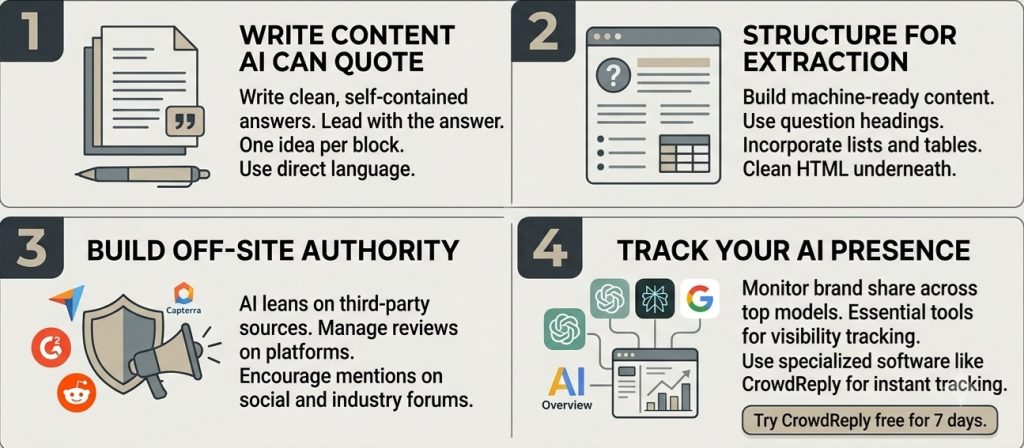
Good news for anyone dreading a whole new playbook. If you know about SEO, GEO work is mostly familiar. Four moves are all it takes to do the heavy lifting:
1 – Write content AI can quote
Models lift clean, self-contained answers. Write one idea per block, lead with the answer and keep the language direct. If a paragraph needs three re-reads to find the point, a model won’t bother extracting it.
2 – Structure for extraction
Make the page easy to pull from. Use questions as headings, structured data, lists and tables and clean HTML underneath. You’re building content a machine can chop into a citation without guessing.
3 – Build authority and mentions off your site
AI models lean hard on third-party sources to describe you. Stuff such as reviews on G2 and Capterra, threads on Reddit and Quora and mentions in industry publications are particularly important. They shape how a model talks about your brand, so they’re part of GEO whether you manage them or not.
4 – Track where you show up
You can’t fix what you can’t see. Check your brand across ChatGPT, Perplexity, Gemini and Google’s AI Overview, then watch your citation share over time. Tracking AI visibility requires specific tools, but we have good news for you.
CrowdReply instantly tracks exactly what you need, so you can forget about pasting prompts into five chatbots by hand. You can try it free for seven days.
When to prioritize GEO vs SEO
For most teams, the answer is both. The mix depends on who your buyers are and where they actually search.
The default: keep doing SEO and layer GEO on top. GEO rides on SEO foundations, so you’re not starting over. You’re extending.
Lean GEO-first if:
- Your buyers are early-stage researchers
- Your category is getting actively asked about in AI tools
- You’re already watching competitors get named in answers while you’re invisible (this is the real trigger for most people)
Stay SEO-heavy if your traffic is:
- Bottom-funnel and transactional
- Heavily local
- Still clicking through in your vertical
Want a real test instead of a guess? Run five buyer questions through ChatGPT and Google. Then, start wherever the gap between you and your competitors is worse.
The two main catches of GEO
Now the part the hype posts skip. GEO is real, but it’s early, messy and not free. There are two things worth knowing before reshuffling a budget:
1 – High GEO program costs
Agencies are charging reported retainers around $5,000 to $20,000 a month for managed GEO. That’s real money for a discipline this young, so go in with clear eyes about what you’re buying. Luckily, you can do a lot yourself by retooling the content team you already have.
2 – Model volatility
The same prompt can give a different answer today than it did yesterday, which makes reporting genuinely hard. There’s no clean attribution standard yet, so proving “this AI mention drove that revenue” requires continuous monitoring.
Moreover, models can flat-out get your brand wrong. This was never a risk with SEO. Anyone promising you a tidy GEO dashboard that works like Google rankings is overselling it.
Final thoughts
GEO vs SEO isn’t an either-or fight. It’s SEO plus a new front you can’t afford to ignore, and the brands that treat it that way will be the ones getting named while everyone else argues about whether it’s real.
So here’s the move for this week. Run your own brand through ChatGPT, Perplexity and Google’s AI Overview, and ask the questions your buyers ask.
If you can’t find yourself in the answers, that’s your starting line. No tool purchase will feel urgent until you’ve felt that gap. When you’re ready to watch it properly, use CrowdReply to check where your brand stands across multiple models.
FAQ
Is SEO dead?
SEO isn’t dead. It’s changing, and AI answers still lean heavily on pages that rank well in traditional search. Clicks are down, but the fundamentals AI rewards are the same ones good SEO has always built. The work shifts rather than disappears.
Do you need both GEO and SEO, or does GEO replace SEO?
Most teams need both. GEO is built on top of SEO (not instead of it) because AI models pull from content that already ranks. SEO earns you the crawlable, trusted pages that make you citable, and GEO makes sure you actually show up in the answer.
What is the difference between GEO and AEO?
AEO (answer engine optimization) targets direct answers like featured snippets and voice results, while GEO (generative engine optimization) targets the generative answers that AI tools synthesize across many sources.
How much does GEO cost?
You can retool your existing content team at no new cost or hire an agency, where managed GEO retainers have been reported around $5,000 to $20,000 a month.
Which drives more revenue: GEO or SEO?
SEO still drives more raw traffic and revenue for most businesses today because it’s not as new and the volume is there. GEO reaches buyers earlier in their research and its referred visitors tend to be more engaged. If your buyers research heavily in AI tools, GEO’s revenue impact climbs fast, so weight it toward where your customers actually are.
How do you measure GEO success?
You track how often your brand is mentioned, your share of citations across the major AI models, sentiment and visibility over time. It’s fuzzier than SEO because there’s no universal rank number and answers shift. The practical move is to monitor mentions and citation share across ChatGPT, Perplexity, Gemini and Google’s AI Overview rather than chase a single score.
Does SEO still help you show up in AI answers?
Yes. AI answers frequently cite the pages that already rank in the top organic results, so strong SEO has a direct impact on GEO. The two reinforce each other more than they compete.