TL;DR
- In a nutshell, GEO optimization is about shaping your content so generative engines cite it inside their AI answers.
- GEO and SEO optimization are complementary practices that must (and do) coexist. GEO isn’t replacing SEO and SEO is not dead.
- However, they have different goals in mind. SEO aims for a top ranking, GEO aims for citations inside AI answers.
- According to real evidence, the most effective GEO optimization techniques include citing sources, adding quotes and using real statistics.
- To find the best GEO optimization tool for you, consider your present needs. Don’t trust vendors overselling a “one-does-it-all” solution.
Today’s guide is practical, focusing on how to perform GEO optimization. For more on the concept of GEO, please check out “What is generative engine optimization?“
This is what I will cover: what GEO is, why it matters right now, how it differs from SEO, the techniques with real evidence behind them and the hands-on playbook I run to get cited in AI Overviews.
But before we look at what GEO optimization is, let’s clear the air by addressing why it’s more than just another AI-search acronym:
Why GEO isn’t just another acronym
Do you ever feel like another three-letter acronym shows up every week? Well, you’re not alone. Many of these acronyms do refer to the same idea. But is GEO (generative engine optimization) just a useless buzzword, or an important concept that actually holds up?
GEO optimization is the practice of shaping your content so AI search engines cite it inside the answers they generate. Instead of ranking a blue link, you optimize to be a source an engine like ChatGPT, Perplexity, Gemini or Google’s AI Overviews pulls into its response.
Therefore, GEO optimization is relevant for anyone who wants to improve their AI search visibility. It’s not marketing jargon; it’s a direct answer to the changes in search behavior that have been made increasingly obvious during the last few years.
Another quick disambiguation before we go further: GEO has nothing to do with geo-targeting or local SEO. When people in the AI world say “geo,” they mean generative engine optimization, not “show up for coffee shops near me.” If you came here for local rankings, this is the wrong guide…
What GEO optimization actually is
As established, GEO optimization is optimizing to be cited inside an AI-generated answer. Yes, it’s that simple! However, many people get lost in the acronym soup…
Consider, for example, GEO, AEO (answer engine optimization), AIO (AI optimization) and LLMO (large language model optimization). Despite minor technical differences (mainly related to the scope of the terms), the acronyms refer to the same thing: AI search optimization.
While there’s no official “right” term, I favor GEO because it was actually formalized in a 2023 Princeton paper. Based on a benchmark of 10,000 real queries, the paper determined that specific content changes can lift a source’s visibility in generative answers by up to 40%.
GEO optimization is not “vibes”; it’s a measured discipline with an academic origin. To better understand it, let’s compare it to SEO (search engine optimization).
How GEO optimization differs from SEO
The simple explanation? SEO gets you ranked in a list of links. GEO gets you cited inside the answer the engine writes.
This apparently small difference changes everything. Search engines rank a list and let you pick, while a generative engine reads several sources, synthesizes one answer and drops those sources in as inline citations.
The GEO optimization playbook is new because you are no longer chasing a position, you are trying to be the sentence that gets quoted. But don’t throw away all of your SEO efforts just yet, as there are plenty of similarities too.
GEO vs SEO: the differences at a glance
This table clarifies the essential differences between GEO and SEO:
| Dimension | Traditional SEO | GEO optimization |
|---|---|---|
| Unit of visibility | A ranked link on the results page | A cited source inside a generated answer |
| How success is measured | Position and click-through rate | Citation share and presence in answers |
| What you optimize | Pages for crawlers to rank | Extractable claims for a model to synthesize |
| Primary engines | Google, Bing | ChatGPT, Perplexity, Gemini, Google AI Overviews |
GEO vs SEO: the similarities
This is not a teardown of SEO because a lot carries over from SEO to GEO optimization. Helpful content still wins. Authority still matters. Technical hygiene, crawlability and a fast site remain the unglamorous price of entry that no amount of AI-era cleverness lets you skip.
Keyword-matching reflex is the essential switch. Stuffing a phrase ten times helped you rank once, but it does close to nothing when a model is deciding what to quote. And it’s not just me guessing, as this was evidently demonstrated in the Princeton paper I mentioned before.
For a deeper take on the topic, please consult my GEO vs SEO breakdown. For the purpose of this guide, we have enough to move on.
Why GEO optimization matters now
This is why I’m confident GEO optimization matters now: (1) AI answers have become mainstream and (2) clicks are no longer the first prize. Here’s the gist:
1 – AI answers are now commonplace
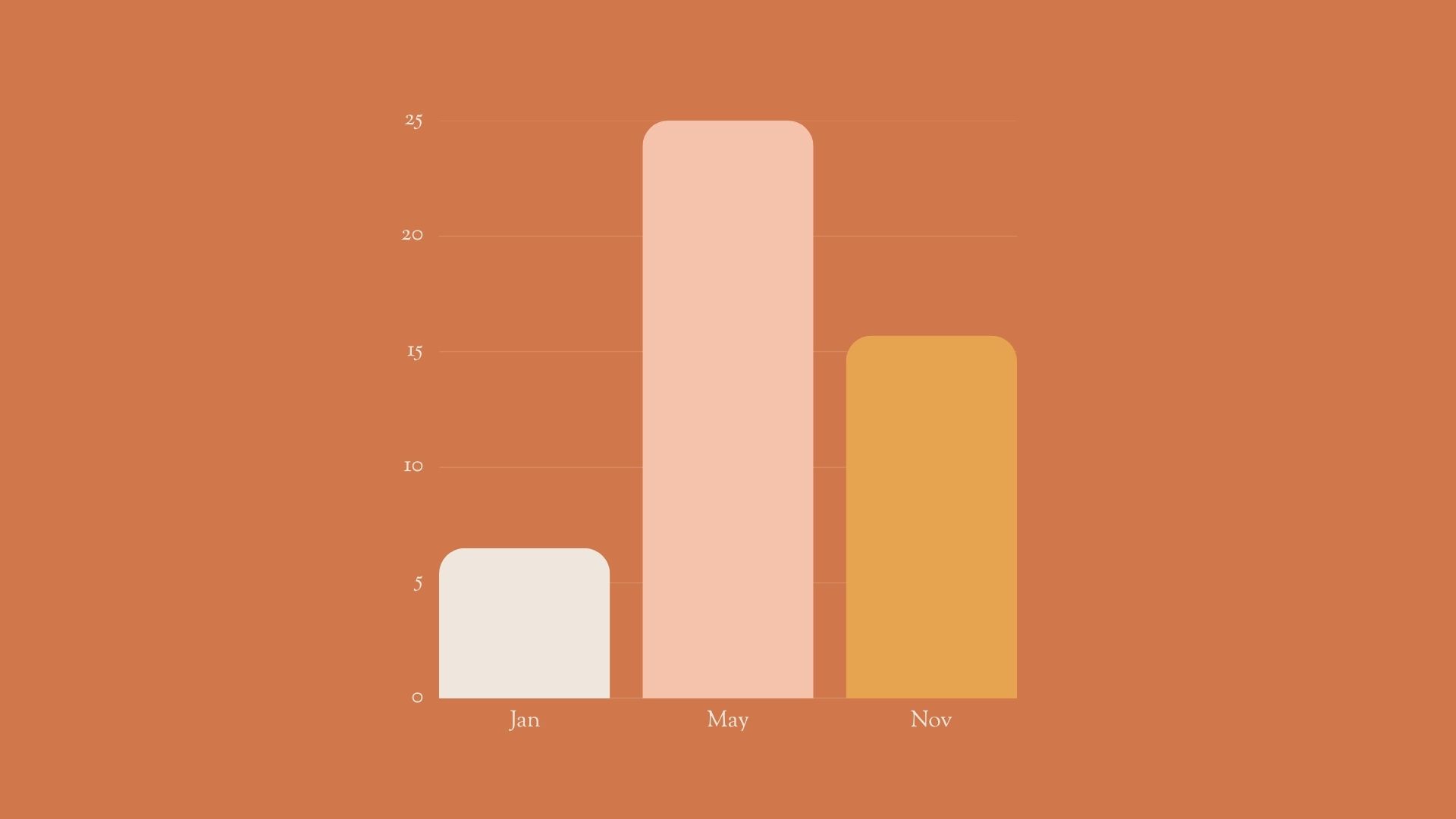
The trajectory is steep. AI Overviews appeared on 6.5% of Google queries in January 2025, climbed to nearly 25% by July, then settled around 15.7% in November (per a Semrush AI Overviews study).
This means roughly one in six or seven Google searches now opens with a generated answer. But how common are AI answers in 2026?
Well, a lot… “Mass market” would be a good way to put it, and I have the numbers to back this claim. Google’s AI Overviews reached more than 2 billion monthly users by June 2026 and ChatGPT passed 800 million weekly users by December 2025.
2 – AI answers directly impact clicks
Here is the thing that got me. When an AI summary is present, people click a traditional result 8% of the time versus 15% when there is no summary. That’s roughly half as often.
Per Pew Research, only about 1% click a link inside the summary itself. The honest read is not “AI Overviews always kill clicks.” The takeaway is that the click stopped being guaranteed. The prize shifted from ranking a page to being the source the answer leans on.
GEO optimization techniques that really work
Ignore “miraculous” tactics and quick “hacks.” The evidence says the biggest wins come from citing sources, quoting credible experts and adding real statistics, plus writing clearly. Keyword stuffing does almost nothing.
Proven GEO optimization techniques
- Cite credible sources inside your content
- Add real quotes from people who know the subject
- Back your claims with actual statistics instead of hand-waving
- Write clearly, answer the question directly near the top and keep the whole thing genuinely helpful rather than padded
How we know these techniques work
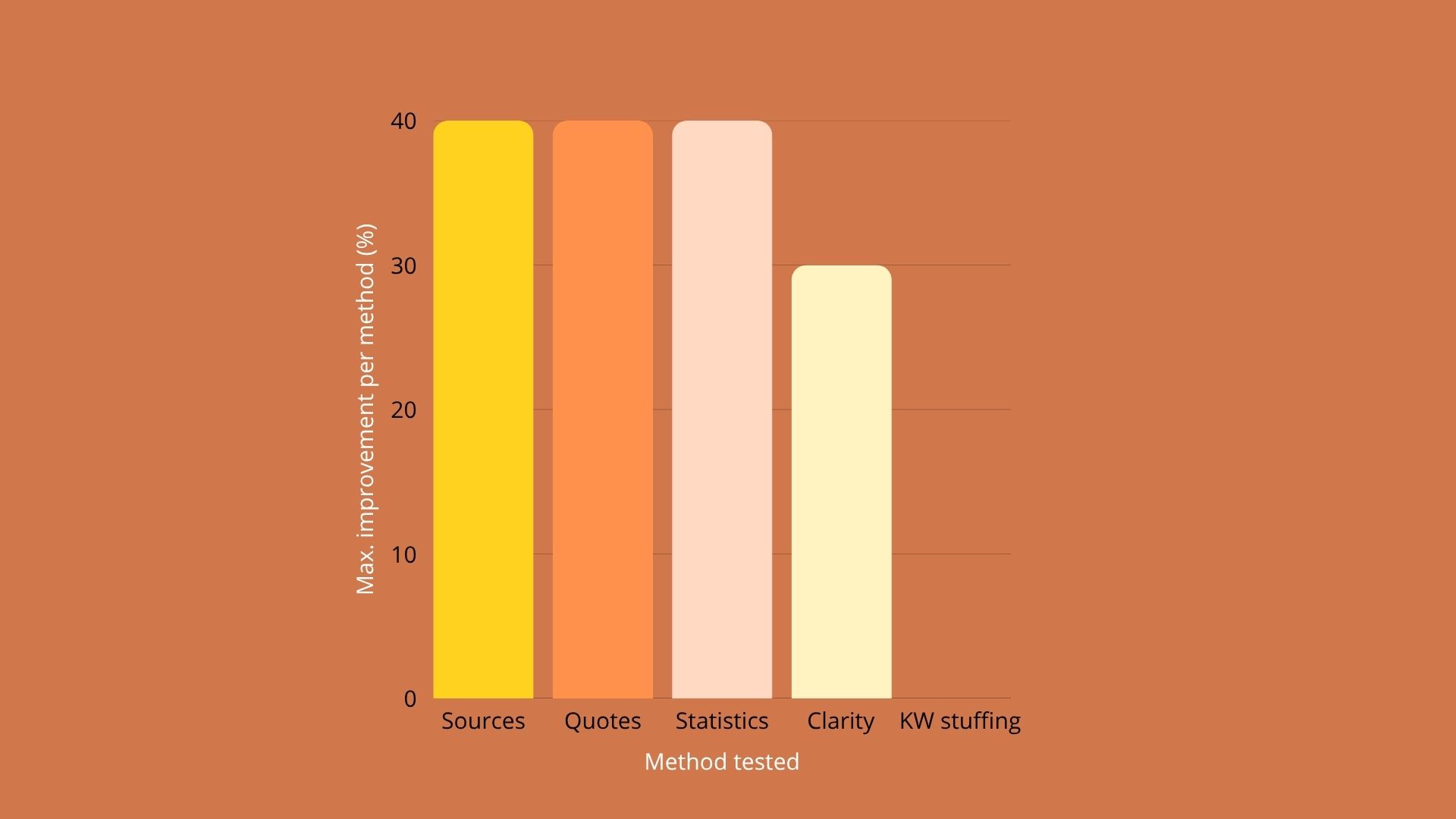
Remember that Princeton paper? The team tested a set of content changes and measured how each moved a source’s visibility in generated answers. The most effective methods, which delivered a 30% to 40% relative improvement, were:
- Citing sources
- Adding quotations
- Adding statistics
Improving readability and fluency (i.e., writing clearly) delivered a 15% to 30% improvement. On the other hand, keyword stuffing produced little to no improvement.
A final, important note: you may have seen a tidy list going around claiming things like plus 41% for quotes and minus 9% for keyword stuffing. That list oversimplifies what the paper measured and mixes two different metrics together. Trust the ranges, not the neat per-technique numbers.
Why GEO optimization favors the underdog
Like a gift that keeps on giving, the Princeton paper also determined that GEO optimization helps lower-ranked sites the most. If you’re new to the game, that is an encouraging finding.
Adding citations is probably the best way to start. The technique doubled the visibility of a site ranked fifth (a 115% lift under a simulated universal-adoption scenario) while causing the average top-ranked site’s visibility to fall by around 30%.
If you are not a dominant force in your category, GEO optimization is one of the few levers that actually tilts toward you. The effect also carried over to a live engine, Perplexity, with gains up to 37%.
How to rank on AI Overviews: a step-by-step playbook
Seven steps, in order. This is the simplest possible playbook to rank on AI Overviews and the step-by-step method I personally use.
For a deeper take, please refer to how to rank in AI Overviews.
Step 1: start from prompts, not keywords
Pick the 5 to 15 real questions people actually ask an AI about your category. Not keywords. Questions, phrased the way a person would type them into ChatGPT. Try “What is the best gamer PC in 2026?” instead of “best gamer PC 2026.”
The reason is simple. Generative engines answer questions, so your target list should be questions. Pull them from the sales calls you sit in on, from the People Also Ask box, from what your customers email you and so forth. Each real question is a prompt the engine might answer with your page.
Step 2: write the extractable answer first
Lead each page with a plain, liftable two- to three-sentence answer, then support it below. The model is scanning for a clean passage it can quote. If you give the model what it wants, your chances of being cited increase.
Leave the long introductions and warm-up anecdotes for your personal blog. If you bury the answer the model is looking for in paragraph four, your chances of being cited decrease.
Step 3: add citations, quotes and statistics
These are the techniques with the strongest evidence behind them, straight from the research section above. Cite your sources, quote credible people and use real numbers.
Do this on the page itself. It makes your content reachable and it moved the needle more than any other technique tried by Princeton. Off-page citation building is a separate lever.
Step 4: get the technical foundation right
Server-render your content so a crawler sees it. Keep the structure clean. Make the page fast and crawlable. Boring? Yes. Non-negotiable? Most certainly.
While necessary, though, step 4 is often overstated. Do not chase AI-specific markup or special files. That is a trap I cover in the “stop wasting time” section below. The foundation is normal technical SEO, not a secret AI layer.
Step 5: earn credible mentions and citations off-page
Being cited by sources the engines already trust is a real lever, and it is the hardest one to fake. Editorial mentions and links from pages your buyers read make you look like a citable entity to a model running a trust check.
Earning credible mentions and citations off-page can be a tedious process requiring weeks of manual domain finding, emailing and bargaining.
That’s why I and my team created a feature that streamlines the process. The CrowdReply backlinks marketplace ranks editorial backlinks by how likely they are to move your AI citation eligibility and offers Citation Strategy Playbooks that map the workflow required to get cited by specific sources.
Step 6: keep it fresh
Update the pages that matter, and do it regularly. Generative engines lean toward current sources. A page that has not moved in three years reads as stale.
You do not need to churn for churn’s sake. Pick the pages that carry your priority prompts and keep them genuinely current. Freshness is a signal, not a treadmill.
Step 7: verify you actually got cited
Re-run your prompts across the engines and check whether you appear. Most AI summaries (roughly 88%) cite three or more sources and only around 1% cite a single source (per Pew Research). So the realistic target is to be one of several cited sources, not the number one.
This is a hands-on check for now. The full measurement loop is the next section because eyeballing it across dozens of prompts does not scale.
My cross-engine GEO optimization measurement loop
There’s only one right way to measure your AI visibility: on a cadence. Below, you can find the tracking cadence I use for three of the most important GEO optimization platforms: Google AI Overviews, ChatGPT and Perplexity.
A realistic tracking cadence
The loop is not complicated. Define your prompt set, run it across the engines on a cadence, record whether and how you are cited and fix the highest-intent gaps first.
| Engine | What to check | Cadence |
|---|---|---|
| Google AI Overviews | Do you appear in the box for priority prompts | Weekly for priority, monthly for the long tail |
| ChatGPT | Are you named or cited in the answer | Weekly for priority prompts |
| Perplexity | Are you in the cited sources list | Weekly for priority prompts |
In my testing, what I keep seeing is that a prompt where you show up strongly in Perplexity can go completely silent in ChatGPT for no evident reason. That is why you have to watch them side by side, which requires tiring manual checks.
CrowdReply is a gamechanger because it provides tools that address this specific GEO optimization need. The AI visibility trackers watch your presence and citations on a set cadence across Google AI Overview, ChatGPT, Gemini and others.
There’s also a competitor share-of-voice view (so you can see who is winning the prompts you care about) and other useful GEO optimization resources.
Why Google-only tracking misses the picture
The engines disagree about who to cite more than you would expect, so going all-in on Google is not the best tactic.
Ahrefs’ study on AI search overlap concluded that only 12% of the pages quoted by standalone assistants (ChatGPT, for example) also sit on Google’s first page of results for the same prompt. Perplexity overlaps more (around 29%), but that doesn’t change the big picture.
One thing to keep straight. Those are the standalone AI assistants, not Google’s AI Overviews. But, once more, the takeaway holds. Watch Google alone and you are blind to most of where ChatGPT and Perplexity are sending your buyers.
What to stop wasting time on
A lot of the GEO advice going around is hacks that do not move anything. Here is my honest do-not-bother list, so you can spend the effort on the seven steps I shared above instead.
Hacks that do not work
- Keyword stuffing. We already covered why: it does close to nothing in a generative setting.
- Inauthentic mentions across the web. Google says plainly that seeking those out is not as helpful as it seems. A cheap mention on a junk site is not the trust signal you are hoping for.
- Word count and chunking. Length for its own sake is not the point (there is no magic paragraph size that wins the citation).
- The llms.txt file. There’s no reason to waste your time on this hyped format, and you can find exactly why in our llms.txt guide.
Too many unsourced numbers floating around
A lot has been written about GEO optimization already, but please don’t trust every single claim you see online. Be particularly skeptical of tidy percentage lists, especially if they have no real citation behind them.
If a stat cannot point you to a primary source, treat it as decoration. The honest numbers in this guide all trace back to the paper, the study or the doc they came from. Hold everyone else to the same bar.
Is GEO optimization replacing SEO?
The question is fair. Yet, the answer is bluntly simple: GEO and SEO optimization are complementary practices that must (and do) coexist. GEO isn’t replacing SEO and SEO is not dead.
Here’s why SEO isn’t dead:
Think of it as two layers. Foundational SEO (meaning crawlable, helpful and authoritative content) is the base. GEO is the layer that makes that content extractable and citable inside an answer. Without a solid base, there’s nothing worth citing in the first place.
How do I know this? Google’s own AI optimization guide tells marketers to keep prioritizing foundational SEO and to treat GEO hacks as secondary. The text literally opens with the question “Is SEO still relevant for generative AI search?” and the answer is yes.
Here’s what changed:
GEO didn’t change the fundamentals of the game, but it did change the unit of visibility and how visibility is measured. You used to optimize a page to rank and win a click. Now you also optimize it to be extractable and win a citation.
Same content discipline underneath, one new layer bolted on top of it. Anyone telling you to throw out SEO and start from scratch is giving you bad advice. Think one on top of the other, not one instead of the other.
GEO optimization tools: a quick and honest look
A few categories of tools help with GEO. There are roughly three buckets, and here’s an honest read on what each does:
- AI-visibility trackers: tell you whether you appear in AI answers across engines.
- Content and optimization tools: help you write the extractable, well-structured content that gets quoted.
- Citation and off-page tools: help you earn the mentions the engines trust.
Don’t let one vendor convince you a single product does all three well. Most do one bucket properly and gesture at the others. Others, like our own tool, cover two categories simultaneously (just not everything).
CrowdReply lives mostly in the first and third buckets, featuring an AI-visibility tracker with a citation and backlinks angle. Is that the right pick for you? It depends entirely on which gap you’re trying to overcome right now.
Frequently asked questions
Is SEO dead or evolving in 2026?
SEO didn’t die; it evolved. It is the foundation generative engines still build on, so the fundamentals of helpful, crawlable and authoritative content still decide whether you are eligible to be cited at all.
Is GEO replacing SEO?
No, GEO sits on top of SEO rather than replacing it. You need the SEO base to have anything worth citing before GEO makes that content extractable.
Which is better, SEO or GEO?
It’s never a matter of SEO or GEO. You should run both because they target different stages of the same funnel. SEO earns the ranked link and the crawlable authority, while GEO earns the citation inside the AI answer.
How do you optimize for AI search?
The proven, most effective methods: write a clear, liftable answer, back it with citations, quotes and real statistics and earn credible mentions off-page.
What is the difference between GEO and AEO?
In practice, none. GEO (generative engine optimization) and AEO (answer engine optimization) are used interchangeably for the same goal, which is being the source an AI answer cites. Pick one term and move on.
What are the best GEO optimization tools?
It depends on the job. AI-visibility trackers handle measurement, content tools help with extractable writing, and citation or off-page tools help you earn mentions.
Are there risks to GEO optimization?
Yes. Over-optimizing for hacks wastes effort, AI answer visibility is more volatile than classic rankings, and chasing llms.txt or bought mentions burns time you will never recover. Tracking is also challenging because your AI presence can switch overnight.