TL;DR
- AI search optimization means shaping your content so AI answer engines like Google AI Overviews, ChatGPT and Perplexity select and cite it. The goal is citation, not just a rank.
- Due to the rise of zero-click searches, getting a number one Google ranking is no longer the number-one priority.
- Because of how AI engines pick their sources, you should focus on optimizing individual passages, not just pages.
- After all, being cited by AI is not the same as ranking on Google. Only about one in eight AI citations also ranks top-10, so the surfaces need different optimization.
- SEO is not dead, but it is evolving… The teams that treat citation as the first prize are the ones that will own AI search optimization.
- Start with a short brand-prompt audit across ChatGPT, AI Overviews and Perplexity. Find where you are cited, find where you are missing, and then fix the gaps.
According to Pew Research, user behavior changes when an AI summary sits at the top of the page. If it’s there, people click a result in about 8% of the visits; if it’s not, the number rises to 15%. This means that you can rank number one and still watch the traffic dry up…
AI search optimization is how you shape your content so AI answer engines pick it, summarize it and cite it in their answer. This guide covers what it is, how it differs from old-school SEO, why it matters, how to earn citations, the technical layer, per-platform tactics and measurement.
Introducing AI search optimization
AI search optimization is the practice of shaping your content so AI answer engines select, summarize and cite it as a source behind their generated answer. The target is not a ranked blue link but being one of the few pages the model quotes when it writes the answer for the user.
That distinction is the whole game. Old SEO asks how you climb to position one. AI search optimization asks a different question entirely.
When someone types a question into ChatGPT or sees an AI Overview on Google, which pages does the machine lean on? And how do you become one of them? Let’s find out!
What “getting cited” actually means
Getting cited means the AI engine names your page as a source it used. It might be a footnote, a linked citation or a “sources” panel. Either way, your brand shows up inside the answer the user actually reads.
Here is the part that matters more than it sounds. Most AI answers do not pick a single winner. According to the Pew Research study cited above, the vast majority of Google AI summaries cite three or more sources and only about 1% cite just one.
So the realistic goal is to be one of the cited few, not the lone answer. That is good news because you don’t have to beat everyone. Making the shortlist is a far more winnable target than beating every single competitor.
AI SEO vs optimizing for AI search
AI SEO is not the same as optimizing for AI search:
- With AI SEO, you use AI to do SEO. This means, for example, using AI marketing tools to research, draft and cluster faster.
- Optimizing for AI search is all about getting those mentions in AI answers. It’s not AI-assisted SEO because it’s not about Google rankings and blue links.
The two overlap in practice, and yes, you will use AI tools along the way. But the thing you are optimizing here is your visibility inside AI-generated answers, and that’s precisely what this guide is about. Keep that straight and the rest lands cleanly.
How AI search differs from traditional SEO
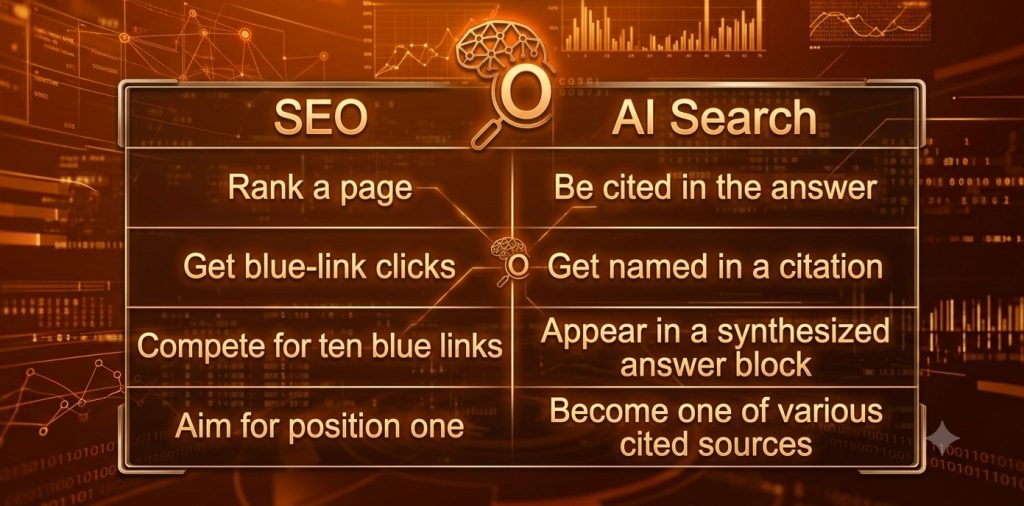
Think about what a search result page looks like now versus three years ago. The old page was ten blue links and you fought for the top of them. The new page opens with a synthesized answer, and the links live below it or inside it.
SEO wins when you get one of those ten blue links. AI search optimization wins when your brand is cited inside the answer sitting at the top of the page. The two are still important, but user behavior shows mentions tend to beat links in 2026.
Answer-first beats link-first
When users get a complete answer at the top of the page, they tend to stop there. When they read the summary and move on, the links underneath become an afterthought for a shrinking slice of searchers.
Links are far from worthless, but they’re no longer the first prize. The number-one goal is being named inside the answer itself because that is what the reader sees first and trusts most.
The zero-click reality in 2026
Zero-click search is the new default, and the trend line is steep. In the first four months of 2026, roughly two in three Google searches ended without a click to the open web (as per SparkToro).
Compare that to 2024, when the same longitudinal series found around 360 clicks per 1,000 US searches reaching a non-Google property. The direction is unmistakable even if the two panels are not a like-for-like comparison.
In 2024, the same longitudinal series found around 360 clicks per 1,000 US searches reaching a non-Google property. The trend is unmistakable even if the two panels are not a like-for-like comparison.
Since a rising share of search demand never leaves the results page, the answer box is where that demand now gets satisfied.
A number one ranking no longer guarantees the click
Ranking first used to mean traffic. Now it often means you feed the AI Overview that eats your click. As of late 2025, the presence of an AI Overview correlates with a 58% lower click-through rate for the top-ranking page, up from a 34.5% reduction measured by Ahrefs in April.
Note the word correlates. Ahrefs is careful about causation, and so should you… The pattern is real regardless, and it is large enough to change how you think about a top ranking. Ranking and being cited are now two different games, and winning one does not automatically win the other.
Why AI search optimization matters now
AI answers are now the default surface for hundreds of millions of searches, so being uncited means being invisible to a fast-growing share of demand. This is not a niche experiment anymore. It is where a large chunk of your audience already gets its answers.
The scale flipped fast. What felt like early-adopter behavior in 2024 is mainstream in 2026, and the numbers make that obvious.
AI answers went mainstream
Google’s AI Overviews reach more than two billion people a month, and ChatGPT passed 800 million weekly active users by October 2025, up from 500 million that March (per TechCrunch). Those are not fringe surfaces. The audience is mass-market now.
The implication? If your brand is missing from the answers these engines generate, you are missing from where a huge share of buyers look first.
Sessions end inside the answer
We know that people are less likely to click on links when an AI summary appears in the results. The click never happens because the user got what they needed from the AI answer and left.
The cost of doing nothing compounds from there. Your pages can rank and still lose visibility because the answer above them is doing the talking. You are not competing with the page below you anymore. You are competing with the summary that sits on top of the whole page.
How does AI search optimization actually work?
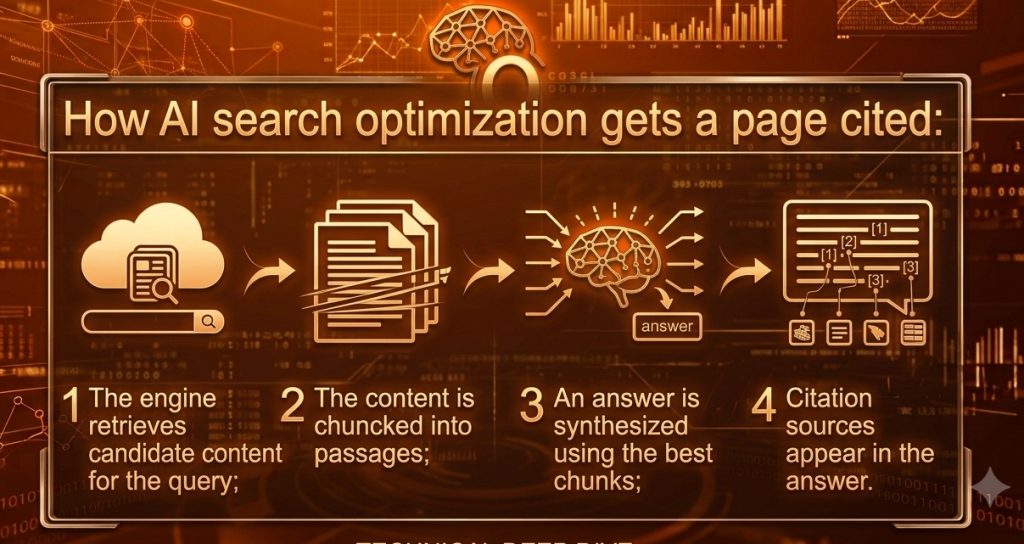
AI answer engines retrieve and chunk content across many sources, then cite the ones that most clearly and credibly answer the prompt. So optimizing means being the clearest, most citable chunk on a topic. That is the mechanism in one sentence. The rest is detail.
Most guides skip this part and jump straight to tactics. That is a mistake, because the tactics only make sense once you understand how the machine actually picks its sources.
How AI engines pick their sources
The pipeline runs in four rough steps:
- The engine retrieves candidate content for the query;
- Chunks it into passages;
- Synthesizes an answer across the best chunks;
- Cites the sources it leaned on.
Keyword density is not the lever here. Citation-worthiness is. The engine is asking whether your passage answers the prompt cleanly and whether it can trust the source enough to name it. Stuffing keywords does nothing for either question.
The retrieval step is worth dwelling on for a second. The engine is not reading your whole site. It pulls the passages most relevant to the specific prompt, then judges those passages in isolation.
This means that a brilliant page with the answer buried on line forty loses to a plain page that answers in line one. You are optimizing individual passages, not just pages.
Why citation is not the same as ranking
Here is the part that trips people up. Getting cited by an AI assistant is a separate outcome from ranking on Google. Ahrefs found that only 12% of the URLs cited by ChatGPT, Gemini and Copilot also rank inside the Google top 10 for the query, with Perplexity showing up as the outlier at around 28.6%.
The paradigm shifts. Your top-10 Google position does not automatically buy you a citation in ChatGPT and a page that gets cited by an assistant may not rank at all. You need to play two scoreboards across two different games.
What that means for how you write
When it comes to writing, the practical takeaway is simplicity:
- Write self-contained, question-led chunks that an engine can lift without needing the rest of the page for context
- Lead each section with the direct answer
- Make the passage make sense on its own
You win if a model can grab one clean paragraph from your page and drop it into an answer with attribution.
You lose if your best answer is buried three scrolls down inside a wall of setup.
Is it AEO, GEO, AI SEO or AI search optimization?
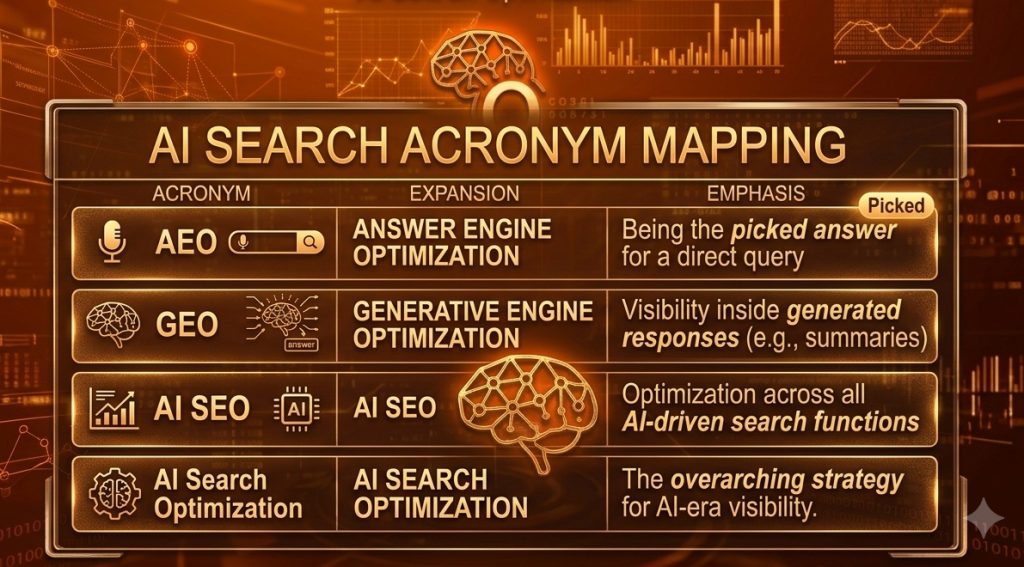
The labels overlap far more than they conflict. AEO, GEO and “AI SEO” all describe optimizing to be selected by AI answer engines, and the naming disagreement matters a lot less than the practice underneath it.
If the acronym soup has been slowing you down, you’re going to love this section. A new concept shows up every few months, but the actual work barely changes. So let us define the terms and move on.
What each label means
Here’s what each term means, explained as plainly as possible:
- AEO is answer engine optimization: ensuring AI engines use your content as a direct answer to a question.
- GEO is generative engine optimization: improving content and authority so AI engines cite your brand.
- AI SEO is often used to describe AI search optimization, but, as we’ve already established, it technically refers to AI-assisted SEO (like when you use AI tools).
- AI search optimization is the practice of getting your content selected and cited by AI answer engines.
For further clarification, we recommend checking these in-depth guides:
The tactics do not change based on which acronym your team writes on the whiteboard, so the naming fight is a waste of a good meeting. Avoid confusion by picking one label internally and standardizing it.
Where GEO came from, and why it matters
The term “generative engine optimization” was formalized in a November 2023 Princeton-led research paper that showed targeted content strategies can lift a source’s visibility in generative-engine responses by up to 40%.
The authors were careful to note that the effect varies by domain, so treat “up to 40%” as a ceiling, not a promise. It is a measured result, not a marketing number, and that is exactly why it is worth knowing where GEO came from.
The origin of GEO matters because it grounds the whole discipline as something real and measured, not as a trend chased by content marketers. There is peer research behind the idea that you can deliberately optimize for citation, and that research is where the name came from.
Create citation-worthy content with E-E-A-T and topical authority
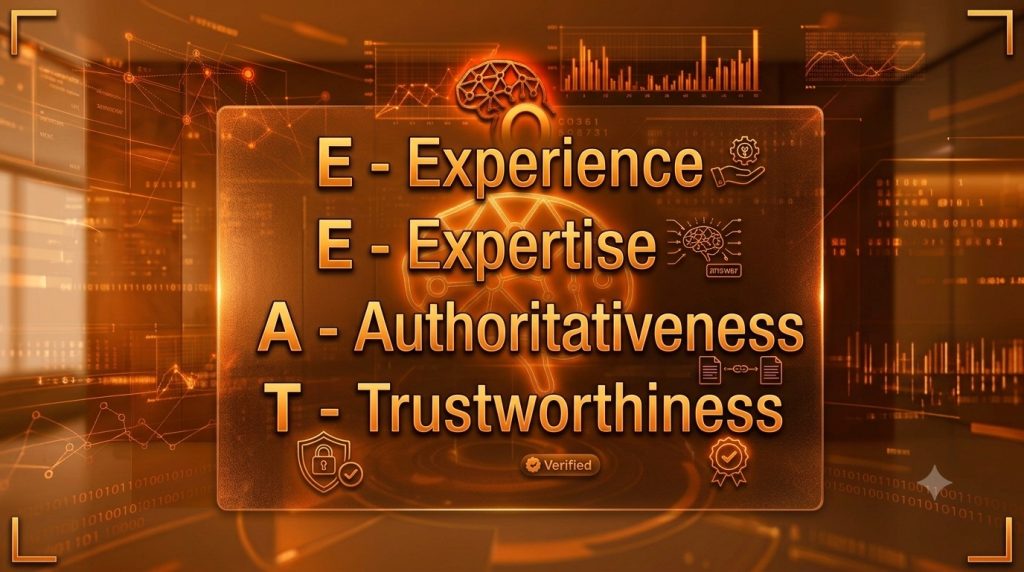
AI engines cite sources they can trust and clearly attribute, so citation-worthy content means:
- Demonstrable experience
- Topical depth
- Liftable answers
This is the largest lever most teams have. It is also the one they neglect while fiddling with technical settings, and that’s why it is important to analyze each individually:
1 – Demonstrable experience: what makes content citation-worthy
The Pew Research study mentioned above determined that Wikipedia, YouTube and Reddit account for 15% of all citations. AI engines love these sites not because they’re based on user-generated content, but because they’re recognized and high authority. They have the required demonstrable experience.
To put it simply, citation-worthy content earns trust the way a good source earns a reporter’s confidence. E-E-A-T is the shorthand: Experience, Expertise, Authoritativeness and Trust.
In practice that means a named author with a real bio, first-hand specifics instead of vague summaries and claims a reader can verify. Think about what personally makes you trust an online source and apply it to the content on your site.
2 – Topical depth: build topical authority, not one-off pages
Think in topics, not keywords. A single page targeting one keyword rarely earns the depth signal AI engines reward. A cluster of pages that covers a topic thoroughly does, because it signals that you actually know the subject rather than chasing a search term.
Pick the topics your audience genuinely cares about and cover them completely. Answer the obvious questions and the second-order ones. Depth compounds, and it is much harder for a competitor to fake than a single optimized page.
Link your related pages together so the cluster reads as a coherent body of work on the topic. A pillar page that frames the subject, with supporting pages that go deep on each sub-question, signals real coverage. Proper internal structure also gives an engine more clean, relevant passages to pull from when someone asks about your area.
3 – Liftable answers: write for easy extraction
These are the three pillars of writing for easy extraction:
- Clear, question-led headers
- Answers in the first sentence under each header
- Self-contained chunks that hold up when pulled out of context
If you’re not sure whether your content is extractable or not, read one section in isolation and ask whether it answers its own headline. If it does, an engine can lift it cleanly. If it needs three paragraphs of preamble to make sense, you should rewrite it.
Structure your site so AI can read it
AI systems can only cite content they can crawl and parse cleanly, and there’s more to it than just writing clearly. The technical structure of your site is also key. You do not win on this layer, but you can certainly lose… Make sure you get the two essentials right:
1 – Structured data and schema for AI readability
Structured data helps machines understand what a page is about. Schema.org markup labels your content in a vocabulary crawlers already parse, so an engine can tell a review from an FAQ or how-to without guessing.
Add the schema types that match your content, ensuring the markup describes what a human actually sees on the page. It looks a little bit like this:
“`json { “@context”: “https://schema.org”, “@type”: “FAQPage”, “mainEntity”: [{ “@type”: “Question”, “name”: “What is AI search optimization?”, “acceptedAnswer”: { “@type”: “Answer”, “text”: “AI search optimization is shaping your content so AI answer engines select, summarize and cite it as a source behind their answer.” } }] } “`
Google’s rules plainly state that your schema.org markup should match your visible content, not describe things that are not there. Mismatched markup is worse than none, because it reads as an attempt to game the system.
2 – Crawlability and AI bot access
The engine has to reach your content before it can cite it, and that’s why AI crawlers are always welcome. Keep a clean site structure, fast pages and a sensible robots policy that does not accidentally block the bots you want reading you.
There are two major mistakes to avoid:
- A well-meaning rule in a config file quietly blocks an AI crawler, and the brand disappears from a surface it never knew it was on. Check what your robots policy actually does to GPTBot, ClaudeBot, PerplexityBot and Google-Extended before assuming you are visible.
- If your key content only appears after heavy client-side JavaScript, some crawlers will see an empty shell where your answer should be. The solution is, if possible, to serve the important text in the initial HTML.
A quick note on the llms.txt question
llms.txt is a proposed standard introduced in September 2024 that puts a markdown file at your site root to give LLMs a clean map of your content, conceptually similar to robots.txt. You have probably heard someone insist you absolutely need an llms.txt file. So, why don’t we consider it essential for the technical structure of your site?
According to one large study of 300,000 domains published on Search Engine Journal, only 10% of sites have an llms.txt file,and there’s no verified measurable link between having llms.txt and how often a site gets cited. Moreover, Google never supported the format.
Does that mean it’s bad to have an llms.txt file on your site? Not exactly. What the aforementioned study proves is that, as of 2026, llms.txt is not essential. We have written in depth about it in our llms.txt guide.
Do platforms matter? AI Overviews vs ChatGPT vs Perplexity

We wish it was different, but a single “AI search” tactic set is not enough to cover every single platform. Google AI Overviews mostly cite pages that already rank, while the chat assistants often cite pages that do not. Treat them as one target, and you’re missing out on valuable citations.
Don’t worry, though: the differences between platforms are learnable and stable enough to plan around.
Google AI Overviews: where rank still matters
Remember that Ahrefs study on AI search overlap? It determined that 76% of Google AI Overviews’ citations come from top-10 results, allowing classic SEO to carry over almost directly. That’s why Google AI Overviews is the surface where rank still matters.
If you want to increase your visibility on Google AI Overviews, keep doing the ranking work you already know. Strong pages, good technical health, real authority… The SEO fundamentals remain.
ChatGPT and the chat assistants: where rank does not carry over
The assistants are a different animal. Their overlap with Google’s top 10 sits in the single digits to low teens, so ranking alone will not get you cited. What matters here is citation-worthiness and broad presence across the sources these models were trained on and retrieved from.
That is why a page can be invisible on Google and still get named by ChatGPT, or rank first on Google and never appear in a chat answer. Optimize for these surfaces by being genuinely authoritative and widely referenced, not just by climbing a SERP.
Practically, that means presence in the places these models draw from. Get mentioned in the roundups and comparison pages your buyers read. Earn references on the recognized sites in your space.
Finally, keep your own pages clear and answer-first so a model can lift them cleanly. The assistants reward brands that show up credibly across the web, not brands that happen to win a single ranking on one search engine.
Perplexity: the middle ground
Perplexity sits between the two. It is the most Google-aligned of the assistants, with around 28.6% of its cited URLs also landing in Google’s top 10 (per Ahrefs). That makes it the closest thing to a rank-and-cite bridge among the chat tools.
In this case, the approach should be a hybrid of the two discussed above. Perplexity is the surface where the ‘rank’ and ‘citation-worthiness’ playbooks overlap the most.
Measure and audit your AI visibility
You cannot optimize what you cannot see. A repeatable audit is the operating loop of AI search optimization: run representative prompts across the engines, record where you are cited and where you are missing, then fix the gaps. Do it once, and you have a baseline. Do it on a cadence, and you have a system.
You cannot optimize what you cannot see, and AI search optimization requires repeatable audits. If you do it once, you have a baseline; if you do it regularly, you have a system.
This is the operating loop:
- Run representative prompts across the engines
- Record where you are cited and where you are missing
- Fix the gaps
Most teams ignore measurement and jump right to tactics. Then, they wonder why nothing feels like it is working… Don’t skip the obvious first step: seeing clearly. Everything else follows from that.
How to measure AI visibility in 2026
Start with what you already have. Google Search Console now reports on AI-features visibility, so Search Console is your first stop for how your pages show up in AI experiences. Then add manual prompt checks. Ask ChatGPT, an AI Overview and Perplexity the questions your buyers actually ask and write down who gets cited.
The manual checks may feel low-tech, but they are the most honest signal you will get. Ten real prompts run by hand will teach you more about your true visibility than any dashboard estimate. You see exactly what a buyer sees.
Record the results somewhere you can compare over time. A simple sheet with one row per prompt and one column per engine is enough to start. Note whether you appear, which competitors appear and what the answer says about you.
Finally, remember not to stop at the baseline. Run manual checks for a month, and the pattern of where you are strong and where you are absent becomes obvious.
The step-by-step AI search audit
Here’s a step-by-step workflow that does not require specific premium tools:
- Pick your buyer prompts. Write down the questions your audience actually types, not the keywords you wish they used.
- Run them across the engines. Put each prompt through ChatGPT, Google AI Overviews and Perplexity. Record which sources get cited for each.
- Diagnose the gap. For every prompt, note whether you show up, show up with the wrong message or are missing from the roundup entirely.
- Fix per gap type. Not showing up at all calls for citation-worthy content and authority. A wrong message calls for correcting the sources the model is pulling from. Missing from roundups calls for getting into the pages the model cites.
- Re-run on a cadence. Run the same prompts every month/quarter and track whether your citation share moved.
Fixing the gaps you find
A brief note on step number four: fixing the gaps. The first step is to reframe your goal. You are trying to be one of several cited sources, not the single top result (most AI summaries cite three or more sources anyway).
That takes the pressure off because you don’t need to dominate. You just need to earn a spot on the shortlist for the prompts that matter to your buyers.
Prioritize the most valuable prompts. You should fix the ones closest to a purchase decision first because that is where a missing citation costs you the most. Then, re-run and confirm the change before moving to the next gap.
What comes next?
AI search optimization comes down to earning citations, not just ranks. The surfaces differ, sure. Google AI Overviews, for example, reward the ranking work you already know, while the chat assistants reward citation-worthy authority. But the fundamentals hold across all of them: trustworthy content, clean structure and honest measurement.
So here is the move for this week. Run a small prompt audit of your own brand across ChatGPT, AI Overviews and Perplexity. Ten real buyer prompts. Write down where you show up and where you do not. You will learn more from that hour than from any checklist, and you will know exactly what to fix first.
And no, SEO is not dead. It is evolving, and the teams that treat citation as the first prize are the ones that will own the next few years of it.
Frequently asked questions
How does AI search optimization work?
AI search optimization works by making your content the clearest, most credible source on a topic so answer engines cite it. The engines retrieve and read across many sources, then name the ones that most cleanly answer the prompt.
What is AI search optimization called?
AI search optimization goes by several names, including AEO for Answer Engine Optimization and GEO for Generative Engine Optimization. Despite being slightly different, both describe optimizing to be cited by AI answer engines.
Can you do SEO with AI?
Yes, you can use AI tools to help with SEO, and it is worth separating that from optimizing for AI search. Even though the two terms are often incorrectly used to describe the same thing, AI SEO is a different activity from AI search optimization.
Is SEO dead in 2026?
No, it’s evolving. The fundamentals still matter: useful content, clean structure and real authority. The landscape feels different because zero-click search has become the default, and the answer box now absorbs the clicks that used to reach your page.
Is SEO still relevant for generative AI search?
Yes, SEO is still relevant, especially for Google AI Overviews, which mostly cite pages that already rank. It carries over less cleanly to the chat assistants, where citation-worthiness matters more than rank.
What is AI SEO?
AI SEO is a loose label for optimizing content using AI tools.
What are the benefits of using AI in SEO?
The benefits of using AI in SEO are speed and a new visibility surface. AI tools accelerate keyword research, drafting, content clustering and auditing, so a small team gets more done.
What is the 30% rule in AI?
The rule is about letting AI handle the bulk of repetitive work (70%) and limiting human judgment to 30%. Don’t take it too seriously, though, as the 30% rule has no specific meaning in the context of AI search optimization.