By Dawood Khan, Founder, CrowdReply.
TL;DR
- CrowdReply is the best pick for most B2B SaaS teams because it tracks your AI citations and then hands you the workflow to close the gap, not just a dashboard.
- Profound is the best tool for enterprise depth.
- Semrush is the way to go if you already own the product and you’re just looking for an added AI visibility layer.
- Almost every tool answers “am I cited?” Very few answer “so what do I do about it?”
- That gap is the whole ballgame, and that’s why I listed CrowdReply #1.
I’ve tested most of the AI citation tracking tools on the market, and I’ll be honest with you. Most of them do the exact same thing: they show you a dashboard. There are exceptions, though, and, ultimately, it all depends on your specific needs.
This article will help you identify those needs and find the perfect tool to address them. I reviewed the following products: CrowdReply, Profound, Peec AI, Otterly, Scrunch AI, Semrush and SE Ranking. I tested them on pricing, engine coverage and whether they help you act.
Quick comparison of the 7 best AI citation tracking tools
Before the deep dives, here’s the short version. I ran all seven against the same brand and the same prompt set, and this table is how they shook out:
| Tool | Best for | Engines | Citation detail | Acts on the gap? | Starts at |
|---|---|---|---|---|---|
| CrowdReply | Teams that need to close the gap, not just watch it | Up to 7 | URL + prompt level | Yes, full workflow | $99/mo |
| Profound | Enterprise depth + crawler attribution | 10+ | Page level | Limited | ~$499/mo |
| Peec AI | The “used vs cited” distinction | 3 + add-ons | URL level | Partial (beta) | ~€89/mo |
| Otterly | A budget first baseline | 4 | URL level | Audit only | $29/mo |
| Scrunch AI | Crawler-feed intel on complex sites | 4 (7+ ent) | URL + domain | Monitoring-led | $250/mo |
| Semrush | Teams already living in Semrush | 5+ | Page level | Yes, in-suite | $139/mo |
| SE Ranking | Budget SEO and AI in one view | 3+ | Mention level | No | ~$95/mo |
Before my individual analysis of the tools, let’s try to understand the concept of AI citation tracking a little better.
AI citation tracking: everything you need to know
AI citation tracking measures which source URLs an AI answer references for the prompts your buyers actually type. It’s about which specific pages the model pointed at as its sources, not whether your name got mentioned in passing.
I learned to care about this the hard way. For a while I watched a brand-mention counter tick up and felt good about it. Meanwhile, the actual citations and linked sources told a completely different (and worse) story…
An AI citation is not a backlink
A backlink is static. It sits on a page until someone removes it. An AI citation is the opposite: it gets regenerated every single time someone asks a prompt and it changes engine to engine and day to day.
That threw me the first time I tracked it seriously. I earned a citation in Perplexity one week and it was gone the next, with nothing changed on my end. A competitor had published something fresher, and the model re-weighted.
So a citation tracker isn’t measuring a fixed thing; it’s sampling a moving target. That’s exactly why single-sample tools, the ones that check a prompt once a day, are close to useless here. One sample of a random process is just noise.
Which engines actually show their sources
Here’s the catch nobody tells you upfront. You can only track citations in engines that reveal their sources, and they don’t all play nice.
Perplexity lists its sources on basically every answer. Google AI Overviews links theirs too. ChatGPT is the tricky one, as it only shows sources when it’s actively browsing the web (meaning a citation there can come down to luck on any given run).
Gemini and AI Mode are still rolling coverage out. AI Overviews, meanwhile, already trigger on a big and growing share of Google queries, somewhere between a fifth and half depending on whose Search Engine Land methodology you trust.
The takeaway for tool choice is simple. Any tool that claims clean, reliable ChatGPT citation data on every prompt is overselling it. Judge a tracker on how well it handles the engines that genuinely expose sources first.
The metrics that really matter
Three numbers earn their place on a dashboard, and everything else is decoration:
- Citation share is the percentage of your tracked prompts where your URL shows up as a source.
- Source diversity tells you whether AI leans on your owned pages, review sites or third-party press.
- Citation velocity is how fast that share is moving.
Measure each one per engine, and measure it against your competitors, not against some absolute. Why? Well, citation rates swing wildly by industry. An 18% share means nothing on its own, but it means everything once you learn the competitor you care about is sitting at 40%.
Pick the two or three prompts that actually map to revenue and watch those weekly. The rest is a monthly glance.
The 7 best AI citation tracking tools
Alright, now for the main event! I ran the same brand and the same prompt set through all seven and here’s the honest version of each, starting with the one I’d point most teams at:
1. CrowdReply: best for teams that need to close the gap
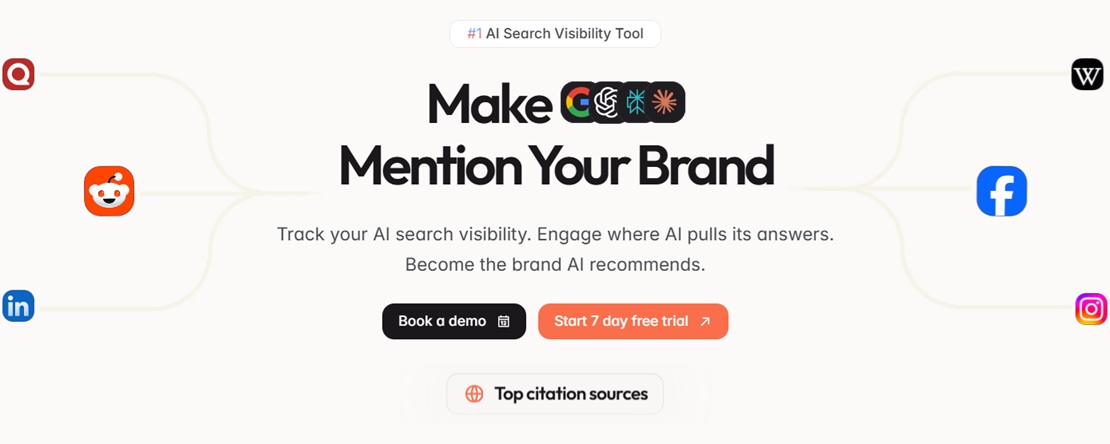
CrowdReply is the one tool here that treats tracking as step one instead of the whole product.
It tracks prompt-level citations across up to seven models, and it shows your competitor’s citation set right next to yours. Then, it does the part that actually matters: hands you the workflow to go win the citations you’re missing.
What CrowdReply tracks is standard, at least on the surface. Your citations and share of voice across the major engines, daily, with historical trend lines and full competitor tracking. The dashboard groups everything by prompt, competitor and citation source, which is exactly how I think about the problem.
Setup was quick. I dropped in a brand, imported a prompt set, picked my models and had a first read the same day. But what I really like is what happens after the dashboard. Most tools stop at “here’s your gap,” but CrowdReply keeps going.
There’s more plumbing underneath than I expected. An LLM Traffic pixel shows the real visits AI drove to your site. AI crawler log analysis shows what the bots read before they decided whether to cite you.
When I traced a missing citation, that combination let me see the whole chain, from what the crawler ingested to what finally got attributed. Most tools show you the outcome. CrowdReply shows you the cause.
The MCP server is a small thing I ended up using constantly. I could query my own visibility gaps straight from inside Claude and ChatGPT, without opening the dashboard at all. For the way I actually work, that turned out to be the stickiest feature of the lot.
Here’s the catch, because there’s always one: CrowdReply is younger than Profound. If you want the most battle-hardened enterprise reporting visuals in the category, that’s not the pitch yet.
The Starter plan also caps you at two models and twenty prompts, so serious multi-engine tracking means Growth or above. Moreover, the engagement-credit model takes a beat to wrap your head around if you’re used to a flat monitoring fee.
Pricing is refreshingly readable. Starter is $99 a month, Growth is $299 and Enterprise starts at $499 with all seven models plus a dedicated account manager. There’s a 7-day free trial. Every plan bundles engagement credits.
On the pricing page, customers report lifts like 47% more LLM visibility and 75% citation coverage. Treat those as their results and not a promise to you. The direction is the point.
All things considered, this is my take on CrowdReply:
- Get it if you’re a mid-market B2B SaaS team that has found a citation gap and needs to move the number;
- Don’t get it if you only want a chart and have a separate team to do the fixing.
If this feels like the right tool for you, you can start here.
2. Profound: best for enterprise depth
Profound is the serious enterprise option, and it’s more than deserving of that label. It runs millions of prompts a day and has the deepest prompt-level analytics I tested. When I dug into its Conversation Explorer, I got real AI search-volume data that most tools simply can’t show you.
The standout for me was Agent Analytics. It traces which AI crawlers hit your site, how often, and which pages they read. Then it correlates that crawl behavior with citation outcomes. That means it can help you diagnose why a citation was lost, not just tell you that it vanished. Nothing else I tested does that as cleanly.
Profound is also built for procurement. SOC 2 Type II, SSO, role-based access, the whole checklist. And it’s clearly well backed, having raised a $96M Series C at a billion-dollar valuation in early 2026.
Where it lost me is price and posture. Entry sits around $499 a month and climbs steeply from there. I’ve also seen a cheaper Lite tier mentioned in places, so confirm current pricing with Profound directly.
Profound is also retrospective, at least for the most part. It tells you what happened in AI answers beautifully, but it won’t stop stale claims about you from getting cited in the first place.
In sum:
- You should get it if you’re an enterprise that needs the deepest analytics and crawler-to-citation attribution, with a team to act on it;
- You shouldn’t get it if you’re a lean team that needs the tool itself to help you fix things.
3. Peec AI: best for the “used vs cited” distinction

Peec AI is the cleanest, most focused dashboard I used, and it has one genuinely original idea. It separates “used” sources (the domains the model leaned on to build its answer) from “cited” sources (the ones it actually linked). That gap sounds small; it isn’t…
When I looked at my own data in Peec AI, I could see pages that were clearly shaping answers without ever getting attribution. That’s the difference between influencing the model and getting the traffic credit for it.
Peec AI is the only tool I tested that draws the line that clearly. Its Actions module then scores your source gaps by estimated impact. That turns a vague “you’re under-cited” into a prioritized to-do list a content strategist can work through.
That was the one report I actually forwarded to someone on the team. Most tools hand you a number and leave you to figure out what it means, but Peec AI handed me a ranked queue of gaps worth closing.
Pricing is transparent, at least in theory. One prompt times one model times one day is one credit, and every plan includes unlimited seats, which is genuinely rare. Starter runs about €89 a month.
The catch is the add-ons. Base plans only cover three engines, so every extra engine tacks on €20 to €30 a month. The advertised price is rarely what you actually pay once you cover the engines that matter.
There’s no crawler log analysis either (at heart, Peec AI is still a monitoring tool). The Actions feature is a real step toward doing something, but it’s early.
Long story short, I recommend Peec AI to B2B marketing and content teams that want clean, multi-region citation analysis and care about the influence-versus-attribution gap.
4. Otterly: best for a budget first baseline
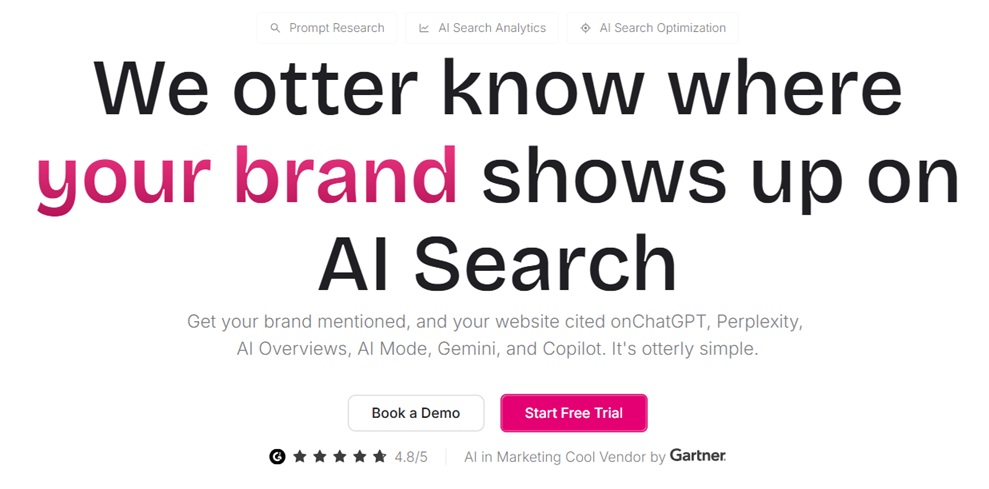
Otterly is where I’d tell a small team to start when money is tight. It’s the cheapest real entry point in the category at $29 a month, yes, but it doesn’t feel like a toy. It captures every cited URL and source domain for your tracked prompts and logs link-position changes over time.
What I liked in testing was the URL-level honesty. It shows which specific links are cited, not just that your brand got a passing nod. Its GEO Audit then points at the on-page factors hurting your citation odds (such as structure and parsability).
Otterly even plugs into the Semrush App Center if you want your GEO data sitting next to your SEO data. For a first baseline, that’s a smart touch. I had it set up for a small side project in about ten minutes, with a clean read on which URLs were getting cited and no hand-holding.
The limits are the limits of a starter tool, and that’s fine as long as you know it going in. It’s monitoring only, with no execution behind it. Data refreshes weekly on the lower tiers, which is too slow when citations are drifting fast.
The prompt-based pricing also scales quickly, with the Pro plan reaching $989 a month once you need real volume. Unfortunately, Gemini and AI Mode are add-ons, not included.
Upon review, this is my take on Otterly:
- You should get it if you want an affordable, automated baseline to learn where you stand;
- You shouldn’t get it if you need real-time data or anything past the report itself.
5. Scrunch AI: best for crawler-feed intelligence
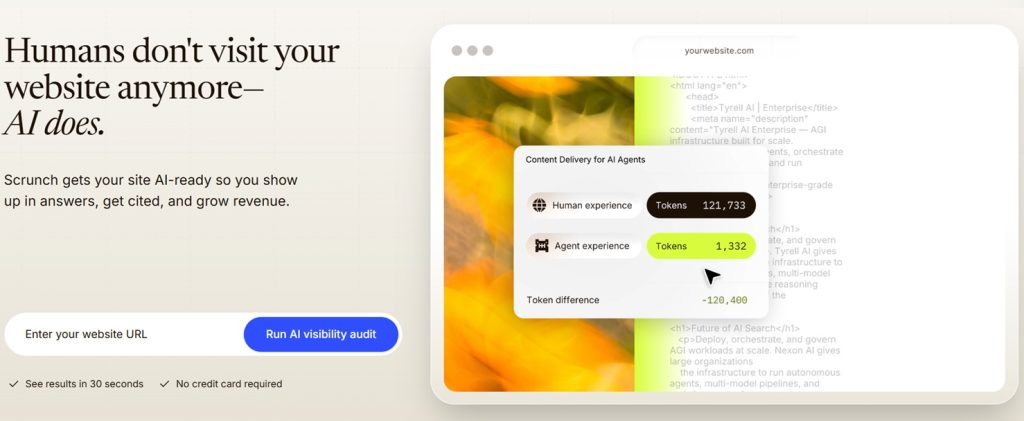
Scrunch is the most technically sophisticated tool I tested, and it comes at the citation problem from an angle most others ignore. It sits close to your infrastructure and shows you, in near real time, which AI bots are crawling your pages before they decide whether to cite you.
When I explored it, the crawler feed was the thing I kept coming back to. It ties into GA4 and Cloudflare and sorts bot visits into buckets like Citations, Training and Indexing.
Its citation trend analysis flags what’s rising, falling or newly appearing. That means you can catch a competitor dropping off a source before it ever shows up in your aggregate numbers.
Scrunch AI is also the only tool here with SOC 2 Type II, and it has real enterprise logos behind it. If you’re selling into procurement-heavy accounts, that matters more than any feature. Watching a bot hit a page in the feed, then seeing whether a citation followed, is a genuinely different way to work the problem. It moved me from guessing to watching.
The downsides are pricing and cadence. Core starts at $250 a month, and data refreshes every three days as standard, which is slower than the daily tools. Its slickest feature, the Agent Experience Platform that serves a token-light version of your site to AI agents, is enterprise-only.
It also doesn’t touch content freshness, which is a big downside. It optimizes how AI reads your pages, not whether the facts on them are still true. That’s why I believe it’s best suited for enterprise and technical teams with complex, JavaScript-heavy sites that AI struggles to parse correctly.
6. Semrush AI Visibility Toolkit: best if you already live in Semrush
If your team already runs on Semrush, this is the path of least resistance, and it’s a genuinely good one. The AI Visibility Toolkit layers citation tracking into a stack you already know, with no new login to fight over.
The thing that impressed me is that it’s one of the few mass-market tools with the whole loop in one place. You track citation share against up to nine competitors per prompt, run an AI site audit to catch the technical issues blocking the bots, and then act on the gaps with the content, backlink and PR tools already sitting there.
Coverage is where Semrush frustrated me. Its AI tracking is architected around Google AI Overviews, so it misses a real chunk of the discovery happening in ChatGPT and Perplexity.
On the base plan, there’s no prompt intelligence, so you can’t see what users are actually asking. Moreover, the AI features are scattered across a few tools rather than living in one clean workflow. Pricing starts at $139 a month for SEO, with bundled AI visibility on the higher tiers.
So, should you get Semrush?
- Yes, if you’re already a Semrush shop and want AI visibility as an incremental layer;
- No, if you need deep, multi-engine citation data as your main job.
7. SE Ranking: best budget SEO and AI in one view
SE Ranking is the sensible budget pick for a team that wants traditional rank tracking and AI citation tracking in a single view. It starts from about $95 a month, and the AI tracking is included in the Pro plan rather than sold as an add-on.
The tool layers AI mentions and citations on top of thirteen-plus years of SEO data. In testing, it did the basics well: citations and mentions across ChatGPT, Google AI Overviews and Perplexity, sitting right next to your keyword rankings.
For a team making the jump from SEO to AI search, that side-by-side view is a clean mental model to start from. But SE Ranking is far from perfect…
The honest limit is depth. Its citation-level granularity and source analysis trail the dedicated AEO platforms. Its engine coverage is narrower, and there’s no optimization or governance layer.
SE Ranking tracks well, but it doesn’t help you act. That’s why I recommend it exclusively to budget-conscious SMBs and agencies that want SEO and AI citation tracking under one roof.
How I tested
I judged each AI citation tracking tool on five things:
- Which engines they cover
- How granular their citation data is (URL versus mention)
- How transparent the real pricing is once add-ons hit
- Whether the tool helps you act on a gap or just reports it
- How usable the dashboard is day to day
I signed up where a trial existed, tracked the same brand and the same buyer-prompt set and compared the cited-source reports, side by side, for each tested tool. I walked the pricing tier by tier, then noted where each one fell short in normal use.
Every tool got judged against the same buyer profiles. The best-for call on each reflects where its strengths and weaknesses actually landed, not where its marketing says they do.
The gap most citation trackers don’t fill
Here’s the thing I kept running into with almost every tool on this list: they are very good at answering the question “am I being cited?”, but almost none of them help you answer the question “what do I actually do about it?”
That gap is not academic. The most common citation problem I see with teams isn’t invisibility. It’s a tool showing you a gorgeous chart of your gap, then leaving you to go fix it by hand, with no idea which lever to pull first.
Closing the gap does work when you actually do it. A Princeton GEO study found that adding citations, quotations and statistics to your content can lift how often AI pulls it by up to 40%:
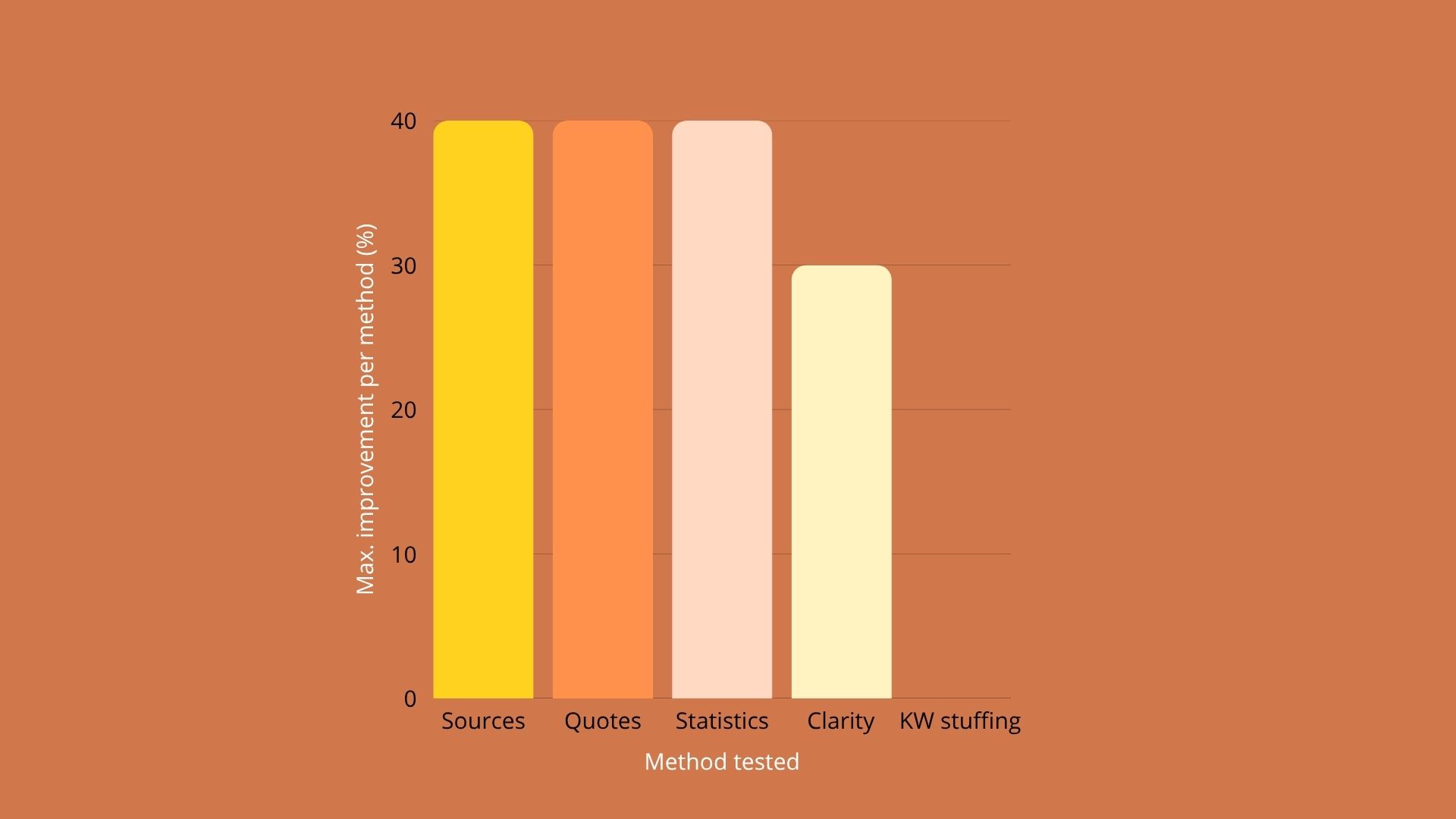
This means that the fix is knowable. The open question is whether your tool helps you execute it, or just hands you a report and wishes you luck.
That’s the real dividing line in this whole category. Monitoring is table stakes now (everyone does it mostly fine). What separates a tool worth paying for is whether tracking flows into action or dead-ends at a dashboard you can admire but can’t act on.
How to choose the right AI citation tracker
The big question is: what do you plan to do the day after you see your gap?
- If you’re a mid-market B2B SaaS team with a real visibility gap and you need to move the number, start with CrowdReply. It’s the one built around closing the gap, not just charting it, and it’s priced for teams that aren’t ready to sign an enterprise contract.
- For enterprise depth with crawler attribution, go Profound.
- If your budget sits around $30 per month, try Otterly.
- If the “influence-versus-attribution” question is at the center of your strategy, I recommend Peec AI.
- For a technically messy site that AI can’t parse, go Scrunch AI.
- If you’re already living in Semrush, stay in Semrush.
- If you want SEO and AI in one budget view, try SE Ranking.
The mistake I see teams make is buying for the dashboard, then discovering a quarter in that they needed the action layer all along. Buy for what you’ll do, not for what you’ll look at.
How to find your citation gap this week
You don’t need to buy anything to start. Here’s the exact self-check I run, and it takes about half an hour:
- Pick ten prompts your actual buyers would type (not keywords but prompts, the full questions people ask an AI out loud).
- Run each prompt through ChatGPT, Perplexity and Google AI Overviews.
- For every answer, log the sources it cited (just the URLs, in a spreadsheet, with the prompt and the date beside them).
- Look at the pattern: which domains keep showing up? Are any of them yours? Which competitor keeps getting cited exactly where you don’t?
That list of sources you’re missing is your citation gap, in plain sight. For each one, you’ve got two moves:
- Match the content that’s winning the citation;
- Go earn your own spot on the source the AI already trusts.
Do this once, and you’ll understand your position better than any dashboard will explain it in week one. Better still, you’ll know which tool you actually need before you spend a cent. Get started today with CrowdReply.
Frequently asked questions
What is the best AI citation tracking tool?
CrowdReply is the best pick for most teams because it’s the only tool in the category built around closing your citation gap, not just measuring it. Profound is the stronger choice for enterprise buyers who need the deepest analytics, while Otterly fits teams whose budget tops out around $30 a month.
What is an AI citation, and how is it different from a backlink?
An AI citation is a source an AI answer references when responding to a prompt. It’s different from a backlink because a backlink is static and permanent until removed, while an AI citation is regenerated on every prompt and can change by engine and by day.
Which AI engines show their sources?
Perplexity and Google AI Overviews show source links on almost every answer, which makes them the most trackable. ChatGPT only reveals sources when it’s browsing the web, so its citation data is less reliable. Gemini and AI Mode are expanding source visibility but still vary.
How do I track which sources ChatGPT uses?
You track ChatGPT sources by running the same prompts with browsing enabled and capturing the links it shows in its Sources view. Store the prompt, the date and the cited URLs, then trend them week over week.
How many prompts do I need for reliable tracking?
Most teams get a stable read from a set of 25 to 100 prompts that mirror real buyer questions, split across your money, problem and proof topics.
Are there free AI citation tracking tools?
There’s no strong fully free citation tracker, but the cheapest real option is Otterly at $29 a month (several tools offer trials, though).
Is AI citation tracking the same as AI brand monitoring?
No. AI brand monitoring tells you whether your business gets mentioned in an AI answer, while AI citation tracking tells you which specific URLs were cited as sources.