TL;DR
- Generative engine optimization (GEO) is shaping content so AI engines like ChatGPT, Perplexity, Gemini and Google AI Overviews cite it in their answers.
- Different AI engines require different GEO approaches, but the playbook is essentially the same across platforms.
- Adding citations, quotations and statistics lifted AI visibility 30-40%, showing GEO is an actual discipline with proven success methods.
- How to get started: add sourced statistics and expert quotations to your highest-value pages, allow the AI crawlers in robots.txt and then track whether engines start citing you.
SEO earns you a ranked link that people click. GEO earns you a place inside the answer itself. Most marketers hear that definition and think it’s SEO with a fancier name. But while the skepticism is healthy, that doesn’t tell us the whole truth.
In fact, GEO came out of actual research and deserves to be its own discipline. Some of it works and some of it is snake oil sold with confidence. The job of this article is separating the two.
What follows: the definition and where the term came from, how the engines actually pick their sources, what beats what (with effect sizes), how the engines differ from each other, how to measure any of it and where the whole thing can go wrong.
What is generative engine optimization?
Generative engine optimization (GEO) means shaping your content and its off-site footprint so generative AI engines retrieve it, trust it and cite it when they compose answers.
What’s new about GEO
Despite being similar to SEO in many ways, generative engine optimization is a new type of engine optimization. The big novelty is that, in GEO, the win condition is visibility inside the answer (a citation, brand mention, quoted claim, etc.), not a position on a results page.
That distinction changes what the work looks like day to day. You structure pages so a model can lift a clean answer from them, back claims with named sources because engines favor material they can verify and keep your entity story consistent across the web so the model knows exactly who you are.
Say you run a project management tool and buyers keep asking ChatGPT which option handles client billing best. GEO work on that page means a named statistic in the opening paragraph, a quoted line from a recognizable expert and a claim structure an engine can quote without cleanup.
What counts as a generative engine
A generative engine is any system that answers a question by generating prose on top of retrieved sources instead of listing links. Five matter right now:
- ChatGPT: The conversational giant, pulling from search partners plus its own crawler.
- Perplexity: Built citation-first from day one, running on its own index.
- Gemini: Google’s assistant app, grounded in Google’s infrastructure.
- Google AI Overviews and AI Mode: The generative layer sitting on top of classic Google Search.
- Copilot: Microsoft’s take, woven through Bing and Windows.
Each gets a proper breakdown later in this article. The shared traits are the ones that matter for now: they all compose answers, pick their sources and decide whether your brand exists in the response.
Notice what’s absent from that list: the base chat models answering from memory alone instead of training data. GEO targets the engines that retrieve live sources because that’s the step you can actually influence.
Where did GEO came from?
Unlike other AI search acronyms, the term ‘generative engine optimization’ has scientific ground. It came from a 2023 Princeton paper published by a team of machine learning experts.
Why the paper matters
The Princeton paper matters because the authors did something the marketing world rarely does: they treated getting cited by an AI engine as a measurable question.
The researchers didn’t came up with the term out of nowhere. They defined visibility metrics, applied nine different optimization tactics to real web content and measured which ones changed what the engines cited.
How GEO was tested
Because the term was born in a paper with a public benchmark, GEO claims are testable. When someone tells you a tactic works, you can ask what it did on the benchmark.
To test any of it, the Princeton researchers built ‘GEO-Bench’, a benchmark of 10,000 queries drawn from datasets like MS MARCO, Natural Questions and ELI5, each annotated with relevant web sources. They also released it publicly so other researchers could rerun the tests.
Compare that to how most marketing terms are born. Someone coins a phrase on a conference stage, agencies productize it within a quarter and nobody can say what the baseline was. GEO started from the opposite end, with a measurement standard before a sales pitch existed.
How generative engines build an answer
Every generative engine runs the same loop:
- Retrieve
- Synthesize
- Cite
Your content only enters that loop if the engine’s crawler can reach it and its retrieval step can score it. All of GEO targets one of those two gates.
How Google AIO does it
AI Overviews rank through retrieval-augmented generation. The model takes your question, fans it out into a set of related queries, pulls indexed pages for each and writes an answer on top of what it retrieved. It’s all there in Google’s own AI optimization guide.
Query fan-out is the part where one question becomes several. A question about reviving a patchy lawn, for example, might spawn queries about grass types, watering schedules and regional climate.
Your page can enter the answer through any of those side doors, not just the head query, and that has a direct structural implication. Pages built as a set of clearly headed subtopics give the fan-out queries more doors to walk through. One long undifferentiated essay gives them one.
How ChatGPT does it
ChatGPT runs a similar play… with different plumbing. In a nutshell, it rewrites your prompt into targeted queries that it sends to third-party search providers.
OpenAI is explicit about the entry ticket: a site has to allow the OAI-SearchBot crawler to appear in ChatGPT search results at all. Being crawled doesn’t mean you will rank, but it’s the part you can control.
The practical takeaway? GEO doesn’t target a ranking algorithm; it targets the retrieval step (can the engine find and score your content?) and the synthesis step (is your content easy to lift a claim from?). Both are workable problems.
Simplifying the terminology: GEO, SEO, AEO and more
It’s not just GEO. There are more engine optimization acronyms to know than ever before, from the ‘OG’ SEO (search engine optimization) to the new AEO (answer engine optimization). But how do they compare to generative engine optimization?
Let’s simplify things, starting with the more important distinction:
GEO vs SEO
The essential difference? SEO deals with pages; GEO deals with passages. Engines extract at the paragraph level, which is why a 4,000-word page of mushy prose can lose to a 900-word page with three clean, liftable claims.
Here’s a quick overview on how the two compare:
| Dimension | SEO | GEO |
|---|---|---|
| Goal | Rank a page on a results list | Get cited inside a generated answer |
| Surface | Search results pages | AI answers in ChatGPT, Perplexity, Gemini and AI Overviews |
| Unit of competition | The page | The passage, claim or entity |
| What you optimize | Keywords, links, technical health | Sourcing, structure, entity clarity, crawler access, third-party footprint |
| How you measure | Rankings, clicks, organic sessions | Mentions, citations, share of voice, AI referral traffic |
There are three genuine divergences:
- The reward: citations inside answers instead of clicks to your site.
- The extraction level: passages instead of pages.
- The weighting of the off-site footprint: engines pull heavily from third-party sources, so what other sites say about you carries more of the load than it did in classic SEO.
On the other hand, these are the most significant similarities between SEO and GEO:
- Crawlability still decides whether you’re in the pool
- Structured, well-organized content still wins the retrieval step
- Authority signals still matter because the retrieval layer of most engines runs on search infrastructure
For an in-depth take on the topic, please refer to our GEO vs SEO guide.
GEO vs AEO, AIO and LLMO
GEO, AEO, AIO and LLMO are four different acronyms used to describe the same essential task – AI search optimization. Here’s how AEO, AIO and LLMO compare to GEO:
- AEO (answer engine optimization): Virtually identical to GEO, but with an added focus on being the answer rather than being the source cited by the answer. This is was extensively covered in our AEO vs GEO comparison.
- AIO (AI optimization): It’s often applied to AI search optimization as a whole but, technically, refers to tasks specifically aimed at improvising visibility in Google AI Overviews.
- LLMO (large language model optimization): Also used as an umbrella term, it focuses on increasing visibility inside model outputs.
The pragmatic guidance: pick one label internally, put it in your briefs and your reporting and do the same underlying work no matter which acronym stuck. The work is identical.
And please don’t pay anyone extra for the acronym! If a proposal reads the same under GEO as it does under AEO, you’re buying the work, not the letters.
Why GEO matters now
GEO matters today because the audience has already moved. Billions of people now get answers from generative surfaces, and the classic blue-link click pays out less every quarter. Those are the two facts this whole discipline stands on.
The 2026 adoption numbers
Start with Google. According to CEO Sundar Pichai, “AI Overviews now has over 2.5 billion monthly active users.” AI Mode passed 1 billion monthly users within a year of launch. The Gemini app crossed 900 million monthly users per the same keynote, more than doubling in a year.
Simultaneously, ChatGPT reached 900 million weekly active users, with 50 million paying subscribers as of February 2026. That’s weekly, not monthly!
None of those users are your buyers by default. But some slice of them is asking questions in your category right now, and doing so in an interface where you either got retrieved or you didn’t.
What it does to your funnel
This is what increasing AI adoption means for generative engine optimization:
- There are fewer clicks on informational queries: The clickthrough decline covered in the intro is a trend line, not a blip. It has worsened as AI Overviews expanded coverage.
- Brand discovery is happening inside answers you don’t control: When a buyer asks ChatGPT for the best option in your category, the engine composes a shortlist from whatever it retrieved. There’s no page two: you’re on it or you’re not.
Picture the modern B2B evaluation. A buyer works through requirements, shortlists and objections in one long chat thread, then visits two websites at the very end. Everything that shaped the decision happened on a surface your analytics never saw.
Here’s the framing that makes GEO click for most operators. You don’t opt out of being described by AI. The engines describe your brand either way. The only choice available is whether you influence the description.
How to rank using GEO tactics (backed by research)
Remember the Princeton paper that established the concept of generative engine optimization? It also happens to be one of the best document we have to assess the efficiency of GEO tactics right now.
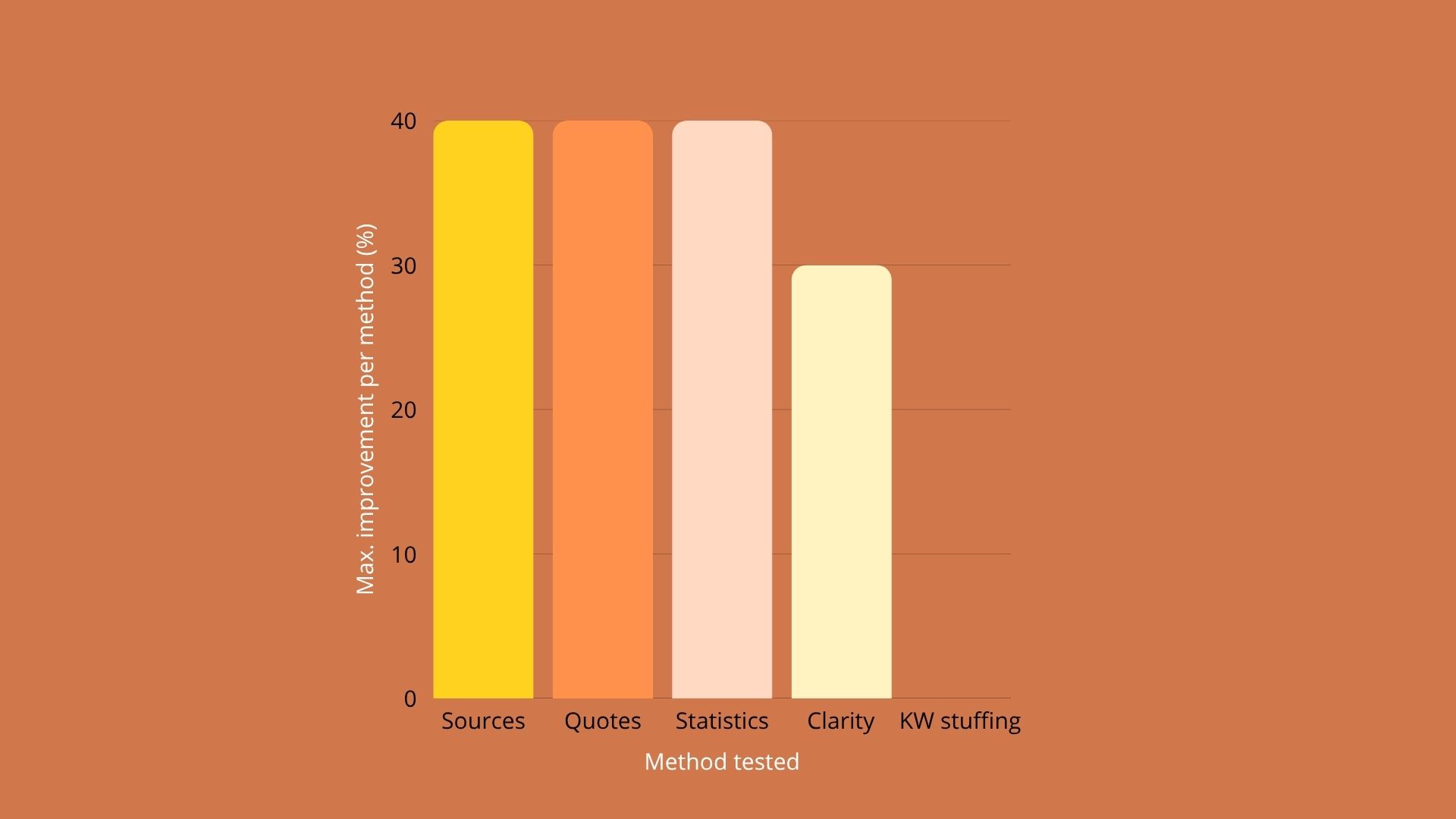
Here’s what works, based on Princeton’s findings:
| Tactic | Measured lift | Engine validated on | Caveat |
|---|---|---|---|
| Add citations to credible sources | Up to 40% relative visibility gain | Study engine plus Perplexity | “Up to” means best case, not average |
| Add quotations from relevant sources | 30-40% band. 22% lift on Perplexity | Study engine plus Perplexity | Quotes need real named sources, not decoration |
| Add statistics | 30-40% band on the primary metric | Study engine plus Perplexity | Strongest when paired with fluency work |
| Improve fluency and readability | 15-30% boost | Study engine | Second tier but cheap to execute |
| Keyword stuffing | Little to no improvement. About 10% worse on Perplexity | Study engine plus Perplexity | The classic SEO reflex actively backfires |
40% improvement: cite sources, quote experts and add statistics
Adding citations, adding quotations from relevant sources and adding statistics each lifted visibility on the study’s primary metric, going up to 40%.
The live-engine validation held up too. On Perplexity itself (which is a deployed commercial engine, not a lab rig), quotation addition registered a 22% lift in the visibility metric.
What this looks like in practice:
- Take the section of your page that answers the money question.
- Give it a named statistic with a source, a short quote from someone with a real title and a number the engine can repeat.
Engines prioritize verifiable claims because they’re safer to synthesize.
30% improvement: make content readable and fluent
Fluency optimization (i.e., simplifying and smoothing the language) moved visibility 15-30% on its own. Your English teacher was right all along: plain sentences that state one thing cleanly beat clever ones.
The edit itself is unglamorous:
- Break the 40-word sentences in half.
- Cut the jargon a model would have to translate before quoting.
- Make the first sentence of each section carry the section’s answer.
In a smaller follow-up analysis, pairing tactics beat any single tactic. The best pair, fluency plus statistics, outperformed the best single strategy by more than 5.5%.
0% improvement: keyword stuffing
Keyword stuffing offered little to no improvement. In fact, it even performed about 10% worse on Perplexity! If you’re relying on this old SEO tactic, you’re doing more harm than good to your brand…
The authors put the lesson in one line: “techniques effective in search engines may not translate to success in this new paradigm.”
Don’t forget to let the AI crawlers in
None of the above matters if the engines can’t read your site. That’s why letting the AI crawlers in should be your number one move (call it ‘tactic zero’).
We already know that ChatGPT search requires OAI-SearchBot access. Perplexity, on the other hand, runs its own index through PerplexityBot. The bot indexes content to surface sites in search results without being used for foundation-model training, while a separate Perplexity-User agent fetches pages when a user asks.
So, open your robots.txt file and check it line by line. If a blanket disallow rule is blocking OAI-SearchBot, PerplexityBot or Google-Extended, your GEO ceiling is zero no matter how good the content is. Two minutes of checking before any content work.
For more hands-on advice on generative engine optimization, please consult our GEO optimization playbook.
The underdog effect: why GEO favors smaller sites
Buried in the study is the finding that should interest smaller sites most. In a simulation where all sources optimize at once, the cite-sources tactic produced a 115.1% visibility increase for sites ranked fifth in traditional search results. The top-ranked site lost 30.3% on average.
That’s the study’s simulation scenario, not a market observation. Still, the direction is the point. Classic search compounds incumbent advantages. Generative answers reward whoever hands the engine the most liftable, verifiable material, which is a game a smaller site can actually play.
The workflow falls out of the ranking. Pick your highest-value pages, add a sourced statistic and a named-expert quote to each section lead, then clean up the fluency. Verify crawler access last.
Engines also reward third-party coverage of your brand (more on that in the per-engine section below). As for cadence, this isn’t a one-time project. Treat it like a monthly editing pass over the pages that earn revenue, not a sitewide retrofit.
What Google says vs what the research shows
Google’s official position is blunt: ordinary SEO is all you need for its AI features, and several tactics sold under the GEO banner are wasted effort for Google Search specifically.
What Google tells you to ignore
Google’s AI guidance lists what site owners can skip for Google Search:
- llms.txt files and special AI markup
- Chunking content into fragments
- Rewriting content specifically for AI systems
That’s the whole memo, but is it really the whole picture? And how does it relate to the Princeton paper findings?
How that squares with the research
The Princeton findings were measured mostly on non-Google engines, with the live validation run on Perplexity. Google’s dismissals cover Google Search. There’s no contradiction, just two scopes talking past each other in the trade commentary.
The practitioner guidance falls out cleanly. Don’t buy llms.txt packages for Google visibility, because the operator of that engine says they do nothing there. Do apply the citation, quotation and statistics tactics on the engines where they’re measured.
And notice the deeper agreement. Google asks for clear structure and verifiable claims on crawlable pages. The research rewards the same list. The two camps disagree about acronyms and hacks, not about the actual work.
When someone on your team asks whether to buy the llms.txt package, the answer now writes itself. For Google, the engine’s operator says no. For the other engines, ask for measured evidence, because the research that does exist never tested llms.txt as a visibility tactic.
Differences between AI engines
There is no single thing called AI search. A 2025 cross-engine study found the engines differ measurably in domain diversity, freshness weighting, cross-language stability and sensitivity to phrasing.
ChatGPT vs Perplexity vs Gemini/AIO vs Claude
The fundamental differences, summarized in one table:
| Engine | Index and crawler | Citation behavior | What to tune |
|---|---|---|---|
| ChatGPT | Third-party search providers. OAI-SearchBot must be allowed | Citations still rare. Wikipedia and Reddit lead when they appear | Crawler access, liftable claims, earned media |
| Perplexity | Own index via PerplexityBot | Citation-forward by design | robots.txt access, quotations, statistics |
| Gemini and AI Overviews | Google Search index | Grounded in Search ranking | Ordinary SEO fundamentals plus extractable passages |
| Claude | Fetches the web when it searches | Cites sources in web-search answers. No published behavioral measurement yet | Fundamentals first. Watch your own referral data |
Specific challenges
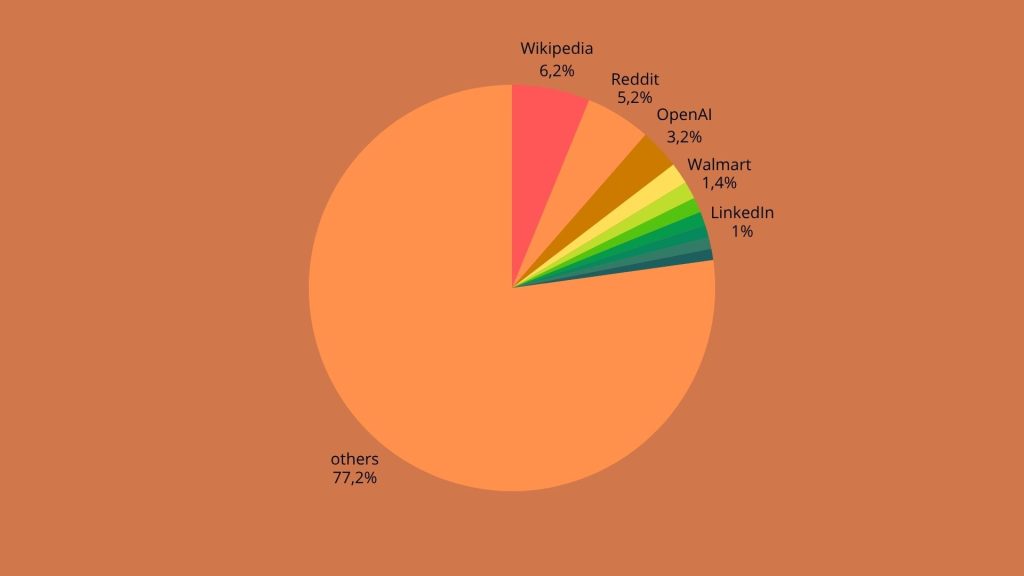
ChatGPT poses its own set of challenges. According to Similarweb, only 2.8% of ChatGPT answers carried citations as of August 2025. That is underwhelming even if you consider that the number sat at only 0.6% by January of the same year.
When citations do appear, Wikipedia (6.2%) and Reddit (5.2%) take the lead, followed by other authoritative platforms such as YouTube and Google itself:
Claude works differently: its web search cites sources, but engine-level citation patterns haven’t been measured the way the other three have. If Claude referrals matter to your business, watch your own analytics before optimizing for it specifically.
How to deal with different AI engines
Because engines respond differently to how a question is worded, a brand can be visible for one phrasing of a buyer question and absent for its synonym. You should cover the variants by answering the same core question under a few naturally different headings across the page rather than betting the whole thing on one canonical phrasing.
The practical read? Optimize the shared fundamentals once. Verifiable claims, clean structure, open crawlers, strong earned media, you know the drill. Tune per engine only if your own traffic data gives you a reason to.
The one bias they share: earned media
The study found a systematic, overwhelming preference for earned media, meaning third-party sources the engines treat as neutral, over brand-owned and social content.
This means what other sites say about you carries more weight inside AI answers than what you say about yourself.
Your own site is only half the surface area. Earned media (reviews, industry publications, comparison posts and reference pages) is the other half. It’s an uncomfortable but useful truth, and it should definitely reshape budgets.
Are GEO wins worth chasing?
Based on Similarweb data, they most certainly are. After all, AI referral visits across the web more than tripled between September 2024 and September 2025. The same panel has ChatGPT referrals converting at 7.1% in its April to May 2026 window, ahead of organic, direct, social, email and display, and only behind paid search (7.8%).
Then came May 7, 2026. ChatGPT started placing clickable brand links inside its answers. Tracked referrals jumped 157.7% week over week. Homepage referrals rose 354.7%, pushing homepage landings from roughly a quarter of the mix to about 60%.
One platform change, overnight, for brands that were already getting cited. If your pages were in the citation pool that week, the jump landed in your referral numbers before you’d read the announcement.
The takeaway is simple:
- Small volume
- High intent
- Compounding
The engines are turning into a referral channel, not just an answer wall. The brands collecting citations now are positioned for whichever distribution change the platforms ship next.
How to measure generative engine optimization
Measuring GEO is not the same as measuring SEO because, as established above, they focus on different prizes (mentions for GEO and rank for SEO).
With that in mind, there are two key factors worth considering:
1 – The four metrics of GEO measurement
The four metrics below are pertinent to GEO regardless of the tool. Each metric implies a distinctive measurement method:
- Mention rate: Build a fixed set of prompts a real buyer in your category would ask, run them on a schedule and track how often your brand appears in the answers.
- Citation rate: Track how often your pages get cited as sources, plus which pages. Your cited pages are your GEO templates.
- Share of voice: Score the same prompt set against named competitors. A mention means less if a rival gets mentioned twice as often.
- AI-referred traffic: Sessions and conversions arriving from AI surfaces, pulled from referrer data in your analytics.
2 – The tools that can help you
On the Google side, Search Console ships a Generative AI performance report covering AI features in Search and Discover. That satisfyingly handles one engine’s slice of the picture.
For the rest, look for purpose-built trackers. Platforms like CrowdReply, Profound and Peec AI track prompts, mentions and citations across engines. Referrer filters in your analytics cover the traffic end.
A workable starter set is 10-20 prompts: a few direct brand questions, a few category questions a buyer would ask before knowing any vendor names and a few head-to-head comparisons against your top competitors. Keep the set fixed for at least a quarter so the trend line means something.
GEO risks and limits
GEO is a young discipline that poses its own set of risks.
Let’s start by considering volatility. The May 2026 brand-links change covered earlier nearly quintupled homepage referrals in a week… without warning! This means your GEO metrics need to be monitored constantly.
Attribution is the second problem. Citations are still rare in most engines’ answers and referral data is young. So, expect noisy measurement for a while. That makes instrumenting early matter more, not less, as you need a baseline before you can claim a lift.
The third risk is the quiet one: bad information. For example: a page ranking in the top 10 for this very keyword (‘what is generative engine optimization’) still promotes Neeva as an up-and-coming AI engine, but the platform was shut down years ago, in 2023.
The honest cost framing to close on: most GEO work is just good-content work. The incremental cost is instrumentation plus sourcing discipline, meaning a tracker subscription, a citation habit and an hour a month reviewing crawler access. If that sounds boring, good. Boring is what testable looks like.
The one-week starter loop I recommend:
- Pick your five most valuable pages
- Add a sourced statistic and an expert quotation to each page’s key section
- Confirm the AI crawlers aren’t blocked in robots.txt
- Run the same 10 buyer prompts through two engines today
- Repeat monthly
Note where you show up, where competitors show up instead and which of your pages actually earn citations. That’s a GEO program: small, measurable and honest about what it knows. No mystique required.
When you’re ready to see where you currently stand, run a free AI visibility check and let the baseline tell you which tactic to reach for first.
Frequently asked questions
Is GEO replacing SEO?
No. GEO extends SEO to answer surfaces rather than replacing it. The work diverges at the citation and synthesis layer; fundamentals remain the same.
What’s the difference between SEO and GEO?
SEO earns a ranked link people click while GEO earns a citation inside an AI-composed answer. SEO competes page against page while GEO competes passage against passage.
Are there risks to generative engine optimization?
The three most significant GEO risks are volatility, noisy attribution and the compounding cost of unverified claims.
Is generative engine optimization the future of digital marketing?
AI surfaces already answer billions of queries, with AI Overviews alone reaching over 2.5 billion monthly users. GEO is surely a part of the future, but it adds to search, social and email rather than replacing them.
How do you do generative engine optimization?
The proven methods are: add citations, expert quotations and statistics to your key pages; keep the language readable; allow the AI crawlers in robots.txt; build third-party coverage of your brand.
Why is generative engine optimization important?
GEO is important because a growing share of buyers now get answers instead of links. Clickthrough on AI Overview queries has fallen sharply, and the engines describe your brand whether you like it or not. GEO is how you influence that description instead of leaving it to whatever the engine happens to retrieve.
How do you measure generative engine optimization?
Track four numbers: AI mentions, citations, share of voice and AI-referred traffic. Run a fixed prompt set on a schedule, score your brand against competitors and watch referrer data in analytics.