TL;DR
- The best AthenaHQ alternative for most teams: CrowdReply (it’s the one that fixes visibility gaps instead of just charting them).
- The best for enterprises: Profound.
- The best for narrow budgets: Otterly AI.
- The best for professionals who already own Semrush or Ahrefs: AI Visibility Toolkit or Brand Radar (respectively).
- I tested 8 AthenaHQ alternatives on pricing, engine coverage, action capability and how they actually feel to use day to day.
- The thing other lists won’t tell you: the real split isn’t features; it’s monitoring versus action. Most tools hand you a dashboard, but few help you move the number.
When my own brand kept getting skipped in ChatGPT (while a competitor got named), I stopped reading launch threads and started signing up. AthenaHQ was on my list, but guess what? While it’s genuinely good, it wasn’t the one I kept opening…
This experience inspired me to create this article. I’ve listed the 8 best AthenaHQ alternatives in 2026 below, and there are solutions for every type of team and project.
We’ll check the top alternatives, one by one, soon enough. First, allow me to tell you more about what AthenaHQ is and why it happens to be a very fine product, but just not the right solution for every one.
What AthenaHQ actually gets right
Let me start by being fair to AthenaHQ, especially since most of the “alternatives” posts out there bury it on their way to selling you something else.
In a nutshell, AthenaHQ is a generative engine optimization platform. It tracks how your brand shows up across AI search in ChatGPT, Perplexity, Google AI Overviews, Gemini, Claude and more.
AthenaHQ is a serious piece of software, not a weekend project. It’s a Y Combinator startup built by two ex-Google Search and DeepMind engineers that raised a $2.2M seed round, as reported by MarketingTech News in mid-2026.
Needless to say, it does a lot of stuff really well. For example:
- The model coverage is deep. The paid Starter plan watches nine models, which is more than most tools give you at any price.
- The content optimization agent is built in. This means it doesn’t just show you a gap; it also drafts a fix.
- There’s a free Essential tier with 300 credits. That’s an easy way to see your own numbers before you spend a cent, but…
- The enterprise side is real too. You can count on role-based access, SSO, multi-region tracking and BI dashboard support (for example).
This is not a “here’s why AthenaHQ is bad” article. AthenaHQ is good! The real question I wish to address is whether it’s the right fit for you… or whether one of the 8 tools below fits better and costs less.
Why I went looking for an AthenaHQ alternative
Three things pushed me off AthenaHQ:
1 – The messy credits math
AthenaHQ prices on credits, with one credit equaling one AI response. That sounds clean, sure, but it becomes messy once you do the math.
Say you track 50 prompts across 5 engines. That’s 250 responses per run. Now run it daily, because AI answers move, and add a second region. At this point, you’re burning thousands of credits a month before you’ve done anything with the data.
The $295 Starter plan comes with 3,600 credits, and I watched how fast that number drops once you turn on real multi-engine tracking. Moreover, you do need to run it repeatedly because AI visibility isn’t a fixed number, it’s a distribution.
A 2026 GEO paper measured four engines and found the sources they cite barely overlap from one day to the next. In conclusion, one snapshot is basically noise, but sampling often enough to get a signal is exactly what eats your credits.
2 – The gap between insight and action
This is the big one. AthenaHQ is excellent at telling you where you stand. The workflow to actually improve it is lighter at the tiers most teams can afford and the heaviest action features sit up in Enterprise.
The problem is that I don’t want to stare at a share-of-voice chart drop and then go build the fix somewhere else. What I really want is that the same tool that spotted the problem helps me close it. This gap is the main reason why I kept trialing other tools.
3 – The entry price and the setup tax
$295 a month is a real commitment before you’ve proven any return. Oh, and the “autonomous agents” framing, while impressive, means configuration. Some teams want to set up digital colleagues, but most just want to see their gaps and fix them this week.
What really matters in an AthenaHQ alternative
This is the essential question I invite you to ask: does the tool just watch, or does it help you act?
Monitoring versus action
Brand mentions, citations, competitor share of voice and sentiment: that’s table stakes. And to be honest, nearly every tool in this category monitors well. The thing that separates them is what happens next.
Some AI visibility metrics tools stop at the dashboard and leave the fixing to you. A few connect the gap to a workflow: content, backlinks, corrections, etc. That’s the stuff that actually moves your citation share, but that’s also the half of the problem most tools haven’t solved yet.
This matters because users have stopped clicking. According to Pew Research, people click a normal link 8% of the time when there’s an AI summary versus 15% when there’s no summary:
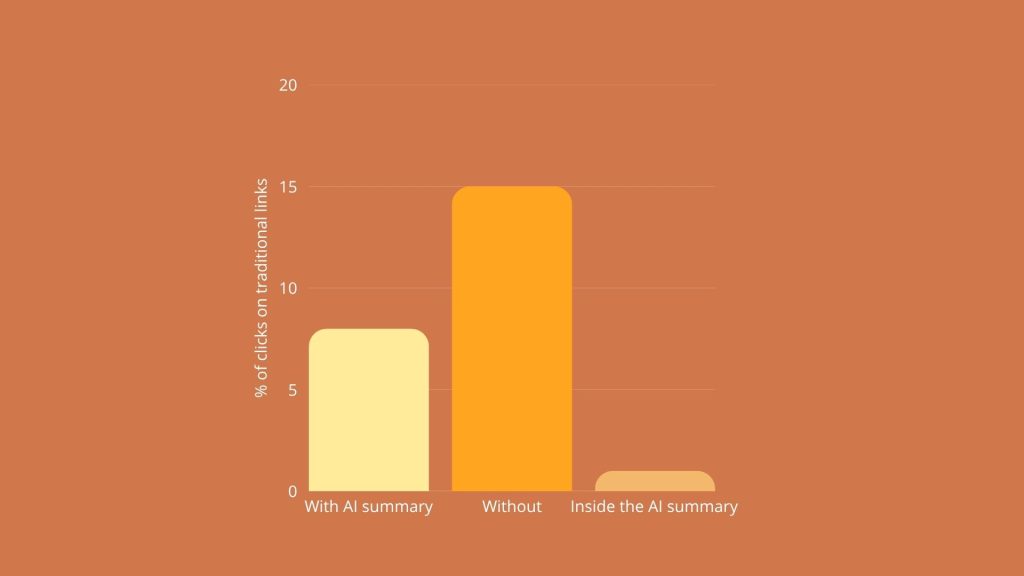
Being invisible in the answer is the main risk.
The boring stuff that still matters
Beyond the monitoring versus action split, I checked five things on every tool:
- Pricing you can predict
- Real engine coverage (does it track AI Overviews and AI Mode or does it just say “AI”)
- Seats and agency fit
- Sentiment and competitor tracking
- Usability and convenience (how fast I got to a useful read)
Those are the details that decide whether you’ll still be using the thing in three months.
AthenaHQ alternatives: the 8 best in 2026
Here’s the quick version before the deep dives (prices are entry-tier monthly):
| Tool | Best for | Entry price | Pricing model | Engines at entry | Action layer | Free trial |
|---|---|---|---|---|---|---|
| CrowdReply | Teams that need to move the number, not just watch it | $99 | Flat tiers + credits | 2 of 7 (up to all 7) | Yes, built in | 7 days |
| Profound | Enterprise and regulated teams | $99 | Flat tiers | 1 (ChatGPT) | Light | Yes |
| Peec AI | Agencies and international teams | ~$89 | Usage-based | 3 | No | Yes |
| Otterly AI | Solo marketers on a tight budget | $29 | Flat tiers | 4 | No | Yes |
| Scrunch AI | Technical SEO teams | ~$100 | Flat tiers | 8 | Delivery layer | Varies |
| Semrush AI Toolkit | Teams already on Semrush | $99 add-on | Flat tiers | 3 | Content tools | Yes |
| Ahrefs Brand Radar | SEO teams already on Ahrefs | Bundled | Ahrefs plan | Search-backed | Research only | Varies |
| Writesonic | Content teams that want to track plus write | $49 | Flat tiers | Multiple | Writing tools | Yes |
I ranked these by who I’d hand each one to, not by how big the brand is. Here’s what every tool does well and where it bit me:
1. CrowdReply: the best for teams that want to act on the data

CrowdReply is an AI visibility platform built around closing the loop. It tracks how AI models mention you, then puts the fix right next to the problem. That’s the piece I wanted from Athena and didn’t get at a price I liked.
What stood out in testing was the action layer. When I found a prompt where a competitor was cited and I wasn’t, I wasn’t sent off to build the fix elsewhere.
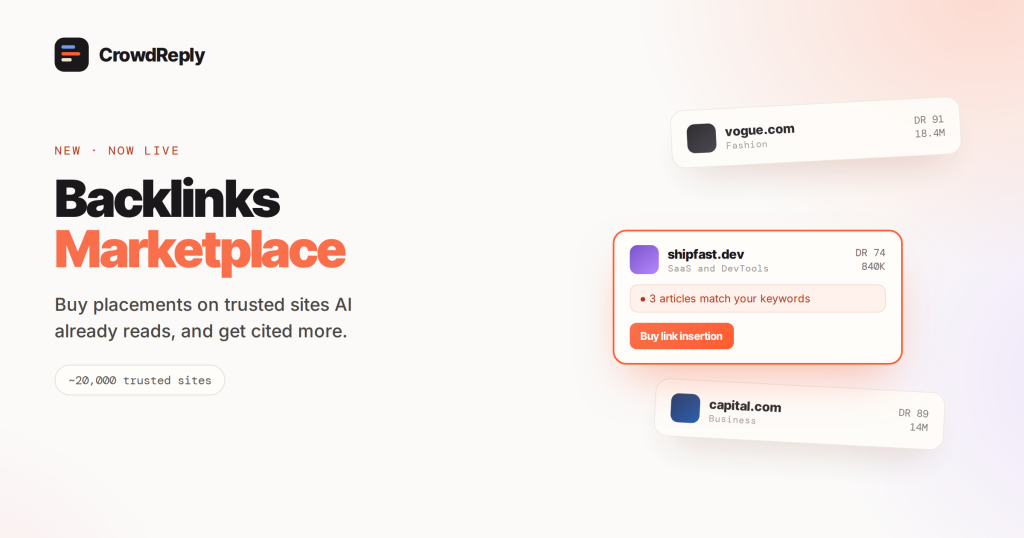
The Backlinks Marketplace let me order vetted editorial placements from a catalog of 40,000+ publishers, filtered by domain rating, traffic, country and citation rate.
The Engagement Engine puts your brand into the conversations AI actually reads and does so through platform-native accounts. Oh, and the Brand Knowledge Fixer targets the spots where AI just gets your facts wrong.
CrowdReply tracks daily, does competitor and sentiment tracking on every tier and gives you MCP plus API access even on the cheapest plan. Setup was fast – I had a useful read of my own brand inside the first session.
The pricing is refreshingly plain:
- Starter, $99/mo: 1 brand, 20 prompts, 2 models, the backlinks marketplace and $50 in monthly engagement credits.
- Growth, $299/mo: 3 brands, 75 prompts, 4 models, unlimited seats and $200 in credits.
- Enterprise, from $499/mo: 10 brands, 200 prompts, all 7 models and $300 in credits.
There’s a 7-day free trial and a 30-day money-back guarantee. Note the $99 entry undercuts AthenaHQ’s $295 Starter and still includes the action layer, not just tracking.
Since CrowdReply is my own tool, I also want to be honest about where it falls short: essentially, it is younger than some of the incumbents, and the category itself is still new.
If all you want is a read-only analytics dashboard to screenshot for a board deck, you’ll underuse half of what it does. The action layer is the point. If you’re not going to act, you’re paying for capability you won’t touch.
Should you get CrowdReply?
- Yes, if you’ll actually work the gaps the tool surfaces.
- No, if you only need a monitoring dashboard and nothing more.
2. Profound: the best for enterprise and compliance
Profound is the polished enterprise pick, and it’s the tool I’d send a buyer to if they need deep data and a compliance story more than they need a low price.
The standout is Agent Analytics: server-side tracking that captures how AI crawlers actually hit your site, which client-side tools miss. The data is the deepest in the category, history goes back all the way and you get SOC 2 and HIPAA at the enterprise tier.
Pricing looks like this:
- Starter, $99/mo: ChatGPT only, 50 prompts.
- Growth, $399/mo: 3 engines, 100 prompts.
- Enterprise: custom.
Here’s the pricing catch, though: the $99 Starter tracks ChatGPT only. Real multi-engine coverage starts at the $399 Growth plan, which watches three engines. Enterprise, with up to nine engines and SSO, is custom and sales-led.
As for the real catch, there’s the fact that Profound is monitoring-led. It’ll tell you what’s happening in gorgeous detail, but it won’t ship the fix for you.
Should you get Profound?
- Yes, if you’re an enterprise and price isn’t the deciding factor.
- No, if you’re a lean team that needs multi-engine coverage without jumping to $399.
3. Peec AI: the best for agencies and international teams

Peec AI is the clean, European option and it won me over on one thing fast: unlimited seats on every plan.
If you’re an agency or a distributed team, per-seat pricing is death by a thousand cuts. Peec AI skips it. The data comes from real UI scraping, so you see what a user actually sees, sidebars and all. Competitor benchmarking, citation tracking and sentiment are all there.
Pricing is usage-based on the number of prompts and models you track. It’s also listed in euros: Starter is around €89/mo for 50 prompts and 3 models and Pro is roughly €199/mo for 150 prompts. Worth confirming Peec AI directly since prices shift.
What’s missing? There’s no content-generation or fixing workflow. It’s all about analytics. Finally, the euro pricing adds a little friction if you’re budgeting in dollars.
Should you get Peec AI?
- Yes, if you’re looking for unlimited seats on every plan.
- No, if you want to optimize content.
4. Otterly AI: the best for super tight budgets
Otterly AI is the cheapest real way into AI mention tracking, full stop. At $29/mo, Lite is a real bargain. You get 15 prompts across four engines: ChatGPT, Google AI Overviews, Perplexity and Copilot. Unlimited team members, daily tracking and a batch of GEO URL audits are included.
The pricing is transparent, which I appreciate more every time a competitor makes me “book a demo” to learn a number. There are three available plans:
- Lite, $29/mo: 15 prompts, 4 engines.
- Standard, $189/mo: 100 prompts, API and MCP.
- Premium, $489/mo: 400 prompts.
The honest caveats? The four engines are the base, and Claude, Gemini and AI Mode are paid add-ons, so the real multi-engine price climbs. In addition, 15 prompts is thin, so you’ll graduate to the $189 Standard plan quickly if you’re serious.
Should you get Peec AI?
- Yes, if you’re looking for simple monitoring for the price of a couple of coffees a week.
- No, if you value flexibility and scalability above affordable plans.
5. Scrunch AI: the best for technical SEO teams
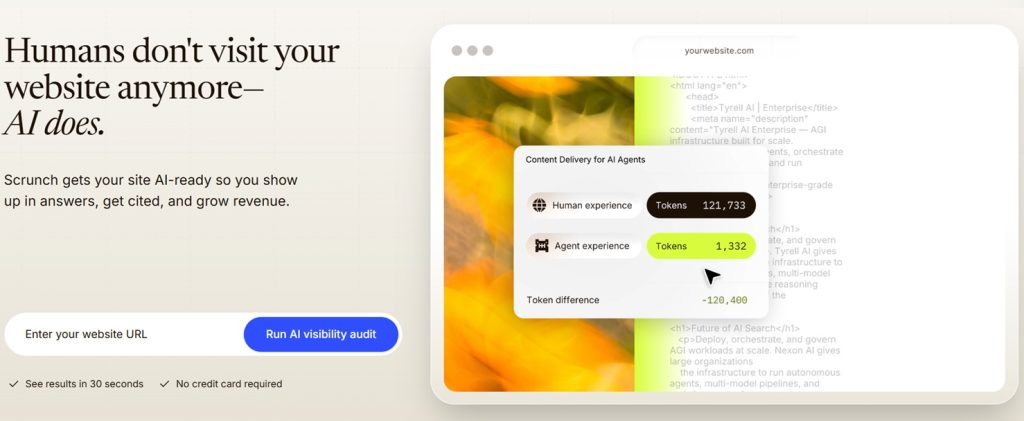
Scrunch AI is the one for the technical crowd, and it does something none of the others do: it serves AI-optimized versions of your pages directly to the bots.
That’s the Agent Experience Platform. It intercepts AI crawler traffic and hands the agents a clean, stripped-down version of your content to improve retrieval. It covers eight platforms, including Google AI Mode and Copilot, and it scores your citation sources by influence.
Pricing lands around $100/mo to start and roughly $500 for the growth tier, though it’s worth confirming with Scrunch AI directly.
Two things to watch out for, though: Otterly AI needs real technical implementation to shine and historical data is capped at 90 days.
Should you get Scrunch AI?
- Yes, if your main concern is improving your technical SEO.
- No, if you have other priorities.
6. Semrush AI Visibility Toolkit: the best if you already pay for Semrush
With Semrush’s AI Visibility Toolkit, you get AI visibility layered onto the SEO suite you already know, meaning you can overlay your Google rankings against your AI presence and instantly see where you rank on Google but vanish in ChatGPT.
The site audit checks for AI-specific issues like a missing llms.txt (backed by Semrush’s enormous keyword database) and the pricing is flat and predictable.
The downsides are the ones you’d expect from a giant suite. It’s dense, the learning curve is steep, share of voice is gated behind higher tiers and the AI toolkit is a bolt-on rather than a purpose-built GEO platform.
Should you get Semrush’s AI Visibility Toolkit?
- Yes, if you’re already paying for Semrush and want AI visibility without onboarding a new vendor.
- No, if you’re not part of the Semrush ecosystem yet.
7. Ahrefs Brand Radar: the best for search-backed research
Ahrefs Brand Radar is the research-grade option, and it’s the one I’d reach for if I were already in Ahrefs and wanted to study the category, not just my own brand.
Its edge is scale. It models AI visibility against 405M+ search-backed prompts drawn from real keyword data, so you get share-of-voice benchmarking and cited-page discovery on a data set nobody else has.
The main con mirrors Semrush: the tool is an add-on and pricing comes bundled with Ahrefs plans. The second important limitation is that Brand Radar was built for research, not operations. It won’t run a full GEO workflow despite being pricey.
Should you get Ahrefs Brand Radar?
- Yes, if you want AI visibility research at real data scale.
- No, if you or your team are not in Ahrefs yet.
8. Writesonic: one of the best for content teams
Writesonic started as an AI writer and grew into a GEO tool, so it’s the natural pick if your team’s center of gravity is content.
It combines visibility tracking with an article writer and an SEO editor, so you can spot a gap and draft something to fill it in the same tab. It also runs server-side AI traffic analytics too.
Pricing is decent. GEO tracking lives on the $249 Professional plan, with cheaper tiers at $49 and $99 for the writing side.
The trade-offs: the workflow logic is less flexible than a dedicated platform and the AI writing still needs a human editor before anything ships.
Should you get Writesonic?
- Yes, if you want to monitor and write in one place.
- No, if content optimization is part of your job, but not the whole deal.
How to pick the right AthenaHQ alternative for your team
Forget about big marketing claims and product reviews. Will you open the tool every week and act on what it shows? This is what really matters.
For the default mid-market B2B SaaS team that needs to move the number and not just watch it, I’d start with CrowdReply. It’s the one that turns a visibility gap into a fix without making you leave the tool.
From there it’s about your specific edge:
- Enterprise or regulated, and you need data depth plus compliance? Profound.
- Agency or international, and per-seat pricing is killing you? Peec AI.
- Smallest possible budget to start? Otterly AI.
- Optimizing site architecture for AI crawlers? Scrunch AI.
- Deep in Semrush or Ahrefs already? Add the AI Visibility Toolkit or Brand Radar before buying anything new.
- Content team that wants to track and write? Writesonic.
Pick the one your team will use, then commit to acting on it for a quarter. Start a trial with CrowdReply now and run your real prompts through it before you decide.
How to switch off AthenaHQ without losing your data
Migrating is mostly about your prompt set, not your dashboards. Here’s the order I’d do it in:
- Export your tracked prompts and brands out of AthenaHQ. That prompt list is the real asset, and rebuilding it from scratch is the only painful part of switching.
- Rebuild the exact same prompt set in the new tool. Same wording, same competitors; if the prompts match, your trend lines stay comparable across the move.
- Run both tools in parallel for two to four weeks. Expect the numbers to differ, because different tools sample differently and AI answers vary run to run. One single snapshot cannot be trusted.
Finally, don’t forget to keep an eye on AthenaHQ credits during the overlap so you’re not paying full freight on a tool you’re leaving.
A final note on my testing methodology:
I focused on the 8 tools a team actually shortlists when it’s leaving AthenaHQ: CrowdReply, Profound, Peec AI, Otterly, Scrunch, Semrush’s AI Visibility Toolkit, Ahrefs Brand Radar and Writesonic.
I tested each on five things: pricing you can predict, real engine coverage across ChatGPT, Perplexity, Gemini, AI Overviews and AI Mode, action capability beyond monitoring, dashboard usability and how fast I reached a useful read.
For each one, I signed up where a trial existed, ran the same buyer-prompt set through it, worked the dashboard, walked the pricing tier by tier and noted where it frustrated me.
Every tool was judged against the same buyer profiles. The “best for” on each reflects where its strengths and weaknesses actually landed, not where its marketing says they do.
Frequently asked questions
What is the best AthenaHQ alternative?
CrowdReply is the best for most teams because it’s the only tool in this set built around fixing your visibility gaps, not just charting them. Profound is the stronger pick if you’re an enterprise or regulated and need compliance-grade data and Otterly AI wins if your budget is under $50 a month.
How much does AthenaHQ cost?
AthenaHQ has a free Essential tier with 300 credits, then a $295/month Starter plan with 3,600 credits across nine models.
Are there cheaper AthenaHQ alternatives under $100 a month?
Yes. Otterly AI starts at $29, Writesonic at $49, Semrush’s AI toolkit and Profound’s ChatGPT-only Starter both at $99. CrowdReply, also at $99, is the cheapest option that includes an action layer rather than monitoring alone.
AthenaHQ vs Profound, which is better?
Profound wins on server-side data depth and compliance certifications, while AthenaHQ wins on model coverage and built-in content actions. Pick Profound for enterprise rigor and AthenaHQ for breadth of engines.
What are the best AthenaHQ alternatives for agencies?
Peec AI and Otterly AI are the agency-friendly picks. Peec gives you unlimited seats and per-region tracking (meaning client work doesn’t rack up per-user fees) and Otterly is cheap enough to run across a lot of small clients without much risk.
Why do teams leave AthenaHQ?
Three reasons come up again and again: credit costs are hard to forecast, the tool measures more than it helps you fix at accessible tiers and the $295 entry price is steep before you’ve proven a return.
Can Semrush or Ahrefs replace AthenaHQ?
Partly, and mostly if you already pay for them. Both bolt AI visibility onto a mature SEO suite, so you get tracking inside a familiar tool, but neither is a purpose-built GEO platform with the same depth of engine coverage or content actions.