Quick Summary
In this guide, we explain how Perplexity SEO works and what it takes to rank in AI-generated answers. We explore how Perplexity chooses which brands to mention, why visibility across trusted sources matters, and how to apply a practical GEO framework. You’ll also learn how brands can build consistent visibility in high-intent conversations that influence Perplexity and other AI search results.
Is Your Brand Invisible When Buyers Ask Perplexity for Recommendations?
You’ve built the content, earned the backlinks, and ranked on page one of Google. But when a potential customer opens Perplexity and asks a simple question about your product category, your brand isn’t there. The traffic from Google still comes. But more decisions are happening somewhere else.
Perplexity now sits alongside Google in the buyer’s journey. It doesn’t rank links; it synthesizes answers from different source pools based on intent. Its rules are different: recency matters more, authority is defined differently, and your website is only one signal among many.
This CrowdReply guide breaks down how Perplexity chooses which brands to feature and the practical steps you can take to increase your visibility in AI-generated answers.
Why Listen to Us?
At CrowdReply, we help brands increase their visibility on Reddit and in AI-driven responses, including Perplexity. We do this by helping them participate in high-quality, high-intent discussions. This guide draws on our extensive experience and proven strategies for driving Reddit engagement to influence AI responses.

What Is Perplexity SEO?
Perplexity SEO is the practice of helping your brand appear in answers generated by AI search tools like Perplexity. Instead of ranking pages in a list of links, your brand is mentioned or cited when the AI gives a direct answer to a question.
Perplexity works by scanning many sources across the web and summarizing what it finds. It looks for clear, accurate, and trusted information that helps users quickly understand a topic or compare options.
In tests using complex research questions, Perplexity linked most of its answers to clear sources. About 78% of its claims were tied to specific references, compared to 62% for ChatGPT, showing that Perplexity puts more focus on citing where information comes from.
Unlike traditional SEO, Perplexity SEO focuses less on keywords and more on usefulness and credibility. Brands that show up consistently across trusted websites, reviews, and discussions are more likely to be included in AI-generated answers.
Why Perplexity SEO Matters for Brand Visibility
1. Perplexity Has the Strongest Recency Bias of Any AI Platform
LLMs possess a massive preference for fresh data to ensure accuracy. A 2025 study analyzed 5,000+ cited URLs and found that 50% of Perplexity’s citations come from content published in the current year alone. This is significantly higher than ChatGPT (31%) and Google AI Overviews (44%).
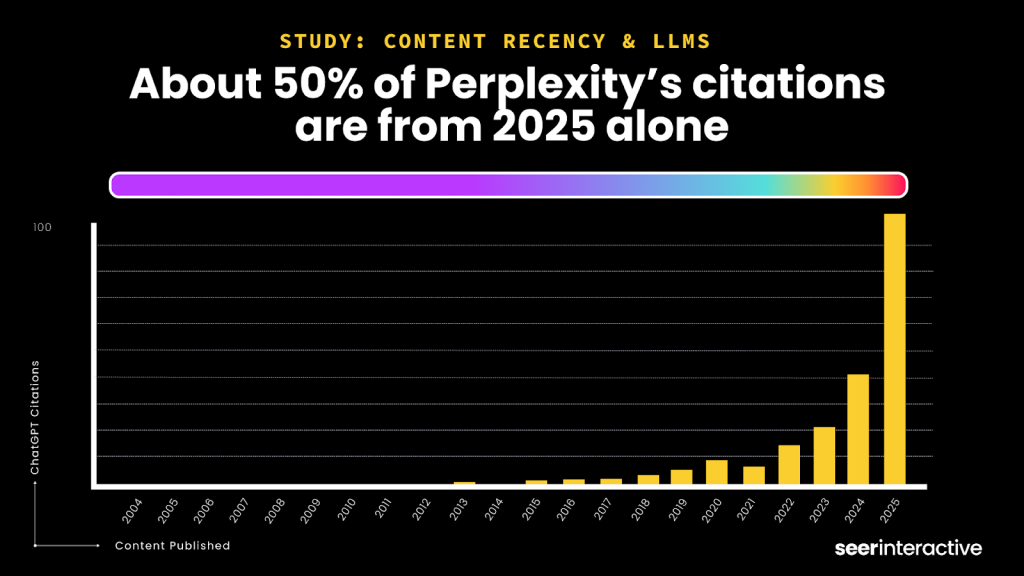
Source: Seer Interactive
If your comparison articles aren’t updated for 2026, Perplexity’s retrieval logic will systematically filter you out in favor of newer sources.
2. Perplexity and ChatGPT Share Only 11% of Cited Sources
Ranking on one AI platform does not guarantee visibility on others. Perplexity and ChatGPT share just 11% of cited sources. Ranking in ChatGPT does not mean you rank in Perplexity. They use different indexes, different retrieval logic, and different ranking signals. This is not a subset of ChatGPT SEO. It is a separate discipline requiring a dedicated strategy.
If you are only optimizing for OpenAI’s ecosystem, you are invisible on Perplexity by default.
3. Perplexity Prioritizes Structural Trustworthiness Over Keyword Relevance
Perplexity’s retrieval engine is mathematically tuned to favor reliability over simple keyword matching. A 2025 peer-reviewed study in PLoS One evaluated ChatGPT, Gemini, and Perplexity across the 25 most-asked medical queries using four validated reliability instruments: EQIP (Information Quality), mDISCERN and JAMA (Reliability), and GQS (Global Quality).
Perplexity outperformed both ChatGPT and Gemini across every single metric with statistical significance ($p < 0.05$).
Because Perplexity selects for structurally trustworthy sources, a citation acts as a built-in endorsement. The model’s preference for high-quality data transfers that credibility directly to your brand. Ranking requires a shift from “SEO writing” to “Evidence-Based Content.” Your pages must feature complete datasets, verifiable sourcing, and transparent claims to pass Perplexity’s reliability filters.
4. The Discovery Gap Is an 11x Trap
A study of 112 Product Hunt startups found that Perplexity recognizes 94.3% of brands when asked by name but only surfaces 8.3% of them in organic discovery queries like “What are the best AI tools launched this year?”
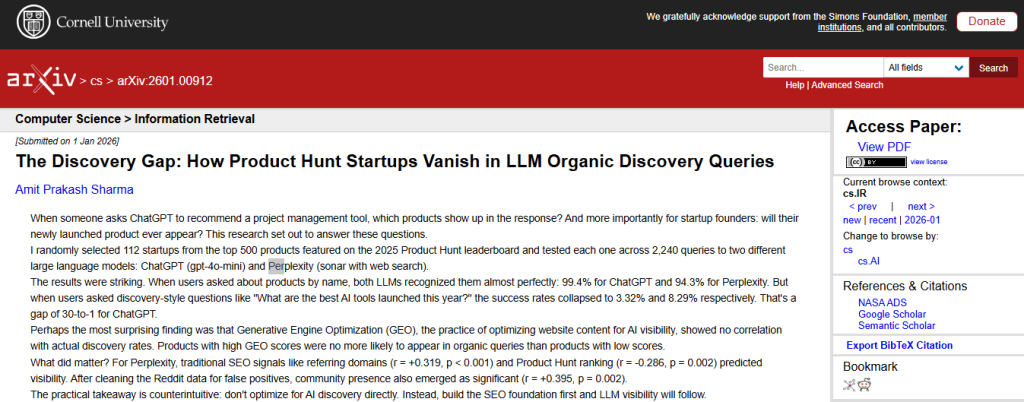
This is the 11x gap. Users can find you if they already know you. But if they are discovering your category for the first time, you vanish. Bridging this gap is the entire purpose of Perplexity SEO.
5. Perplexity Dynamically Switches Between Source Pools
Perplexity is not one search engine. It pulls from different source pools—Academic, Social, Finance, and Web—depending on the intent it detects in your query. Even without an explicit selector, the same core question can return results from entirely different domains based on how you frame it.
| Source Pool | What It Contains | Example Query |
|---|---|---|
| Academic | Peer-reviewed journals, .edu domains, institutional research | “CRM implementation study 2026” |
| Social | Reddit, X, public forums, community discussions | “What CRM do agency owners actually recommend?” |
| Finance | SEC filings, Bloomberg, Reuters, annual reports | “CRM companies revenue growth 2026” |
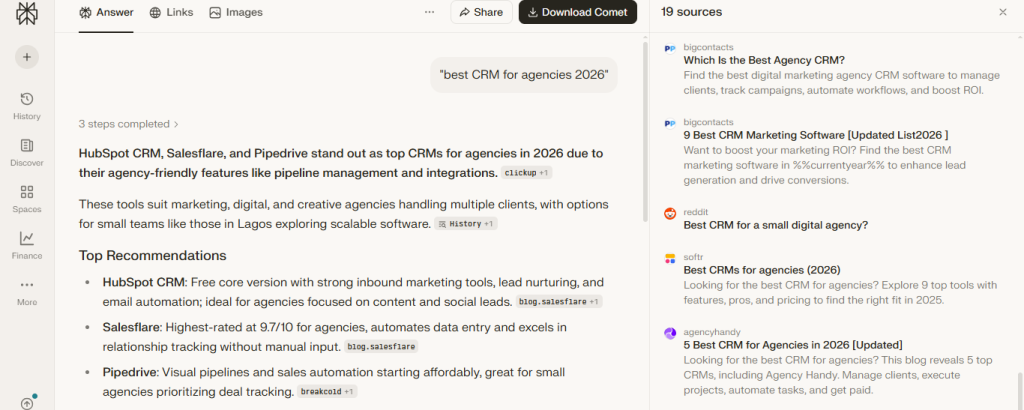
| Web | News articles, blogs, review sites, standard SEO content | “Best CRM for agencies 2026” |
Why this matters: Ranking in Web mode does not mean you appear in Social mode. Your G2 profile does not help you in Academic mode. If your brand only exists in one pool, you disappear the moment your customer switches intent.
A B2B buyer starts in Social mode (“What CRM do agency owners actually recommend on Reddit?”). They verify in Academic mode (“Has anyone published implementation timeline data?”). If you aren’t present in both, you lose the sale halfway through the research journey.
How Perplexity Chooses Which Brands to Mention
Perplexity operates as a Retrieval-Augmented Generation (RAG) engine. It doesn’t “remember” your brand from a training set; it actively fetches proof from the live web every time a user asks a question. To be cited, your content must pass through a multi-stage quality funnel.
Hybrid Retrieval Pulls Passages, Not Pages
Perplexity does not index entire pages as single units. It retrieves “spans,” self-contained passages that directly address a specific intent. It combines keyword matching with Vector (Semantic) Search. If a user asks about “e-commerce cart recovery,” the AI looks for the most relevant 150–200-word block across the web.
The L3 Re-Ranker Drops Low-Quality Candidates
Before an answer is generated, Perplexity applies a three-layer (L3) machine learning re-ranker to score the initial retrieval set.
This system evaluates content for factual density. If a page is heavy on marketing “fluff” but low on verifiable data, the L3 reranker will remove it from the candidate set entirely. Content that ranks #1 on Google for its backlink profile often fails Perplexity’s quality gate because it lacks the information density required to ground an AI response.
Manual Domain Multipliers Act as Gatekeepers
Perplexity maintains curated lists of trusted domains that receive inherent ranking boosts. Platforms like Amazon, GitHub, LinkedIn, and Coursera are pre-identified as authoritative. Content associated with or referenced by these domains inherits their authority. These “citation gatekeepers” appear repeatedly across categories.
Earning a mention on a domain Perplexity already trusts is worth more than hundreds of low-authority backlinks.
Freshness Is a Hard-Coded Ranking Signal
Perplexity has the strongest recency bias in AI search. A 2025 study found that 50% of all citations come from content published in the current year alone, significantly higher than ChatGPT (31%) and Google AI Overviews (44%).
Citation probability declines rapidly as content ages. The same study found that 79% of AI bot hits go to content published or updated in the last two years.
Perplexity’s crawler, PerplexityBot, actively searches for “New Post” signals. If your data hasn’t been refreshed with 2026-specific stats, the model interprets the information as “expired” and selects a newer competitor.
YouTube Title Synchronization Is a Confirmed Ranking Boost
YouTube titles that exactly match Perplexity’s trending queries receive enhanced visibility on both platforms. This suggests cross-platform validation: Perplexity may use YouTube engagement to verify what topics are currently relevant and reward creators who act fast on emerging trends.
How to Rank on Perplexity (A Practical GEO Framework)
Audit Your Brand’s Current Presence in Perplexity
Before optimizing, you must identify where Perplexity currently ignores you. Research shows Perplexity recognizes 94.3% of brands by name but only 8.29% in organic discovery queries like “best inventory tools for 2026.”
Start by running a “Discovery Probe” using prompts such as “Best [Category] for [Persona] in 2026” and document every missing mention. Note which domains Perplexity cites instead of yours. If it favors a Reddit thread or a G2 comparison, those are your primary “Trust Seed” targets.
If you don’t appear in these “Best of” lists but your competitors do, you are losing the discovery gap, which acts as a direct revenue leak.
Build Proof in Perplexity’s Social Mode
Perplexity’s Social Mode is specifically designed to retrieve real-user opinions from Reddit, X, and public forums. A Search Engine Journal citation study found that Reddit accounts for 6.6% of Perplexity’s citations, the highest of any AI platform.
Manual Reddit marketing sees 60–70% removal rates on comments from new or low-karma accounts and consumes 8–10 hours weekly. Most brands abandon it before seeing results. CrowdReply closes this gap.
Instead of using corporate accounts that look like ads, CrowdReply utilizes a network of established, high-karma persona-based accounts. This ensures your brand mentions are woven into conversations naturally, appearing as authentic peer recommendations rather than marketing spam.

In an era where subreddits have strict moderation, CrowdReply maintains an industry-leading removal rate of under 5%. This level of “stickiness” is critical for ensuring your brand mentions remain live long enough to be indexed by Perplexity’s RAG systems.
Seed Your Brand in Review Platforms and Editorial Gatekeepers
Social proof proves your brand is discussed. Editorial roundups prove your brand is vetted. Perplexity uses both.
Audit your category’s citation gatekeepers:
- Run your core category query in Perplexity Web Mode
- Scroll to the cited sources. Do this 10 times over one week.
- Identify the domains that appear repeatedly. These are your targets.
For Web Mode, this requires completing your profiles on review sites and responding to feedback, as activity signals relevance to the AI.
Because Perplexity is biased toward recency, you should pitch editors of existing “best of” lists with new 2026 data. Securing these editorial mentions provides the top-down authority that validates the bottom-up proof generated on Reddit.
Engineer Content for “Passage Extraction”
Perplexity retrieves chunks, not pages. If your content is a dense wall of text, the Retrieval-Augmented Generation (RAG) system will fail to “lift” a clean quote for the final answer.
The chunking checklist:
- Modular “answer-first” sections: Every H2 and H3 should be a standalone unit of 150–250 words
- Direct opening: The first sentence after a header must be a direct, factual answer to the implied question
- High semantic density: Replace adjectives with unique entities and hard data (ROI stats, timelines, specifications)
- Claim-based headers: “Software X Reduces Churn by 12%” outperforms “Benefits of Our Solution”
Perplexity’s L3 re-ranker favors these dense, factual statements over thin marketing copy. Pages structured this way are exponentially easier for RAG systems to extract and cite.
Test yourself: Copy a section from your page, paste it into a blank document, and read it cold. Does it stand alone as a coherent mini-answer? If not, rewrite it.
Cover Category Entry Points and Follow-Up Questions
Users don’t stop at one question. Neither does Perplexity. Its Follow-up feature creates a conversational chain where users start broad, “best inventory tools 2026,” and then narrow their search. Your content should mirror this pattern.

Map the full conversation:
- Start with your primary category entry point
- Use AlsoAsked or AnswerThePublic to see what humans ask next
- Use query fan-out tools like Profound or DataForSEO to see what Perplexity searches internally
Common fan-out patterns to optimize for:
- “Is it good for [persona/segment]?”
- “Does it work with [constraint]?”
- “How does it compare to [alternative category]?”
- “Is it worth it for [use case]?”
- “[Product] vs [competitor]”
For an e-commerce software provider, this means answering:
- “How can I reduce cart abandonment rates for a high-volume Shopify store in 2026?”
- “What are the best headless e-commerce alternatives for mid-market brands moving away from Magento?”
- “Recommend an inventory management tool that syncs across TikTok Shop and Instagram.”
By linking broad category pages to granular feature and comparison pages, you signal to Perplexity that you are the most comprehensive source for the topic. This “Fan-Out” strategy ensures that when Perplexity suggests the next question, the answer is already waiting on your domain.
Best Practices for Ranking on Perplexity
Build Entity Authority Through Language Consistency
Perplexity does not view your website in isolation; it attempts to perform “Entity Resolution” by connecting mentions of your brand across the entire web. If your brand is described as a “Project Management Tool” on your homepage but a “Team Productivity Suite” on G2 and a “Task Organizer” on Reddit, the AI’s confidence in your brand’s category drops.
To rank reliably, you must adopt a standardized brand vernacular. By using the exact same phrasing for your product category, core value proposition, and pricing across every platform, you provide the AI with a clear, repetitive signal.
When Perplexity sees the same factual claims mirrored on your site, in community forums, and on editorial reviews, it treats your brand as a verified entity, making you significantly more likely to be featured in high-intent summaries.
2. Ensure Technical Accessibility for PerplexityBot
A fundamental but often overlooked barrier to visibility is the technical “gatekeeping” of your content. Many modern firewalls and CDNs now block unknown or high-frequency bots by default, and PerplexityBot is frequently caught in these automated filters. If the crawler cannot access your site, your brand effectively ceases to exist in its real-time index.
Securing your presence begins with your robots.txt file. You must explicitly allow PerplexityBot and ensure your server does not rely on heavy JavaScript to render key facts. Perplexity’s RAG engine favors clean, semantic HTML that it can “tokenize” instantly.
If your pricing or feature comparisons are tucked behind interactive elements or scripts that the bot cannot execute, the AI will bypass your site in favor of a competitor whose data is more accessible.
3. Leverage YouTube as a Validation Signal
In 2026, YouTube has emerged as a primary “Trust Signal” for Perplexity’s discovery engine. The AI often uses video titles and transcripts to validate which brands are currently trending or relevant to specific “Category Entry” queries. There is a documented correlation between YouTube videos that exactly match a search intent and the citations Perplexity provides in its responses.

The most effective tactic is Title Synchronization. By identifying the specific 2026 trending queries in your niche, such as “Best Inventory Software for Small Business,” and publishing a video with that exact phrase as the title, you “jack” the AI’s validation loop.
When Perplexity finds a matching video title and a corresponding embedded video on your blog post, it receives a high-confidence signal that your brand is a primary authority on that specific topic.
4. Optimize for Extraction, Not Promotion
Perplexity’s “L3 Reranker” is specifically designed to filter out “brochure-ware,” content that reads like a sales pitch rather than an objective resource. In the world of AI search, promotional language is a negative ranking signal. If a section is overloaded with your brand name, aggressive calls-to-action, or hyperbolic adjectives, the AI will likely deprioritize it in favor of more neutral, expert-led passages.
To win the citation, you must write as a helpful expert. Adopting an “Answer-First” structure means providing the factual core of the answer in the first two sentences of any section. You should aim for a high density of verifiable facts and maintain an objective tone that includes mentions of competitors where relevant.
By providing the AI with a clean, citable “fact-span,” you make it easy for the engine to lift your content into its final response.
5. Bridge the “Discovery Gap”
The most critical metric for 2026 is the Discovery Gap. While Perplexity recognizes many brands when asked about them by name, it surfaces those same brands in only about 8% of discovery-style queries (e.g., “What are the best tools for…”). This means users can find you if they already know you, but you are invisible during their initial research phase.
Treating this gap as your “North Star” means shifting your focus away from branded search volume and toward Category Citation Share. You must regularly audit how often your brand appears in generic “Best of” queries for 2026.
If you are missing from these organic conversations, your website SEO is failing the AI era. Success is measured not by how many people visit your site, but by how often the AI mentions your name when a user asks about your industry.
Boost Your Brand’s Perplexity SEO with CrowdReply
Ranking in Perplexity is about building clear, consistent brand visibility across the sources AI tools trust: your content, third-party sites, and real conversations where buyers compare options. Brands that do this well show up repeatedly in AI answers, not by chance, but by design.
CrowdReply helps make that process scalable. It surfaces high-intent Reddit discussions, supports safe participation through trusted accounts, and tracks performance so you can see what’s working. Instead of spending 10 hours a week manually monitoring threads and losing 60–70% of your comments to bans, CrowdReply lets you scale authentic participation while staying under Perplexity’s radar.
Sign up for free now and start scaling your brand’s presence in the conversations AI tools trust.
Frequently Asked Questions
How is Perplexity SEO different from traditional SEO?
Traditional SEO focuses on ranking links in search results, while Perplexity SEO focuses on being included in a single AI-generated answer. Success depends more on trust, clarity, and external mentions than keyword rankings alone.
Why does Perplexity rely so much on external sources?
Perplexity pulls information from external sources to support transparency and accuracy. Citing trusted websites, reviews, and community discussions allows the AI to explain where information comes from and build user confidence in its answers.
What types of content rank best in Perplexity?
Content that clearly answers real questions performs best. This includes comparison pages, short explainers, FAQs, and guides that use simple language and appear across trusted sources, not just on a single website.
How long does it take to see results from Perplexity SEO?
Gradually. Visibility improves as your brand appears consistently across trusted sources. Regular updates and external mentions produce stronger results over time, not overnight.
Does Perplexity use Reddit as a source?
Yes. Brands that consistently participate in high-intent Reddit conversations are more likely to build visibility in the discussions Perplexity references.