Quick Summary
AI-driven search is shaping how buyers discover and evaluate brands. Visibility in ChatGPT answers now plays a direct role in awareness, trust, and consideration. This guide explains how ChatGPT SEO works, what signals influence AI-generated answers, and how brands can increase their presence through clear positioning and consistent external signals.
Want to Increase Your Brand Visibility on ChatGPT?
More buyers are turning to ChatGPT to research products, compare options, and make decisions, often before they ever visit a website. This shift in behavior makes appearances in AI-generated answers a vital driver of brand awareness and buyer confidence in the modern digital landscape.
AI systems surface brands based on how clearly they understand your offerings, where they appear across sources, and how consistently signals reinforce trust.
In this CrowdReply guide, we’ll break down how ChatGPT SEO works, what influences AI-generated answers, and the practical steps you can take to position your brand where modern buying journeys now begin.
Why Listen to Us?
At CrowdReply, we help brands optimize their Reddit marketing, increasing visibility on Reddit and in AI-driven content like ChatGPT responses. We identify high-impact threads, track engagement, and optimize participation based on what actually influences AI outputs like ChatGPT. This hands-on experience gives us a practical view of how brands rank on ChatGPT and other AI search tools.

Why ChatGPT SEO Matters for Brand Visibility
High-Intent Visitors Convert at a Higher Rate
Currently, ChatGPT sends significantly less traffic than Google. Data from over 74,000 sites shows traditional search still drives nearly 39% of visits, while AI assistants account for a tiny fraction of that volume.

Source: Ahrefs
However, conversion data tells a much more compelling story. At Ahrefs, AI search traffic represents only 0.5% of total visitors but drives 12.1% of signups. That is a 23x higher conversion rate than organic search.
AI users often arrive later in the buying cycle. They have already compared options and clarified their intent. They don’t need to be convinced a problem exists; they need to know which solution fits. This makes every AI referral disproportionately valuable. For B2B brands, where sales cycles run weeks or months, compressing consideration down to a single chat response is the new efficiency advantage.
AI Summaries Shape Brand Trust Instantly
LLMs do more than find information; they synthesize it into a single, confident response. When ChatGPT describes your product, that summary becomes the “truth” for potential buyers. If the output is inaccurate, outdated, or missing entirely, you lose control of your brand narrative.
AI answers feel authoritative, and users rarely fact-check a well-written summary. A mention that mispositions your features or omits your category leadership can quietly influence every future interaction a buyer has with your brand. The goal is to be described accurately and consistently across the sources AI models trust most.
Rapid Growth Makes Early Visibility a Competitive Edge
While ChatGPT’s current traffic share is small, the trajectory is moving quickly. Global referral traffic from ChatGPT has grown nearly 10% month-over-month, with even higher adoption in sectors like business, electronics, and industrial software.

Source: Ahrefs
AI models learn from the data that exists right now. Brands that participate in discussions and appear in third-party reviews today are more likely to stay referenced as these tools become default discovery engines. If you wait for traffic to peak before optimizing, you will be competing for attention after the AI has already decided which brands are the leaders in your category.
How ChatGPT Chooses Which Brands to Mention
1. Training Data Determines Your Base Level of Existence
Before ChatGPT answers a prompt, it relies on its internal map of the world. OpenAI trained its models on billions of web pages from sources like Wikipedia and Common Crawl. Brands that appeared frequently across these datasets became part of the model’s core memory.
However, training data has a cutoff date. If your brand launched recently, the base model may not “know” you exist. This means you cannot rely on what ChatGPT learned in the past; you must ensure your brand appears in the live content it reads today.
2. Live Web Retrieval Prioritizes Third-Party Validation
Most product comparisons now use Retrieval-Augmented Generation (RAG) to search the live web and generate answers in real time. Even for branded queries, ChatGPT rarely relies on your own website. Analysis of over 23,000 citations shows that brand-owned content accounts for only 23% of AI sources, with the majority coming from earned media and community discussions.
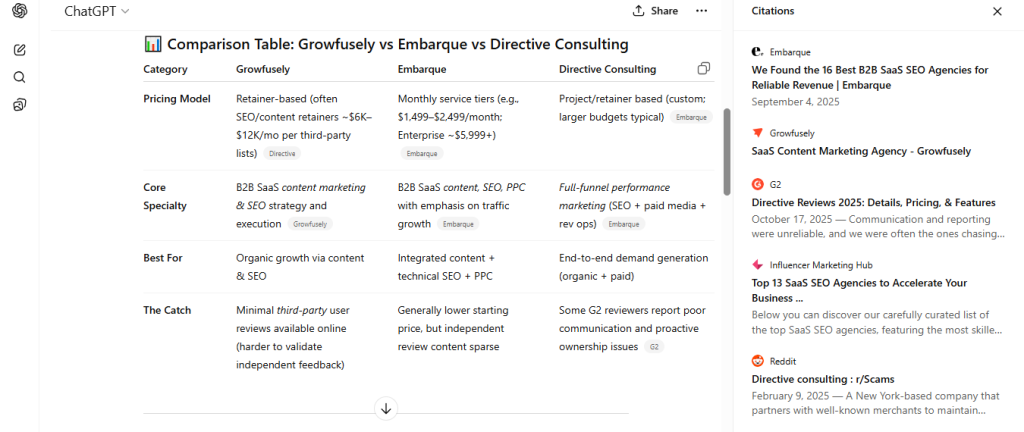
For example, when comparing skincare brands, ChatGPT cites Reddit threads and journals alongside official sites for a balanced view. Since your owned content isn’t the main driver of AI visibility, you must be present on third-party platforms. Participating in high-intent Reddit threads ensures your brand is part of the “earned” signals ChatGPT uses to verify your authority.
3. Query Fan-Out Forces You to Compete in Sub-Conversations
ChatGPT rarely looks for one perfect answer. Instead, it “fans out” broad questions into multiple sub-queries. According to the DataForSEO LLM Scraper API, a search for “best CRM” triggers internal searches for specific needs, like “best CRM for startups” or “best CRM for sales teams.” To be mentioned, you must rank for the specific variations the AI generates, not just the user’s initial prompt.
This “fan-out” process also creates a significant year-bias. In early 2026, AI models prioritize fresh data by automatically appending the current year to nearly a third of their internal searches. If your brand mentions are tied to “2024” or lack a date entirely, you become invisible to these critical retrieval opportunities.
This means you win by appearing across the full spectrum of use cases and years that ChatGPT considers. The brand seen in the most sub-query results becomes the default recommendation.
How to Rank on ChatGPT: The Core Pillars
Audit Your Current Visibility in ChatGPT Answers
Before trying to rank in ChatGPT, it’s important to understand how AI systems currently represent your brand. ChatGPT already has an interpretation of who you are and where you fit. The question is whether that view is accurate and aligned with your positioning.
Start by asking ChatGPT about your brand directly. For example:
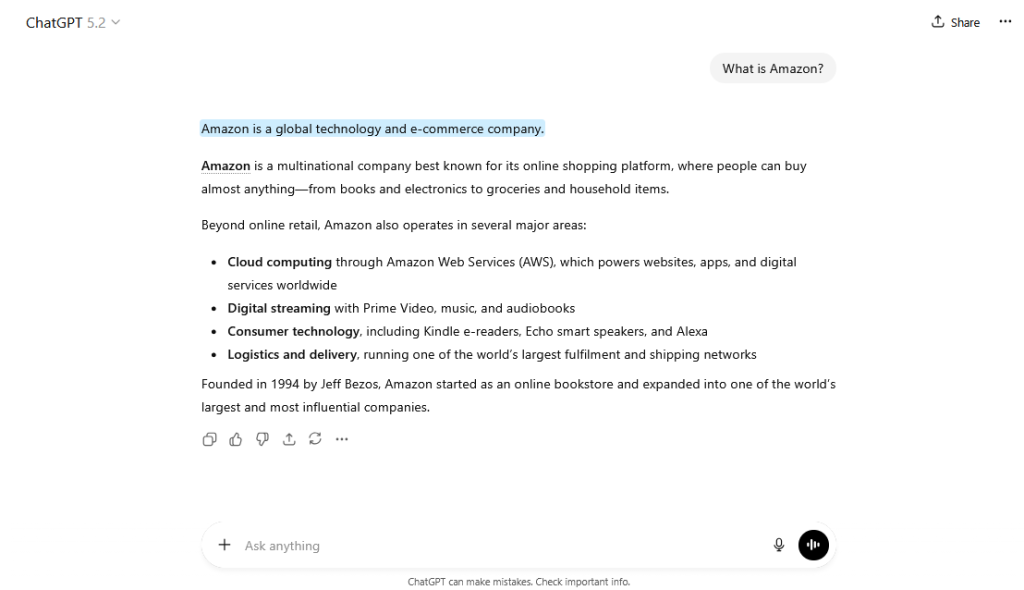
What shows up? Is the description clear, current, and aligned with how you position your product? If the answer feels vague, outdated, or flat-out wrong, that’s usually a sign the AI is pulling from weak or stale sources.
As you audit, pay attention to:
- How your brand is described (features, use cases, positioning)
- Whether the information is accurate and up to date
- Which sources appear to influence the answer
Then zoom out. Most buyers won’t search for your brand name first; they’ll start with the category. These category-level questions are where visibility is won or lost.
Test queries your ideal customer would ask before they know you exist to see where you stand.
For a skincare brand, this looks like:
- The Problem-Solver: “I have sensitive skin and frequent redness. What is the best morning skincare routine for me?”
- The Comparison: “What are the best affordable alternatives to high-end vitamin C serums in 2026?”
- The Persona-Specific: “Recommend a 3-step skincare routine for a 30-year-old man with oily skin.”
Note which brands appear, how competitors are framed, and which patterns repeat. Treat this not as a one-time audit but as a baseline. You can’t optimize what you haven’t measured. Every missing mention highlights where your ChatGPT SEO needs reinforcement, and every competitor citation shows the type of signals AI currently trusts. Once you see where you stand, you can start optimizing with intention.
Build Brand Visibility Across Trusted External Sources
Your website alone isn’t enough to influence AI answers. ChatGPT pulls signals across third-party sources: comparison articles, review platforms, and real user discussions. If your brand isn’t showing up there, AI has little external evidence to work with.
This is where execution-led visibility becomes the deciding factor. Reddit plays a particularly important role here, as it accounts for 40% of citations in AI-generated responses. Its threads capture the real-world comparisons and firsthand experiences that AI models trust most.

To win in this landscape, you need a way to scale your presence safely and authentically. A tool like CrowdReply is one of the few LLM visibility solutions that handles the actual execution of this strategy:
- Persona-Based Engagement: Instead of using corporate accounts that look like ads, CrowdReply utilizes a network of established, high-karma persona-based accounts. This ensures your brand mentions are woven into conversations naturally, appearing as authentic peer recommendations rather than marketing spam.
- Industry-Leading Safety: CrowdReply maintains a removal rate of under 5%. In an era where subreddits have strict moderation, this level of stickiness is critical for ensuring your brand mentions remain live long enough to be indexed by AI scrapers and RAG systems.
High-Intent Thread Discovery: The platform doesn’t just post randomly; it identifies high-value Reddit threads that are already ranking on Google or being cited by AI. By placing your brand in these specific “fan-out” conversations, you directly influence the sources ChatGPT uses for its retrieval.

By moving beyond your own domain and using execution tools to secure a presence on trusted third-party sites, you build a “digital trail” that makes your brand an undeniable choice for AI models.
Track, Test, and Iterate Continuously
ChatGPT SEO isn’t a “set and forget” strategy. AI models retrain, competitors pivot, and the answers users see today will evolve. Staying visible requires a closed-loop system of tracking, analyzing, and refining your presence.
You need two distinct feedback loops: visibility tracking and traffic tracking.
Track Visibility to See Where You Appear
Visibility tools tell you whether ChatGPT mentions your brand at all, and how you compare to competitors across the hundreds of hidden sub-conversations that happen behind the scenes. Because AI responses are probabilistic, you need tools that handle model randomness and query “fan-outs.”
AI Visibility Tracking Tools Comparison
| Tool | Primary Use Case | Key Differentiator | Price Point |
|---|---|---|---|
| LLMrefs | Brand mention monitoring & model drift detection | Uses 4.5M real ChatGPT prompts; tracks model opinion shifts | Free tier available Pro: $79/month |
| Profound | Query fan-out analysis & competitive gap mapping | Surfaces hidden AI sub-queries and competitive gaps | Enterprise only $499/month |
| Sitechecker | Citation share & brand name variant tracking | Re-runs prompts to measure true AI visibility | Demo available Custom enterprise pricing |
Track Traffic to See Who Actually Clicks
Visibility is the lead indicator; traffic is the lag indicator.
- UTM parameters are non-negotiable. AI platforms often strip referrer data. Append ?utm_source=chatgpt&utm_medium=ai_referral&utm_campaign=brand_citation to every link you seed in external sources (like Reddit or partner blogs).
- GA4 “AI/LLM” Channel: Don’t let this traffic get buried in “Direct.” Create a custom channel group using the regex .*(chatgpt|openai|perplexity|claude|gemini|copilot).* and place it at the top of your hierarchy.
- The Intent Premium: While AI traffic volume is often 100x smaller than organic search, the conversion rate is significantly higher (often 5x to 15x). These users have already completed their “consideration phase” inside the chat; they aren’t browsing, they’re buying.
Close the Loop
Every week:
- Check visibility: Run your core category prompts in LLMrefs or Sitechecker. Are you present? How many competitors are ahead?
- Check traffic: Pull your AI channel in GA4. Which pages are getting clicks? Which UTM-tagged mentions drove the most sessions?
- Check citations: Which sources is ChatGPT citing for your category? If Reddit threads or competitor reviews dominate, that’s your gap.
- Adjust: Document every change. The gap between perception and reality is where competitors win.
The brands that win AI visibility aren’t the ones with perfect launch strategies. They’re the ones who treat visibility like a continuous feedback loop and actually respond to what the data tells them.
Best Practices for Ranking on ChatGPT
1. Update Your Content Regularly
AI models are heavily weighted toward the latest data to ensure accuracy and user trust. Recent analysis of over 5,000 cited URLs reveals that 71% of ChatGPT citations come from content published within the last three years, while Perplexity pulls half of its citations from the current year alone.
Because 28% of AI sub-queries automatically append the current year, stale content faces immediate devaluation. Reviewing cornerstone content annually and performing substantive refreshes, updating dates, data points, and context, is the only way to signal continued relevance to these models.
2. Design Content for Extraction, Not Just Reading
Retrieval-Augmented Generation (RAG) systems do not read entire pages; they retrieve semantic chunks. If your insights are buried in long-form prose, they become invisible to the model. To maximize your “citability,” design your content for extraction by creating self-contained passages of 50–150 words.
Each section should feature a tight heading stating the topic, followed by 1–2 crisp claims, a supporting statistic or definition, and a single-sentence takeaway. If a section cannot stand alone as a coherent answer, it is unlikely to be cited in a generated response.
3. Cover Category Entry Points, Not Just Your Brand Name
ChatGPT doesn’t search for one answer. It expands one broad question into dozens of niche sub-queries: “best for startups,” “best for enterprise,” “best 2026.” To be visible, you must move beyond brand-name queries and capture category entry points, the specific problems and situational triggers buyers actually search for.
For an e-commerce software provider, this means answering:
- “How can I reduce cart abandonment rates for a high-volume Shopify store in 2026?”
- “What are the best headless e-commerce alternatives for mid-market brands moving away from Magento?”
- “Recommend an inventory management tool that syncs across TikTok Shop and Instagram.”

Map your category’s full range of use cases, budgets, and user profiles. The brand that appears across the widest spectrum of sub-queries becomes the model’s default recommendation. If your content only addresses one angle, you only compete for one of the dozens of searches the model actually performs.
This is why category mapping matters more than keyword lists. Buyers don’t arrive knowing your name; they arrive with a problem. Win the problem, and the model chooses you.
4. Fix Your 404s Before AI Sends Visitors to Them
AI assistants frequently hallucinate URLs or reference dead links, sending users to 404 pages 2.87x more often than traditional Google Search. In fact, nearly 2.4% of all URLs cited by ChatGPT return a 404 error. Since these visitors are seeking specific help, your 404 page should act as a functional bridge rather than a dead end.
Use monthly crawls to identify broken links and implement 301 redirects for deleted content. For “hallucinated” URLs that are receiving traffic, proactively redirect them to the most relevant current resource to capture that displaced intent and provide a seamless user experience.
5. Be Consistent Everywhere AI Looks
AI models gain confidence through consensus. When your website, third-party review platforms like G2, and community discussions on Reddit all align on your product’s core facts (what it does, who it’s for, and what it replaces), the model views you as a high-authority entity.
Conversely, conflicting signals across different channels cause the model to hedge or omit your brand entirely. Regularly auditing third-party descriptions and naming competitors openly helps the AI accurately place you within the market landscape, turning varied signals into a unified web of confirmation.
Increase Your Brand’s ChatGPT SEO with CrowdReply
Ranking on ChatGPT comes from consistent visibility across trusted sources like your content, third-party platforms, and real user discussions. Reddit plays a key role, but success requires showing up in the right conversations, contributing contextually, and maintaining a steady presence where buyers compare options.
CrowdReply supports this broader ChatGPT SEO approach by helping you surface high-intent Reddit threads, participate consistently, and track what actually drives visibility. With features like opportunity alerts, engagement tracking, and competitor insights, CrowdReply helps reinforce the external signals that strengthen how AI models like ChatGPT present your brand.
Sign up for free now and start building sustainable visibility in AI-generated answers.
Frequently Asked Questions
How is ChatGPT SEO different from traditional SEO?
Traditional SEO is about ranking pages on search engine results pages, while ChatGPT SEO is about becoming part of a single, synthesized response. Instead of competing for clicks, you’re competing for inclusion in the answer itself.
Can you rank on ChatGPT without ranking on Google?
Yes. ChatGPT frequently cites third-party discussions and reviews that don’t rank highly in Google. Visibility depends more on credibility and relevance than traditional search rankings.
Does ChatGPT use Reddit as a source?
Yes. Reddit is frequently used because it reflects real user opinions, comparisons, and firsthand experiences. These discussions help AI systems understand how products are perceived in practical, real-world contexts.
How long does it take to see results from ChatGPT SEO?
ChatGPT SEO results usually appear gradually. As AI models encounter consistent mentions of your brand across trusted sources, visibility improves over time rather than instantly.
Do I need to publish long-form content to rank on ChatGPT?
No. AI models often reference concise, well-structured content that clearly answers specific questions. Length matters less than clarity and relevance.
How can I tell if ChatGPT is mentioning my brand?
You can test category and comparison prompts in ChatGPT and similar AI tools to see if your brand appears and how it’s described. Monitoring referral traffic from AI platforms can also reveal indirect signals of visibility over time.
What types of content perform best for ChatGPT SEO?
Content that clearly explains concepts, compares options, and answers specific questions tends to perform best. AI models favor structured, easy-to-understand content that provides context rather than promotional messaging.
Can smaller brands compete with larger companies in ChatGPT answers?
Yes. AI systems often prioritize relevance and clarity over brand size. Smaller brands with clear positioning and strong third-party signals can appear alongside, or even instead of, larger competitors.
Can inaccurate information about my brand affect AI visibility?
Yes. Outdated or incorrect information can lead AI tools to misrepresent your brand or omit it entirely. Inaccurate third-party content weakens trust signals and can reduce how often your brand appears in AI-generated answers.