TL;DR
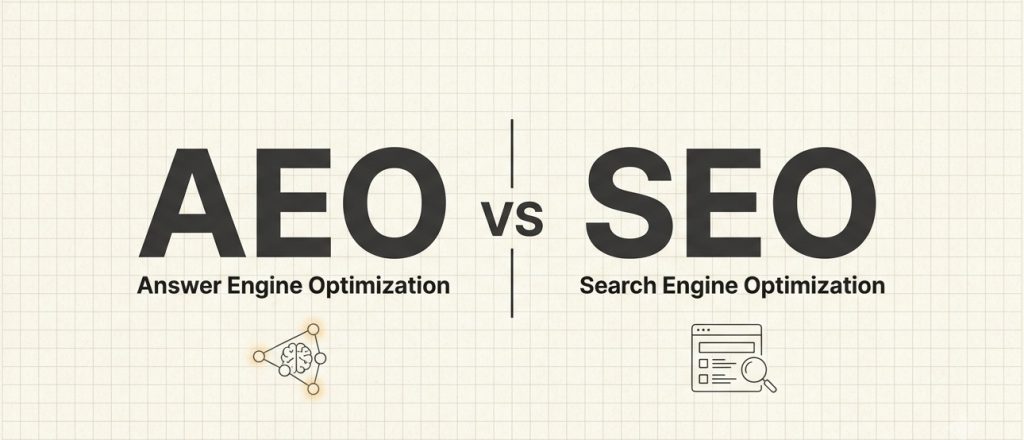
- SEO earns rankings and clicks in search engines, while AEO earns citations inside AI answers.
- The foundations overlap, but the win conditions are different. Right now, most teams need both.
- Cutting on SEO is not the right move. A strong SEO foundation is required for your AEO efforts to land.
- AI visibility isn’t just impacted by your own site, with sources such as Wikipedia and Reddit playing a pivotal role.
- Consistency is key. Ensure product names, descriptions, website claims, directories, profiles and docs match across references.
- Don’t decide on a budget before seeing exactly where your brand stands across AI engines.
Every few months someone declares SEO dead. This time the funeral has a sponsor: answer engine optimization. This AEO vs SEO guide covers the definitions, the five real differences, how answer engines pick sources, tactics that work for both, tracking and a 30-day starter plan.
In one pass, SEO gets pages ranked in search results so people click, while AEO gets content understood and cited by AI systems like ChatGPT and Google’s AI Overviews.
What is AEO?
AEO (answer engine optimization) is the work of making content easy for AI systems to find, understand and cite when they answer a question. Google’s AI Overviews and AI Mode, ChatGPT, Perplexity and Gemini are among the most popular AI systems today.
When it comes to AEO, winning looks different. In classic search you win a position on a results page, whereas in AEO you win a mention or a citation inside the generated answer itself. The visibility is inside the answer, not under it.
AEO is not a new discipline invented from scratch; it’s search optimization pointed at a new surface where the machine reads your content and speaks on your behalf. In our answer engine optimization explainer, we go deeper on the mechanics.
This new surface got big fast. TechCrunch reported that AI Overviews passed 2 billion monthly users in mid-2025, putting the figure above 2.5 billion at I/O this year. Two months later, they announced that ChatGPT crossed 800 million weekly users.
AEO has come to stay, but what does this mean for SEO in 2026?
Why SEO still matters in 2026
SEO hasn’t changed job titles. It’s still the work of making a site technically sound, matching pages to what people actually search and earning enough authority that engines trust you. Technical, on-page, off-page… The fundamentals are the same.
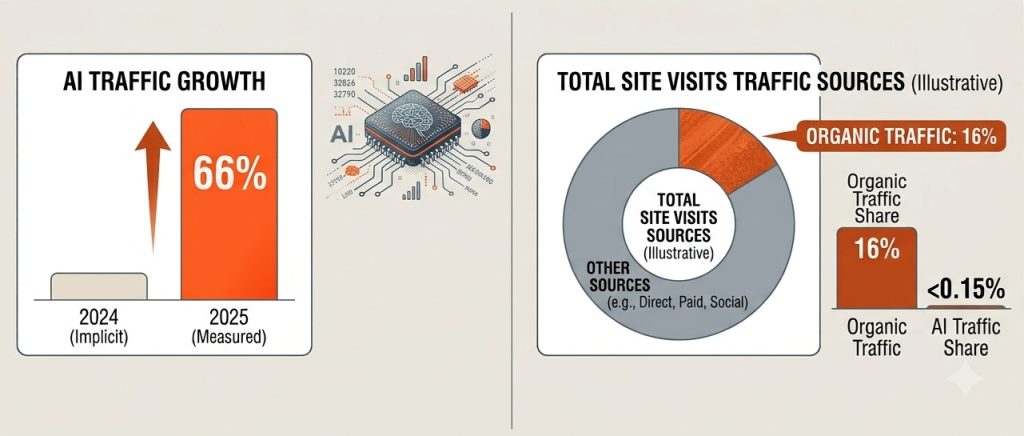
What changed is the context around SEO. A Semrush study determined that despite growing 66% in 2025, AI traffic added up to less than 0.15% of total site visits (organic traffic, on the other hand, sat at 16%). Conductor’s independent numbers tell the same story at a different scale.
The same crawlable, authoritative site that ranks in Google is also the raw material AI systems pull from when they assemble an answer. Far from dying, SEO has simply picked up a second job.
Normally, cutting on SEO to fund “AI optimization” is going backwards. SEO is the foundation on which your AEO must stand.
AEO vs SEO: the five differences that actually matter
Put side by side, AEO and SEO diverge on five things:
| SEO | AEO | |
|---|---|---|
| 1 – Goal | Rank pages in search results | Get cited inside AI-generated answers |
| Where you win: | The results page | The answer itself |
| 2 – Query patterns | Keywords, short phrases, commercial modifiers | Full questions in natural language |
| 3 – Content shape | Deep pages built around topics | Extractable answer blocks with depth below |
| 4 – Technical signals | Crawlability, speed, links, metadata | Entity consistency, clean structure, machine-readable clarity |
| 5 – Scoreboard | Rankings, clicks, organic sessions | Mentions, citations, share of AI answers |
Let’s take an honest, closer look at each:
1 – Goals: the click vs the citation
SEO’s end state is a click that lands on your page. AEO’s end state is your brand or your page showing up inside the answer, with or without a link.
A citation builds recall and trust even when no session shows up in analytics, which is exactly what makes AEO hard to defend in a traffic-only dashboard.
2 – Query patterns: keywords vs questions
People type fragments into Google and speak full sentences to AI. The data backs the split: according to Pew Research, “just 8% of one- or two-word searches resulted in an AI summary” but “that share rose to 53% for searches with 10 words or more.”
To put it simply, question-shaped demand is where AEO lives. According to the same source, “60% of search queries that began with question words such as ‘who,’ ‘what,’ ‘when’ or ‘why’ resulted in an AI summary.”
3 – Content shape: depth vs extractability
Classic SEO content is built to be comprehensive. AEO content is built to be quotable. Machines lift short, self-contained blocks, so the winning page pattern in 2026 is hybrid.
To cover both SEO and AEO in one page, you should have a direct answer in the first lines of a section and depth underneath for the humans who keep reading.
4 – Technical signals: what each machine reads
Search engines reward crawlability, speed, internal links and clean metadata. Answer engines also care about those but lean harder on clarity. Consistent naming, a tidy heading hierarchy and content that parses without a fight become the goal.
SEO and GEO don’t really care about your color scheme. Both care whether they can tell what a page is actually about.
5 – Scoreboard: rankings vs mentions
SEO measures rankings, impressions, clicks and conversions (concrete, math-based metrics). AEO, on the other hand, measures whether AI systems mention you, cite you and describe you accurately, and the tooling for that is younger and messier.
The measurement gap is the main reason teams underinvest in AEO. It’s hard to fund what you can chart, and this is one of the biggest challenges in AEO.
How answer engines actually pick their sources
Here’s the thing nobody on page one explains: answer engines don’t rank your page the way ten blue links do. They run a different pipeline, and once you see it, most AEO advice snaps into focus.
To understand how answer engines actually pick their sources, consider:
Query fan-out (explained in plain English)
When someone asks Google’s AI Mode a question, the system doesn’t run one search. Google describes it as query fan-out: the model triggers multiple background searches at once, reads through the results and assembles one response with links. Deep Search pushes the same technique into hundreds of queries.
So a single question like “best CRM for a small agency” quietly becomes searches about pricing, integrations, agency workflows and alternatives. Your content can get pulled in through any of those side doors, not only the head term. One question in, thirty searches out.
The origin of the citations
The sources AI answers lean on are not a mirror of the top ten. Semrush’s 2026 AI Visibility Index, built on 126 million prompts, found ChatGPT cites about 15 sources per answer while Gemini cites around 3.
Community and reference sites like Wikipedia and Reddit consistently beat corporate websites as citation sources. Tech Now reported that Wikipedia, YouTube and Reddit comprised about 15% of all AI Overview links.
The uncomfortable takeaway: your own site is only one of the surfaces that decides your AI visibility. What review sites, forums and reference pages say about you counts too, sometimes even more…
The difference between training data and live search
AI systems answer from two places: what they retrieve live and what they already learned in training. As of March 2026, only roughly 46% of ChatGPT queries actually trigger a live web search.
You can’t schema-markup your way into a model’s memory. You get there by being described consistently across the open web over time, which is why the consistency work in the next section matters as much as any on-page fix.
Where GEO fits into all this
Marketers love an acronym, so the category grew three of them: SEO, AEO and GEO. Here’s the quick untangle:
- SEO gets pages ranked
- AEO gets answers cited
- GEO shapes what generative systems learn and repeat about a brand over the long run
Three acronyms, one job.
GEO and AEO overlap far more than they differ. AEO chases the visible answer surface (today’s citation). GEO plays the longer game of influencing what models believe. When it comes to tactics, the two are virtually identical.
Knowing these concepts is valuable, but here’s the honest take: the acronym war is a distraction most teams should avoid.
To avoid this pitfall, treat AEO and GEO as one motion aimed at the same machines and spend the saved energy on the actual work. If you’re looking for more insights, check this GEO vs SEO breakdown.
Is AEO replacing SEO?
No. AI answers are eating clicks, not eating search, and that difference matters.
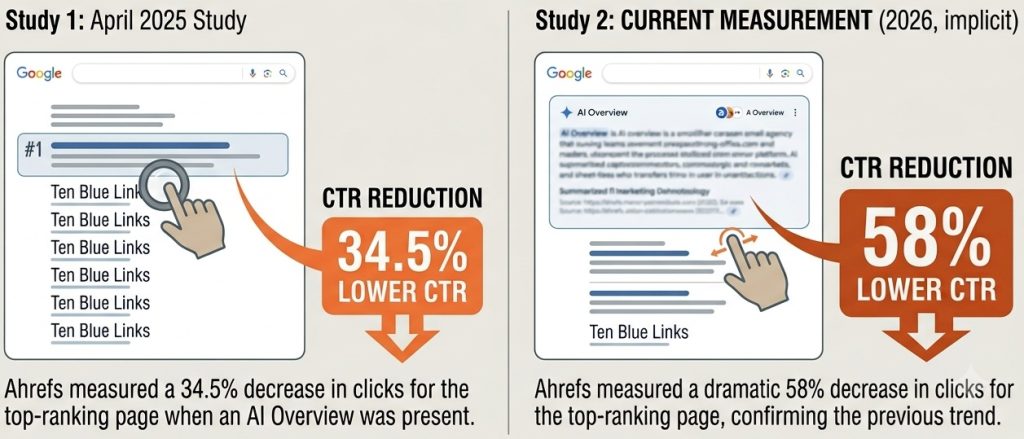
Ahrefs measured a 58% lower clickthrough rate for the top-ranking page when an AI Overview is present, up from 34.5% in its April 2025 study. The click erosion is certainly real, but that shouldn’t be reason to panic.
But watch the budgets instead of the panic. In a survey of 300-plus marketers covered by Search Engine Land, 87.8% said they’re worried about staying findable in the AI era. Simultaneously, 61.2% plan to raise SEO budgets precisely because of AI. AEO doesn’t replace SEO; it makes it even more important.
In sum:
- You should worry if your model depends entirely on informational clicks
- There’s no reason to panic if you’re willing to play both boards
This begs the question: how can you win at both AEO and SEO?
How to win both at the same time
The overlap between AEO and SEO is big enough that one content motion can serve both. Six moves cover most of it:
1 – Lead every page with the answer
Take the question a page targets and answer it plainly in the first two to four sentences of the section, using language a machine could quote without edits. Then go deep for the human who keeps scrolling.
This is the highest-value retrofit for existing content. The authority is already there; the extractable answer usually isn’t. For the ambitious version, see how to rank on ChatGPT.
2 – Say the same thing everywhere
Remember query fan-out. Answer engines assemble responses from many sources at once, and they favor brands whose story matches across all of them. Same product names, same descriptions, same claims on your site, your directories, your profiles and your docs.
If your homepage, your review-site profile and your docs describe the product three different ways, the model runs with whatever looks most consistent elsewhere. The good news? That’s a visibility leak you can fix in an afternoon.
3 – Earn mentions, not only links
Backlinks still carry authority, including in AEO. What changed is the weight of unlinked mentions. Alex Birkett, co-founder of Omniscient Digital, makes the point that LLMs read links like trails of evidence, so being named across trusted sources moves AI visibility even when nobody links.
Digital PR, expert commentary, original research people reference… The tactics aren’t new. The scoreboard finally credits them properly.
4 – Structure for machines without worshipping schema
Clean heading hierarchy, short self-contained sections, lists and tables where they genuinely help. That’s the structural floor, and it serves readers as much as machines.
Schema markup helps machines parse meaning and earns rich results. Keep it in perspective, though: Google’s own documentation says no special markup or AI files are required to appear in AI Overviews or AI Mode. The entry ticket is already covered by SEO: fundamentally, the page needs to be indexed and snippet-eligible.
5 – Keep the answers current
Answer engines re-fetch and retrain constantly, and stale answer blocks quietly stop matching how people ask. Recency appears to matter more on the AI side than the classic side, so check the pages holding your key answers on a schedule instead of after something slips.
A refresh means confirming the answer still matches reality and current phrasing. Not a rewrite.
6 – Open the door for AI crawlers
None of this works if the machines can’t get in. This is the most commonly skipped step in the whole stack, but all you have to do is:
- Check robots.txt for GPTBot, ClaudeBot, PerplexityBot and Google-Extended before assuming you’re visible
- Add an llms.txt file to point AI crawlers at what matters
- Keep key content out of JavaScript-only rendering and keep status codes honest
When to lead with AEO and when to lead with SEO
Sure, you need both AEO and SEO. But when should you prioritize one over the other?
The query decides, not the budget meeting. With that in mind:
- Prioritize AEO if the query is a question with a short factual answer. The summary is the battleground because definitional and how-does-it-work searches trigger AI summaries at the highest rates. Get the answer block right, then let the depth below carry the SEO load.
- Prioritize SEO if the reader needs comparison, pricing or evaluation. Buyers researching a decision still click through for the level of detail no summary can hold. The answer block still tops the page, but depth wins the visit.
For the most part, however, you should:
- Sequence both AEO and SEO, especially if you’re building a brand in a category AI already summarizes. Ship answer blocks across your ranking pages this month. Build out the topic cluster over the quarter. Discovery comes first, conversion second.
How to track AEO next to SEO
SEO tracking is a solved problem. AEO tracking means watching a second scoreboard, and it asks a blunter question: do AI systems mention you, cite you and describe you accurately when it counts?
The free floor covers more than most teams expect. Pick 10 to 15 questions buyers actually ask and run them through ChatGPT, AI Overviews and Perplexity every month, logging who gets named and cited. Search Console shows snippet and rich-result performance. An analytics referrer segment catches sessions arriving from AI surfaces.
When manual runs stop scaling, dedicated trackers take over. CrowdReply monitors brand mentions, citations and share of voice across the major AI engines and pairs that monitoring with a workflow for closing the gaps it finds. Semrush and HubSpot bolt AI visibility features onto their existing suites. Profound and Peec AI sit at the enterprise-monitoring end of the market.
Whatever the tooling, track trend lines over single snapshots. AI answers vary run to run, and one bad pull isn’t a crisis. Wait ten weeks before jumping to conclusions.
A 30-day starter plan
Nothing here calls for a revolution. You can do a lot in just one month by following this 30-day starter plan:
Week One
Pick the 10 to 15 questions that matter most to your pipeline and baseline them. Run each through ChatGPT, AI Overviews and Perplexity. Write down who gets cited, who gets named and what the answers get wrong about you.
Week Two
Retrofit answer blocks onto the pages already ranking for those questions. Two to four sentences at the top of the relevant section, consistent terminology, no throat-clearing.
Existing rankings mean existing authority, which makes these pages the shortest path to citations. Authority you already own beats authority you have to build.
Week Three
Fix the access layer and the consistency layer. AI crawlers cleared in robots.txt, llms.txt added, schema hygiene checked. Then align the third-party surfaces: directory listings, profiles and anywhere else the product gets described.
Week Four
Re-run the prompt set from the first week and log movement. Set the ongoing cadence going forward, with answer blocks checked monthly and deep pages quarterly. After one full cycle the next quarter’s priorities usually write themselves.
Final thoughts
The game didn’t reset. It split into two scoreboards that run on one engine: content that’s credible, consistent and easy to quote.
Skip the framework debates and run the ten-question test this week. What gets cited and what the answers get wrong about your brand: this will set priorities faster than any strategy doc.
When the manual runs get old, seeing where a brand stands across AI engines is the fastest way to know whether any of this deserves a budget.
FAQ
How often should AEO content be refreshed?
AI extraction patterns move faster than rankings do, so AEO content should be checked monthly at the answer-block level and quarterly for full pages. A refresh means confirming the answer still matches reality and how people currently phrase the question, not rewriting the page.
What’s the best way to start AEO with a small team?
Start by picking the 10 to 15 questions your buyers actually ask, adding clear answer blocks to the pages already ranking for them and re-checking the AI answers monthly. Existing ranking pages carry existing authority, so the shortest path to a citation is an extractable answer on a page you already own.
Which schema types matter most for AEO?
FAQPage and Article schema are the useful ones because they make structure explicit for machines. However, you should treat schema as clarity and rich-result insurance, not an admission ticket (Google’s documentation says no special markup is required to appear in AI features).
How do brands appear in AI Overviews?
Brands appear in AI Overviews by being indexed, snippet-eligible and the clearest extractable answer to a specific question. Reinforce that with consistent descriptions across sources AI systems trust. Community and reference sites carry serious citation weight, so third-party presence matters alongside your own pages.
Can you optimize one page for both SEO and AEO?
Yes, and the hybrid page is now the default shape of competitive content. A direct answer block sits at the top of each section for machines and skimmers, depth runs underneath for rankings and readers, and terminology stays consistent through both layers.
What tools can you use for SEO and AEO?
For SEO, Search Console plus any established suite covers the basics. For AEO, dedicated AI visibility trackers like CrowdReply monitor mentions and citations across ChatGPT, AI Overviews and Perplexity, while Semrush and HubSpot offer AI features inside their broader platforms.
Is SEO still worth it in the AI era?
Yes. Organic search still drives orders of magnitude more traffic than AI referrals, and domain authority is exactly what makes AI systems trust a source enough to cite it. You can’t have strong AEO without a strong SEO foundation.