TL;DR
- I tested 10 tools on accuracy, refresh cadence, location depth, true monthly cost and whether they track AI answers at all.
- CrowdReply is my top pick for the AI-era half of rank tracking.
- For pure Google positions, AccuRanker and SE Ranking still win.
- Before you buy, run your own brand through ChatGPT and one Google AI Overview query. The gap you find decides which tool you need.
I’ve been skeptical about rank trackers for a while now. They all show you the same line going up or down, half the “best rank tracker” roundups are written by the tools themselves and the thing they measure keeps getting less valuable.
Here’s what I mean by that last part: a Google position isn’t worth what it used to be. AI Overviews and ChatGPT now answer the question before anyone clicks, so ranking number one buys you fewer visits than it did two years ago.
That’s why I decided to sign up for a dozen of rank tracker tools and track the same keyword set through all of them. Meanwhile, I paid close attention to the stuff that actually matters in 2026: whether the tool tracks AI answers, or just blue links.
Before we start: what actually changed?
Rank tracking used to be about watching where you sit in Google for a list of keywords. That job still exists, but it’s now only half of what “getting found” means. This split is the single most important thing to understand before you spend a dollar.
The first job is the classic one:
- Track your position in Google’s ten blue links by location and device (every tool here does it)
The second job is new:
- Track whether AI answers name you (not every tool here does this equally well)
Why the second job matters so much now comes down to clicks. When someone asks ChatGPT for the best tool in your category, for example, the recommendation happens before the click. This has a direct impact on traditional links:
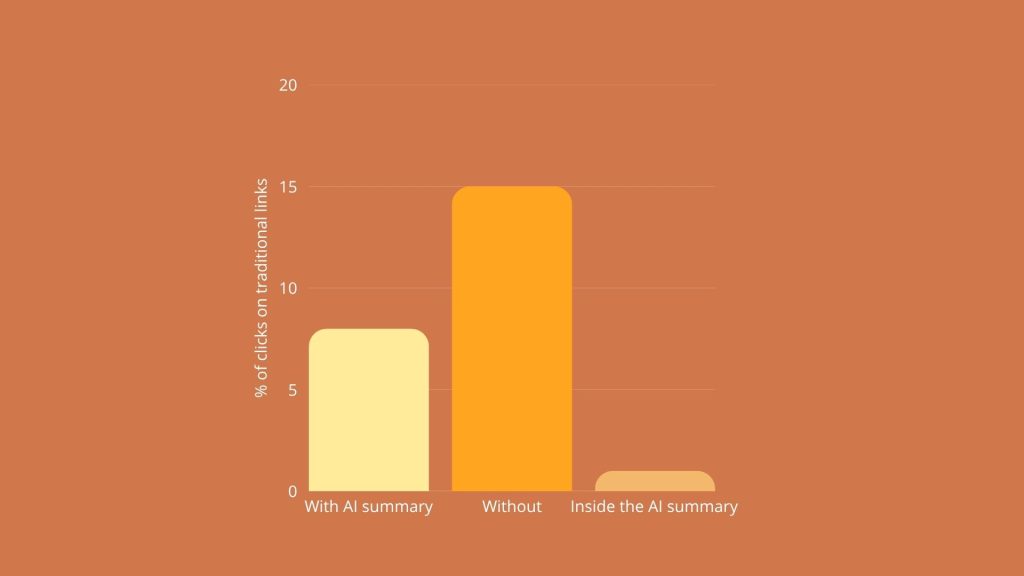
When a Google search shows an AI Overview, people click a normal result link about 8% of the time, versus 15% when there’s no summary (per Pew Research). It gets even sharper, as Ahrefs found the top-ranking page loses 58% of its clicks when an AI Overview shows up.
The bottom line? Your rank can hold perfectly steady while your traffic quietly falls off a cliff. A position-only tracker will tell you everything is fine, and that’s the whole reason I tested for AI coverage this time.
Summary of the 10 best rank tracker software
Here’s the full list before I get into each one, so you can jump to whatever you’re actually shopping for. I’ve ordered them by overall fit for a modern team that cares about both jobs, not just Google positions.
| Tool | Best for | Tracks AI answers | Entry price | Refresh | Free option |
|---|---|---|---|---|---|
| CrowdReply | AI-era visibility (the modern half) | Yes, core, every tier | $99/mo | Daily | 7-day trial |
| AccuRanker | Accuracy and on-demand refresh | Partial, real AI is a separate product | $249/mo | Daily + unlimited on-demand | 14-day trial |
| SE Ranking | Value all-in-one | Yes (add-on for depth) | $103/mo annual | Daily | 14-day trial, free checker |
| Semrush | Teams already in the suite | Add-on ($99/mo per domain) | $139.95/mo | Weekly (daily on Guru) | Capped free account |
| Ahrefs Rank Tracker | Existing Ahrefs users | AI Overviews yes, chatbots via Brand Radar | $129/mo | Weekly (daily is an add-on) | No trial |
| Nightwatch | Agencies and local SEO | Yes, folded into core | $79/mo | Daily | 14-day trial |
| SERPWatcher | Beginners | No (separate Mangools tool) | $37.70/mo annual | Weekly (daily on top tier) | 10-day trial |
| Wincher | Budget daily tracking | No | $49/mo | Daily | Limited free plan |
| Rank Tracker (SEO PowerSuite) | A genuinely free option | No | Free / $349 yr | Manual (scheduled on paid) | Free forever |
| Advanced Web Ranking | Enterprise reporting | Yes, included | $139/mo | Your choice, up to hourly | 7-day trial |
Prices checked July 2026.
AI-answer tracking means the tool watches whether models like ChatGPT and Google’s AI Overviews mention you, not just your Google position.
The 10 best rank tracker software tools in 2026
Every entry gets the same treatment: what it’s good at, what stood out when I used it, the real price and who it’s for.
1. CrowdReply: best for the AI-era half of rank tracking
Buyers ask AI which product to pick; your brand doesn’t come up; you lose valuable opportunities. Does this sound familiar to you? If so, CrowdReply is the tool I’d reach for first. It’s built for job two – ensuring your brand shows up in relevant queries.
Best for
Mid-market B2B SaaS, e-commerce and agencies whose visibility problem has moved into AI answers and who want to move the number, not just report on it.
Why it ranks here
Every other tool on this list is, at heart, a Google-position tracker. Some added AI tracking as a feature bullet. CrowdReply started on the AI side and treats it as the main event.
It tracks whether ChatGPT, Gemini, Perplexity and Claude recommend your brand across the prompts your buyers actually type, benchmarks you against named competitors and hands you a way to act on the gaps instead of just charting them.
That last part is the difference. Watching your AI visibility drop is one thing; doing something about it is another. Most tools stop at the first step.
What stood out in testing
Three things:
- The prompt tracking ties each tracked question to the sources the AI pulled from, so the reason you’re missing sits right next to whether you’re missing.
- The competitor view turned a vague worry into a number I could show someone.
- The alerts hit Slack and email while a shift was still fresh enough to react to.
I run CrowdReply on my own brand, so I’m biased about the workflow. The thing I keep coming back to is that it points at the fix, not just the problem.
Pricing
Starter is $99 a month, Growth is $299, and Enterprise starts at $499.
Every tier tracks AI prompts daily, includes competitor and sentiment tracking, and comes with monthly engagement credits baked in. There’s a 7-day free trial with full access, plus a free brand audit for a one-shot read before you commit.
Watch-outs
CrowdReply is not a traditional Google-position tracker. If your job is watching exact SERP positions for 5,000 keywords by city, you’ll want a dedicated tracker alongside it.
It’s the best tool here for the new job and the wrong tool for the old one on its own. Pair it with AccuRanker or SE Ranking and you’ve got both covered.
2. AccuRanker: best for accuracy and on-demand refresh

AccuRanker is the one the accuracy nerds keep recommending, and after testing it I get why.
Best for
Agencies and active in-house teams that treat rank accuracy and instant refresh as core and have enough keywords to justify the floor.
Why it ranks here
It’s a dedicated tracker that does one thing at a very high level. Positions, fast and correct.
The standout is unlimited on-demand refresh, so you’re never waiting for the overnight update to see if a change landed. It benchmarks its numbers against Google Search Console, which tells you the team cares about being right.
What I like
Speed, mostly. When I hit refresh, the data came back almost immediately, which sounds small until you’ve sat through a competitor’s “check back tomorrow.”
Two additional perks: unlimited users and unlimited domains on every plan make the agency math work, and the Looker Studio and white-label reporting are clean.
Pricing
The entry plan is $249 a month, or $224 on annual billing, and it starts at 2,000 keywords.
There’s no smaller, cheaper tier anymore. If you track 300 keywords for one site, you’re still paying the 2,000-keyword price. The trial is 14 days with no card, but… it’s gated to company email addresses, so freelancers on a personal address are locked out.
AI tracking
Partial. There’s some AI Overview tracking bundled in, but it’s shallow. The real AI and LLM visibility lives in a separate product called AccuLLM, which is a contact-sales conversation. Don’t buy AccuRanker expecting job two out of the box.
3. SE Ranking: best value all-in-one
SE Ranking is the one I’d hand to most small teams that want a lot of tool for not a lot of money.
Best for
Freelancers and small-to-mid agencies that want broad SEO plus accurate daily tracking plus some real AI visibility in one affordable subscription.
Why it ranks here
It’s a full SEO suite, and the rank tracking inside it is genuinely good, not a token feature.
You get 2,000 daily keyword checks on the entry plan, four times what Semrush gives you at its entry tier. In an independent side-by-side, its position data matched AccuRanker’s about 94% of the time.
What stood out in testing
The real AI-search coverage. The base plans track AI Overviews, AI Mode, ChatGPT, Gemini and Perplexity, and the deeper toolkit adds a mentions-and-sentiment dashboard. It felt like a tool that noticed the category split and did something about it.
Pricing
Core is $103.20 a month on annual billing, or $129 month to month. Growth is $223.20 annual.
Here’s the catch: the add-ons stack. Extra keyword credits, more seats, and the deeper AI Search add-on at about $71 a month can push a growing account to roughly 1.5 times the sticker before you notice. Budget for the add-ons, not the headline.
Watch-outs
The listed prices need annual billing, and the backlink data isn’t as deep as Ahrefs.
4. Semrush: best if you already live in the suite
Semrush is the tool a lot of teams already pay for, and its Position Tracking is solid. The problem? It’s the most expensive way on this list to track a rank.
Best for
Enterprise and in-house teams already committed to Semrush who want rank tracking inside the suite they already justify.
Why it ranks here
If you’re already running it, the rank tracking sits right there next to your keyword and competitor data with one login. The SERP-feature depth is strong, the cannibalization and share-of-voice reporting are genuinely useful, and the desktop accuracy tracks closely with Search Console.
What I like
Honestly, I have to go back to the integration here. When your keyword research, competitor gaps and rank tracking share one dataset, you skip a lot of exporting and re-importing. For a team that’s all-in on the platform, that’s worth real money.
Pricing
Pro is $139.95 a month, but it only updates weekly, which isn’t enough when you’re making active changes. Daily updates mean stepping up to Guru at $249.95, and AI-answer tracking is a separate AI Toolkit add-on at $99 a month per domain, with no trial.
Yes, Semrush is expensive… stack daily rank plus AI and you’re looking at roughly $239 to $349 a month before a second domain.
Watch-outs
Bought just for rank tracking, this is hard to defend on price. The weekly-only entry tier is the trap. It looks affordable until you realize active SEO needs daily.
5. Ahrefs Rank Tracker: best for existing Ahrefs users

Ahrefs is my daily driver for backlinks and research, so I wanted to like its Rank Tracker more than I did on its own terms.
Best for
Teams already on Ahrefs who want rank tracking in the same environment and are fine with weekly updates.
Why it ranks here
Inside the Ahrefs suite, the Rank Tracker is a strong companion. Competitor benchmarking up to 10 domains, Share of Voice, traffic-value estimates and deep historical filtering, all pulling from data you don’t need Search Console to see.
If you already pay for Ahrefs, this is the natural pick.
What stood out in testing
The competitive context. Ahrefs doesn’t just show your position, it shows where you sit against rivals and what that’s worth in traffic. That framing is more useful than a bare number, and it’s where the tool earns its keep.
Pricing
Lite is $129 a month for 750 keywords, Standard is $249 for 2,000, Advanced is $449 for 5,000, and Enterprise is $1,499.
Two catches:
- Updates are weekly by default on every tier, and daily requires the Project Boost add-on.
- There’s no free trial at all, so you commit upfront.
AI tracking
The Rank Tracker follows the AI Overviews SERP feature directly, which is nice. But broader AI-chatbot visibility lives in Brand Radar, which comes with a small allowance and then costs $50 to $250 a month as an add-on. Light AI tracking is included, serious AI tracking is extra.
6. Nightwatch: best for agencies and local SEO
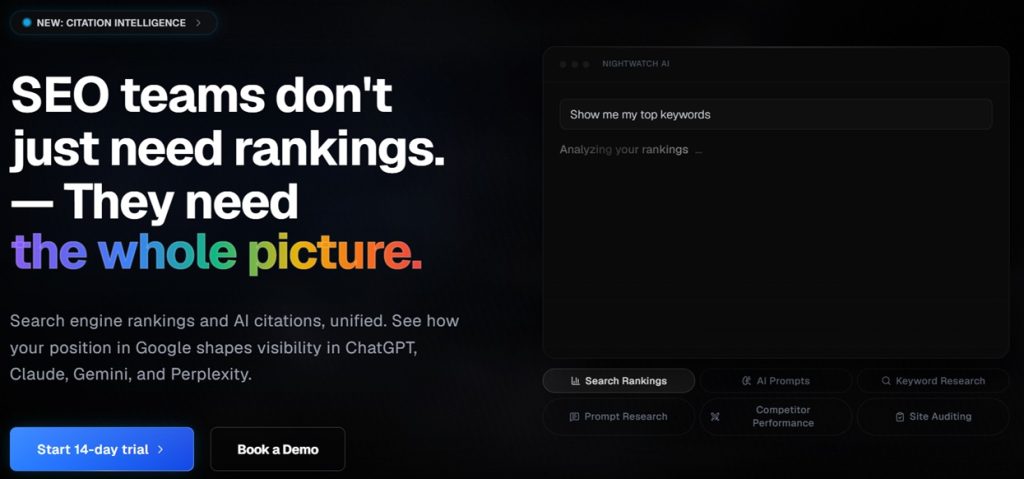
Nightwatch is the one I’d point a local or multi-location agency toward without much hesitation.
Best for
Agencies and multi-location or local SEO teams that need granular geo tracking, white-label reports and per-client seats without per-seat fees.
Why it ranks here
The location precision is the headline. Nightwatch tracks rankings across more than 107,000 locations down to zip-code level, which matters a lot when your client is a chain and “ranking in the city” isn’t specific enough.
White-label reporting and unlimited seats come standard, not gated behind an enterprise call, and that’s another significant pro.
What stood out in testing
Two things:
- The geo granularity is real
- Setting up a client in a specific zip took seconds
Moreover, AI tracking is now folded into the core plans rather than sold as a separate add-on, which was a pleasant surprise. Every paid plan includes an AI-prompt allowance, with more models unlocking as you go up tiers.
Pricing
Starter is $79 a month for 500 keywords, Professional is $159, and Agency is $399.
The catch for small teams is that white-label and unlimited seats live on the $159 Professional tier, so the real agency entry point is there, not at $79. Additionally, the 14-day trial auto-bills if you don’t cancel (good thing I didn’t forget to set a reminder!).
Watch-outs
The AI layer is newer and still maturing, so treat it as a strong bonus rather than the reason you buy.
7. SERPWatcher by Mangools: best for beginners
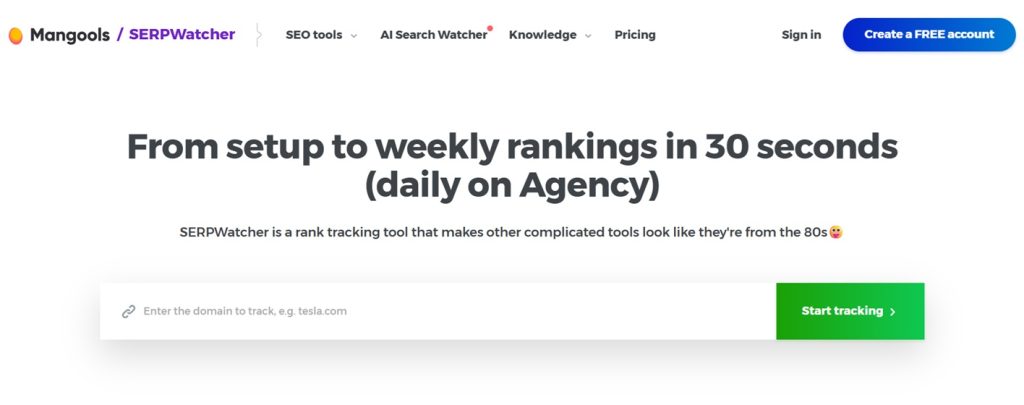
SERPWatcher is the tool I’d give someone who’s never used a rank tracker and doesn’t want a lesson. It’s the most beginner-friendly in the list.
Best for
Beginners, bloggers and small teams who want simple, affordable Google rank tracking inside an easy toolset.
Why it ranks here
Simplicity is the keyword. Setup takes about 30 seconds, the interface is the cleanest of the bunch and the Performance Index rolls your positions and search volumes into one estimated-traffic signal a non-SEO can actually read.
SERPWatcher comes inside the Mangools bundle with four other tools, so the value per dollar is high.
What I like
It doesn’t intimidate. For a blogger or a solo marketer, that’s the whole game. The bundle also pools your keyword allowance across unlimited domains, which is generous at the price.
Pricing
Basic is $37.70 a month on annual billing, Premium is $52.70, and Agency is $97.70.
The catch is refresh cadence. Basic and Premium only update weekly. Daily updates are gated to the $97.70 Agency tier, which undercuts the “cheap” positioning if you need fresh data.
AI tracking
SERPWatcher itself is Google-SERP only. Mangools bundles a separate AI Search Watcher tool, but the rank tracker you’re using day to day doesn’t do job two.
8. Wincher: best budget dedicated tracker
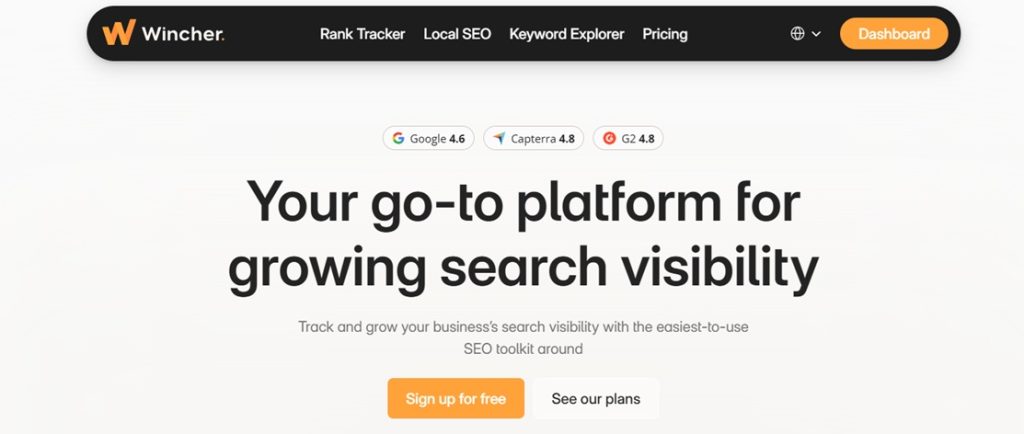
Wincher is the pick when you want reliable daily Google tracking and you want to avoid extra features that you won’t actually use.
Best for
Budget-conscious bloggers, freelancers and small teams that want dependable daily Google tracking without a suite price.
Why it ranks here
It’s a focused rank tracker that does daily updates from the entry tier, which several pricier tools don’t. The most repeated praise I saw was value for money, and after using it I’d agree. It’s clean, fast to set up, and pairs tracking with lightweight keyword research.
What I like
No bloat. You get daily positions, device and geo-tracking and a local Maps tracker without paying for a full suite you’ll ignore. The setup was painless.
Pricing
Basic is $49 a month for 500 keywords with daily updates. Standard starts around $89 and adds on-demand refresh, share of voice, API and white-label. Professional starts at $319, and annual billing trims a couple of months off.
AI tracking
None, and this is the clean line in the sand. Wincher doesn’t track ChatGPT, Gemini or AI Overviews at all. Its “AI” features are content assistants, not answer-engine monitoring. If job two matters to you, Wincher can’t do it.
9. Rank Tracker by SEO PowerSuite: best genuinely free option

If your budget is zero, this is the one. It’s a desktop app, not a web tool, and the free tier is unusually usable.
Best for
Budget-zero solos, students and one-off users who want unlimited manual rank checks free and don’t need cloud, scheduling or team sharing.
Why it ranks here
The free version tracks unlimited keywords across unlimited projects, which basically nothing else offers for free.
Rank Tracker runs on your machine, checks against 597 search engines, and handles local and mobile. For a one-off audit or a scrappy solo setup, free-and-unlimited is hard to beat.
What stood out in testing
The free tier is real, not a countdown trial. But here’s the catch: on free, you can’t save projects, can’t export and can’t schedule checks.
Saving and exporting start at the $349-a-year Professional license and scheduling and white-label land on Enterprise at $599 a year. That kind of throws “free” out the window.
Pricing
Free forever for manual, non-saved use. Professional is $349 a year, Enterprise is $599 and Max+ is $899. These are annual licenses you own, not monthly subscriptions, which some people prefer.
AI tracking
None. It’s a traditional blue-link and SERP-feature tracker, full stop.
Watch-outs
It’s desktop-only and runs on your hardware, so big jobs are slow and the interface feels dated. You’re trading polish for price.
10. Advanced Web Ranking: best for enterprise reporting

Advanced Web Ranking is the quiet 20-year veteran that enterprise teams and reporting-heavy agencies keep on the shelf for good reason.
Best for
In-house teams and agencies that treat rankings as a core metric and need depth, granular geo and device control, and polished white-label reporting across many markets.
Why it ranks here
Depth. It tracks across 4,000-plus search engines and 170-plus countries down to GPS-coordinate precision and the white-label client reporting is best-in-class.
AI visibility tracking, covering AI Overviews, ChatGPT, Gemini, Perplexity and Claude, is included across plans rather than sold as an add-on.
What I like
The reporting and the SERP-feature analysis. You can put desktop, mobile and the local pack side by side, and the forecasting that compares SEO traffic value against Google Ads spend is a genuinely useful boardroom number.
Pricing
Pro is $139 a month for 7,000 keywords, Agency is $279, Enterprise is $699 and Enterprise Plus is $980.
The catch is unit accounting. A “keyword” is one query, weekly, one engine, one device. Switch to daily and you multiply by seven, add a device and you double, add locations and it climbs again. Teams burn through their allowance faster than the headline number suggests.
Watch-outs
There’s a steep learning curve. All that depth means more options to understand, so it’s overkill for a small site.
The true cost of rank tracker software
Sticker prices in this category lie, and they lie in a consistent direction. The number on the pricing page is almost never what a real team pays once daily updates, AI tracking and seats get added.
Here’s what the 10 rank tracker software tools I tested actually cost to run for the modern job:
| Tool | Sticker | True cost for daily rank + AI tracking | The trap |
|---|---|---|---|
| CrowdReply | $99 | $99 | None. AI is the core, credits included |
| AccuRanker | $249 | $249 plus AccuLLM (separate) | No plan under 2,000 keywords |
| SE Ranking | $103 annual | ~$175 to $225 with AI Search and credits | Add-ons inflate ~1.5x |
| Semrush | $139.95 | ~$239 to $349 | Daily needs Guru, AI is +$99/domain |
| Ahrefs | $129 | $249 to $449 plus add-ons | Daily and AI are both extra |
| Nightwatch | $79 | $159 for agency features | White-label gates at Professional |
| SERPWatcher | $37.70 | $97.70 for daily | Daily gated to the top tier |
| Wincher | $49 | $89 plus | No AI tracking at any price |
| SEO PowerSuite | Free | $599/yr to export and schedule | Free can’t save or export |
| Advanced Web Ranking | $139 | Climbs with unit multipliers | Daily is 7x the keyword units |
There are at least two reasons these prices crept up lately:
- Google removed the “&num=100” parameter, which let trackers pull 100 results in a single request.
- Search Engine Land reported trackers had to make roughly ten times more requests to gather the same data.
The pattern to note down: the all-in-one suites carry the biggest gap between sticker and real cost. That happens because rank tracking rides on a base subscription plus AI add-ons. The dedicated and AI-native tools mostly price flat.
Free rank trackers: what you actually get

There’s real demand for free tracking, and there’s a lot of “free” that’s a trial with a timer. My honest opinion? I can only recommend two tools that are free forever:
- Google Search Console gives you your own average positions for free, straight from Google, and it’s the first thing anyone should set up.
- SEO PowerSuite’s free desktop tier tracks unlimited keywords, as long as you don’t need to save or export.
Between them, you can watch your positions at zero cost. But there are some free trials definitely worth running:
- SE Ranking (14 days)
- Nightwatch (14 days)
- SERPWatcher (10 days)
- CrowdReply (7 days) (full access)
- Advanced Web Ranking (7 days)
My advice: run your real keyword set during the trial and export everything before it ends. A trial you use passively teaches you nothing. It’s a three-step process you can do yourself:
- Pick 20 buyer keywords
- Check them manually in an incognito window each week
- Log positions in a spreadsheet
The problem is that this works until it doesn’t… Manual checks miss the location and device variation that changes the answer, and the weekly habit is the first thing to slip in a busy week. Free is a fine way to confirm you have a problem and a bad way to manage one.
If free is the hard constraint, I recommend:
- Starting with Search Console for positions
- Adding a manual ChatGPT check for the AI side
- Upgrading the week the data first changes a decision you make
More on how rank tracking changed with AI Overviews and ChatGPT
The metric moved: it used to be position; now it’s presence, and that’s a different thing to measure. In the old model, you optimized a page to climb a ranking, and a higher rank meant more clicks. That link is broken now:
According to Pew Research, queries with an AI Overview send a click to a result link only 8% of the time (and even the links inside the summary get clicked in only about 1% of visits). Since you can own position one and still be invisible, the target shifted from “rank the page” to “be the answer.”
That means two questions a position tracker can’t answer:
- Does the AI mention me when someone asks about my category?
- And which sources is it pulling from to decide?
There’s a volatility problem too. The pages AI Overviews cite churn fast. Authoritas found roughly 70% of the pages cited in AI Overviews change over a two-to-three-month window. That’s faster than organic rankings move.
If you’re going to track the AI side, you need something watching it continuously, not a spot check… The tools that only track Google positions are measuring the half of visibility that’s shrinking. The ones that track AI answers are measuring the half that’s growing.
Do you still need a rank tracker in 2026?
The short answer: yes, just not the same one you needed two years ago.
You still need to know where you stand in Google. Organic search is still the biggest channel most businesses have and positions are still how you diagnose what’s working. A tracker is how you catch a drop before it becomes a traffic problem and how you prove SEO is doing anything at all.
What changed is that a Google-only tracker now covers a shrinking slice of reality. ChatGPT hit 800 million weekly users by late 2025, and a lot of those sessions are people asking for recommendations that used to start on Google. If your buyers research in AI and you’re only tracking blue links, you’re flying half-blind.
The real answer: you need tracking for both jobs. That can be one tool that does both, or a dedicated position tracker paired with an AI-visibility tool.
What you can’t do anymore is track Google alone and call it visibility. That was true in 2023; it isn’t anymore. If nobody on your team will act on a ranking report within a week of seeing it, buy the cheapest tool that covers your gaps and spend the saved money on the AI side.
How to choose the right rank tracker software
The choice comes down to which job you’re solving and who’s doing the work. Here’s how I’d route it:
Are AI answers your main visibility problem? Start with CrowdReply
If buyers ask ChatGPT for the best option in your category and you’re not in the answer, a Google-position tracker can’t help you. CrowdReply tracks the AI side and gives you a way to act on it. For mid-market B2B, that’s where the movement is now.
You need pure Google-position accuracy? AccuRanker
If your job is precise SERP positions and instant refresh, and you have the keyword volume, this is the specialist. Just budget for the 2,000-keyword floor.
You want the best value per dollar? SE Ranking
Broad SEO, accurate daily tracking and some real AI coverage in one affordable subscription. The best value pick for small teams.
You already pay for a suite? Semrush or Ahrefs.
If you live in one of these already, use the tracker inside it before adding a vendor. Price the daily and AI add-ons honestly first.
You’re all about local SEO? Nightwatch is the obvious pick
Zip-code geo precision, white-label and unlimited seats. It’s built for client work.
Are you a beginner (or on a tight budget)? SERPWatcher or Wincher
SERPWatcher for the gentlest learning curve, Wincher for the cheapest reliable daily tracking. Neither does AI, so pair with a manual check.
Your budget is zero? Search Console plus SEO PowerSuite are free
It won’t be pretty, but those are your only options.
Do you need enterprise reporting across markets? Advanced Web Ranking
Depth, geo control and the best white-label reports, with AI tracking included.
How I tested
I put all 10 tools through the same process so the comparison was fair. The set is the group that shows up across the credible “best rank tracker” roundups, plus CrowdReply for the AI-answer side that most of those lists underweight.
I judged each tool on five things:
- Rank accuracy
- Refresh cadence
- Location and device depth
- Whether it tracks AI answers
- The true monthly cost once the add-ons are counted
My standard process was:
- Signed up (wherever a trial existed)
- Tracked the same keyword set through each tool
- Ran a set of buyer prompts through the ones that cover AI answers
- Walked every pricing tier line by line
Each tool was judged against the same buyer profiles, from solo blogger to enterprise agency. The “best for” call on each one reflects where its strengths and weaknesses actually landed for that profile, not where its marketing wants to land.
Before you buy a rank tracker tool
SEO software is a multi-billion-dollar category still growing double digits, so the tools will keep piling on features. Don’t let that distract you. Pick according to the job you actually have.
So here’s what you should do before buying anything: open ChatGPT, ask it to recommend a tool in your category, and see if you’re in the answer. Then run one of your money keywords in Google and watch how far you scroll past the AI Overview to reach your result.
If both of those sting, you don’t need a prettier position chart. You need CrowdReply and something to watch Google. If only the Google one stings, one of the dedicated trackers above will do the job fine.
FAQ
What is the best rank tracker software?
CrowdReply is the best pick for most modern teams. For pure Google positions, AccuRanker is the accuracy specialist and SE Ranking the best value.
How much does rank tracker software cost?
Rank tracker software runs from free to about $1,500 a month and most mid-market tools land at $50 to $250.
How accurate are rank trackers?
The best dedicated trackers, like AccuRanker, benchmark against Google Search Console and land within a point or two. SE Ranking matched AccuRanker about 94% of the time in one test.
What is the best free rank tracker?
Google Search Console is the best free option for your own site’s Google positions. SEO PowerSuite’s free desktop tier tracks unlimited keywords, as long as you don’t need to save or export. Beyond those, free means short trials or a manual spreadsheet.
How is rank tracking different with AI Overviews and ChatGPT?
The metric moved from position to presence. A Google position used to predict clicks, but with an AI Overview present, people click a result link about 8% of the time versus 15% without.
Do I still need a rank tracker in 2026?
Yes, but you need one that covers both jobs. Google positions still matter, because organic search is still most businesses’ biggest channel and a tracker is how you catch drops early. A Google-only tracker now misses the AI side, where buyers increasingly get recommendations.
What is the best AI rank tracker?
CrowdReply is my pick for AI-answer tracking, because it’s built around it, not bolted on, and lets you act on the gaps. SE Ranking and Advanced Web Ranking include solid AI tracking in their suites and Nightwatch folds it into core plans.